

Blame the Feministe.
“Imamou Lele,” Boukman Eksperyans; “Trumpet Song,” Cranes; “Argument,” from the Chess soundtrack; “Going for a Walk with a Line,” Momus; “Wylin’ Out,” Mos Def; “Eurostar,” S.I. Futures; “Finisterre,” St. Etienne; “Your Belgian Things,” the Mountain Goats (live in the studios of KEXP); the Allémande from Bach’s Fourth Unaccompanied Cello Suite, Yo-Yo Ma; “...to dream,” Lisa Germano.



Hup—
For we couldn’t leave her there, you see, to crumble into scale.
She’d saved our lives so many times, living though the gale.
And the laughing, drunken rats who left her to a sorry grave?
They won’t be laughing in another day…
And you, to whom adversity has dealt the final blow,
With smiling bastards lying to you everywhere you go,
Turn to, and put out all your strength of arm and heart and brain,
And like the Mary Ellen Carter, rise again.
Rise again, rise again
Though your heart it be broken
And life about to end
No matter what you’ve lost—be it a home, a love, a friend—
Like the Mary Ellen Carter, rise again.
You’ll have to fend for yourselves a bit longer, I’m afraid. Pardon the dust. —Hey, could you hand me that allen wrench?
Placeholding.
Yeah, yeah. The day job, you know, and it’s acting up again, and I really ought to get an ointment or something for that, and I’m trying to get some other writing done, and we’re going to be at APE in just over a week, so if you’re in San Francisco the weekend of the eighth, well, hey, we’ll be in the same city, and over in Nemas Animæ we’re getting ready to do up a lexicon game about magical texts, so, you know, I’m somewhat distracted. Which is why I haven’t written much of anything here, I suppose it goes without saying. That, and the fact that there’s two entries I keep alluding to that I can’t seem to get written. So I won’t mention the third. Or the fourth.
So hey! Go read the Valve. I mean, god damn would you look at that masthead.
To Robbie Conal, “America’s foremost street artist” and staff caricaturist to the LA Weekly, on the publication of your profile of Portland᾿s own Mercury Studios (and guests) in Portland Monthly—
(A preface: this is long and self-indulgent, but since when is that new on the pier? It is, though, based on a piece that’s not online. So: no link that you can read and check for yourself. Pick up a copy if you’re in town, if you must; the strips they run along with it all rock. If you’d like a glimpse of Mercury Studios, this Oregonian article is much better, and the classy photos that put faces to names are over here.)
First: hey, thanks. There’s nothing so cool as seeing people you love and things you know through someone else’s eyes. Always a treat. And while some might knock the gonzo excess of your prose stylings, well, I’ve always been a fan of exuberance, myself. Give me a voice that knows what it wants and goes after it full-tilt: I might wince at the occasional typo and grammatical misstep, but at the end of the day I’m going to like it better and remember it longer than bog-standard A1 clarity. Just a word of advice: I know they made it look easy, those gonzo guys, like all you had to do was live through it and then sit down with some liquor and stimulants and, you know, type, but it’s hard, gonzo is. Harder than bog-standard A1 clarity. Injecting yourself into your journalism requires a delicate balancing act between self-indulgence and self-awareness, and just because you’re subjective as all get-out, that’s no excuse for slacking off on the underlying facts. (Just because bog-standard A1 is fucking up on that front these days is no excuse, either.) —Oh, hell, you’re tempted to tell yourself; they’ll get the gist of it, even if the facts aren’t all that. Any publicity’s good. Don’t listen: down that road lies the devil.
But we’ll get to that.
As for myself? Well, I’ve got no complaints with how I’m handled. “Build[s] databases for corporate lawsuits.” Pretty much. I might quibble at being called an “adult,” but that’s my hang-up, not yours. (On the other hand, while I’m hardly the best there is at staining and varnishing, I’d like to think our new front door looks slightly nicer than something you’d pick up at the Home Depot.) —But! I never met you, or spoke with you directly, and anyway, I’m only in the thing for a paragraph and a half. Which, granted, is more than Craig Thompson got. So I’m good as far as that goes.
The rest? —At least, the bits I can speak to authoritatively?
Well, first, it’s Dicebox. Not Dice Box. —A small thing, but the devil’s in the details, such as the title of the comic by your subject of the moment. Or the fact that it’s not available exclusively at dicebox.net (rather than jennworks.com—but hey, URLs, who reads ’em?). It’s also and one might even say primarily available at Girlamatic. And while the checks she gets from Girlamatic might only be enough for some beer and the occasional software upgrade, it’s still not entirely accurate to say that Dicebox is “not capitalized, at all.” There’s no action figures, granted; no T-shirts or posters or stickers or tchotchkes. Yet. (We’re still trying to get her to sell the notecards she does.) But Girlamatic does sell advertising on the site; and if your readers manage to make it there, they might well be unpleasantly surprised by the subscription fee they’ll have to pay to read the archives. (We will leave out the plans for eventual print publication; a distraction.)
I know, I know: this messes with the whole “heady Northwest Linux brew collides head-on with the soy-lentil-green-indie arts scene” riff, which I’m sure tested well in the bullpen. But sometimes we must kill our favorite children to make the overall piece.
Moving on: Anodyne is not a parallel project to Dicebox. Anodyne, in fact, died back in 1999; Dicebox took off in 2002. Nor is it entirely clear to your readers that Anodyne was a freely distributed local arts monthly, not a—well, I’m not sure what they’d think, coming out of that paragraph, but it reads like an editor’s blue pencil took a bad fall in the middle of one of the sentences and never recovered, so we’ll let it slide. (But: neutrinos? Mathematical constructs that conserve energy in the equations that describe half-life decay. No half-life themselves to speak of, much less a blisteringly fast one. —I know, I know, they’ll get the gist of it. Yes yes. Moving on.)
As to the aura Jenn that exudes—“blushing rose,” at one point, shading to “purple” when she says “It’s a public form of self-expression”—and her “Buddha-esque” stature as the “gravitational center in that ethereally radiating alternate reality that is so genuinely precious and fiercely protected in the sweet funky neighborhoods of Portland”? —Well, it’s hard to quibble with someone who says something so sweet. And her “transcendentally radiant, gently surreal inner sanctum” is pretty much spot-on, as anyone who’s seen her studio can attest. (Still: “Buddha-esque”?)
But! You’re being genuinely subjective, there, expressing what you saw, as you saw it. I’m not going to contest you on those grounds. It’s when you try to do the same thing through the supposedly objective means of quoting someone directly that we get, well, iffier:
Why stay on the Web? “Distributors! The comics industry is slowly collapsing on itself. Most retail comics stores in North America that want to carry popular comics deal with Diamond Comics Distribution. It has a virtual monopoly. It sells through its catalog, Previews. If a publisher wants its product to be listed in Previews, it has to pay for ads in the catalog—no problem for the majors, but small publishers can’t afford the extra costs. Now Diamond has a rule that it won’t list any comic that doesn’t sell 2,500 copies per month. I haven’t wanted to bother with it.”
Now, granted, I wasn’t there to hear what was actually said, or in what context, any more than I know what’s actually your writing and what was inserted or amended by an editor. So I don’t know how many of the inaccuracies in the above are due to your own misunderstanding of an abstruse and marginal business plan, granted, and how many are due to Jenn hazarding guesses at some placeholder stats in the service of a more fundamental point, but when your subject of the moment says “Don’t quote me on this,” and “You need to check that before you say anything about it” and goes to the trouble of warning your fact-checker, too, well.
Can I kick off a tangent here, just for a moment? It’s germane, honest. —See, I’ve never taken a course in journalistic ethics myself, but I have written my share of feature articles and personality sketches back in the day, and I always tried to keep in mind the case of Masson v. New Yorker Magazine, Inc.
Jeffrey Masson was a psychoanalyst who, while serving as Project Director of the Sigmund Freud Archives, grew disenchanted with the father of his art; Janet Malcolm wrote a profile of him for the New Yorker that proved less than flattering. A libel suit was filed. And, while she quoted him at length saying words she couldn’t prove with notes or tape recordings that he’d actually said, Masson lost the suit. —At one point, in fact, she says he described himself as an “intellectual gigolo” when the closest the court could find to that in his actual words was “much too junior within the hierarchy of analysis for these important . . . analysts to be caught dead with [him]”—and still, he lost.
So congratulations! As journalists, we’ve got great power: we can make shit up and stick it in other people’s mouths. (Specifically, “the common law of libel overlooks minor inaccuracies and concentrates upon substantial truth.” But that’s in America, bucko; don’t try it overseas.) —But as you should have realized the moment you set out to write about comics, with great power comes great responsibility. (It’s in the pamphlet they give you at the door.) The law sets forth the bare minimum: you can elide stuffily tedentious self-descriptors down to snappily inaccurate soundbites so long as you don’t violate substantial truth. Beyond that, well, we’ve got to call on ethics. (Do keep Malcom’s own snappy self-descriptor in mind: “Every journalist who is not too stupid or too full of himself knows that what he does is morally indefensible.”)
And at this point you’re asking yourself what the hell the fallout from a contentious multi-million dollar libel suit can teach us about a freelance puff piece on cartoonists in a $3.99 glossy ad-horse. Hell, you’re probably saying, I never elided anything! I didn’t make anything up at all! That’s what she said! I’m pretty sure! What gives?
Let’s step through it:
You’re interviewing someone about their webcomics publishing venture and you ask them, why the web? And they tell you there’s a lot of barriers to traditional print publishing. And you ask, like what? And maybe they say something like industry collapsing, Diamond monopoly, ads in the catalog, 2,500 copies. —And you do some research, and you find out that the industry has been through a rough patch, but sales in some quarters are showing signficant upticks; that Diamond in the mad bad days of the late ’90s pretty much had a virtual monopoly, yes, and it’s true that almost every direct-market comics shop in the country still has to deal with them, but there’s a number of competitors now, and new if untested markets cropping up all over, like manga in Borders and strips on, hey, the web; that no, you don’t have to buy ads in the catalog to get listed, just glancing at the thing will tell you that, though if you ask around you’ll hear dark mutterings from some quarters of preferential treatment for those who buy ads (then again, this is a business: what’s new?) and if you do more than glance at the thing you’ll note the listings are so small that it’s pretty much impossible to get noticed at all without buying some real estate to strut your stuff; that Diamond (it’s said) prefers sales of $1,000 a pop with a reliable growth curve over the first few issues, not so much a firm floor of 2,500 copies.
Given that you can make up whatever you like and stick it in their mouth, so long as you don’t violate substantial truth, what do you do?
Well. That all depends on what the substantial truth is, doesn’t it?
And this is why journalism is morally indefensible, and this is why ethics are paramount, at the end of the day. —Are you writing a drily witty, razor-keen hit piece? Well. What you’ll want to do is polish what was said until minor inaccuracies reflect the subject of the moment’s ostensible paranoia and aggrandizing sense of self-importance—conspiracies, projection, sour grapes. Ethically impeccable, morally indefensible, but hey, substantial truth, right?
Are you digging into something as an investigative reporter? Grilling a government spokesperson on the record? In that case, the substantial truth is what, precisely, was said, and when, and how; you won’t want to change a word. But you will want to hold what was said up against the actual facts—or at the very least present those facts, as if they were the other side of an argument. You know?
But if it’s a freelance puff piece on cartoonists for a $3.99 glossy ad-horse? Whose basic point is opening up a genuinely precious and fiercely protected demimonde to latte-sipping shoppers cruising the Pearl? —In that case, your subject of the moment is hardly a hostile witness. Your goals are in synch. The substantial truth is there are obstacles, yes. Your great power is to put words in their mouth. Your great responsibility is to make sure they get the job done.
So: you can change what was said to congrue with reality as you’ve found it. Don’t look at me like that. You can do this. It’s perfectly allowable. Granted, if you’re a mensch, you’re going to call them up before it goes to press and vet the quote with them, word for word, but time is short, and there are so few mensches left in this world. But that’s one thing you can do. Drop the bit about the monopoly; massage the sentence about ads until it says “to get noticed”; correct the number. Morally indefensible; ethically impeccable. Hey presto.
Granted, most writers are going to feel uncomfortable doing this. I’d balk at it myself: I’ve played fast and loose with quotes from time to time (you’ve never heard the fury hell hath none like until you’ve vernaculared the verb of a persnickety grammarian), but not with something so central to a point. In that case: well, they did say there were obstacles, right? Sin by omission: cut the quote there, drop out of their voice and into your own, lay down the facts as you’ve found them to be. —The substantial truth, after all.
(Is the substantial truth that they’ve got some particulars wrong, off the cuff like that? Is that what’s important to note? —Especially when they’ve told you “Don’t quote me on this” and “You need to check that before you say anything about it.” What morals are you trying to defend, again?
(Just be sure whatever you do that the truth you’re citing, in their words or yours, has some little substance. It does no good to say to yourself that the gist of the matter is there are obstacles and the facts merely illustrate this, accurate or not, when your readers take home a gist that says Diamond won’t list your comics unless you also buy an ad.)
But what you don’t do, and I realize I’ve blown through about 2500 words here and you’re probably getting tired of the sound of my voice on what is really a tiny problem in the grand scheme of things, but the devil is in the goddamn details, it’s all small stuff, so bear with me: what you don’t do is pretend that writing it down as if they’ve said it absolves you of the responsibility of finding out for yourself. Putting facts in other people’s mouths is a great way to humanize a story, but it’s also a cheap-ass way to dodge the bullet. “That’s wrong?” you say. “Well, gosh. It’s what they said. I can only write what they tell me.” That’s morally indefensible and ethically questionable, and what’s more, when people turn the page and read this:
The pop-culture industry has already thrown the first brick or two—and they’re gold, baby. There are 2,500 independent bookstores and 3,000 chain stores in the United States, and guess what: book sales are as flat as Nebraska—with the single exception of comics and graphic novels. How does $105 million in sales for 2003 sound?
Like a data point without context, but aside from that: who’s right? “The industry is collapsing,” or “Sales leaping buildings in a single bound”? I mean, I know how to square this particular circle, and Jenn knows, and everyone you talked to for the article knows, because we all know the shape of this thing we call comics. I can’t tell from this piece whether you do or not. But I do know that most of your readers don’t; and after finishing this thing, they still won’t.
They will have missed the gist, basically.
—Damn. I did go on a bit about a piece that’s mostly about other people, didn’t I? Chalk it up to youthful enthusiasm. (I’d sure like to.) And I’m not sure what might (or, granted, might not) be misspelled in Pete Woods’ curriculum vitæ, or out of synch in Matthew Clark’s résumé, but I can tell you that the Wendy-and-the-Lost-Boys riff you pull with Rebecca Woods is almost as old and inaccurate as the idea that cartoonists live out a delayed adolescence that escapes the rest of us benighted souls, but maybe another time. —I had a different point to make, and I hope I have: gonzo’s right, and objective journalism is a myth, yes yes: but this makes it all much harder, not easier. Far from absolving us from the responsibility of checking into the truth of what we’re living through, it goads us all the more into chasing something we’ll never reach—or it ought to, anyway. Only then can we make it all look like we popped the pills and drank the booze and just sat down to type. Easy as pie.
Even for a freelance puff piece. Even for a $3.99 glossy ad-horse, only picked up by power shoppers down from the West Hills. —If we don’t do the right thing, even in the least of what we do, who will?
(One last thing: not to snark overly, but you don’t even know who Craig Thompson is, do you. —No, wait, one more last thing: “Hey, sorry, we gotta refuel the fairy.” What?)
Upon hearing once more the serial bangs and muffled thuds of our crack circular firing squad, the words of—I believe it was Kissinger?—are called to mind.
The stakes are so small precisely because the politics are so vicious.
—No, wait, that’s not quite it.
The stakes are so vicious precisely because the politics are so small.
Fudge. That’s not it, either. Bear with me. I’m sure I’ll get it in a minute.
Old skool.
I may be getting paddled by the Happy Tutor elsewhere, but never let it be said I said he couldn’t turn a phrase on a dime and kick a white-hot nickel back in change:
You are not watching a play. My friend, you are on stage, as a member of the Chorus. The play is a tragedy, with comic or satiric interludes. What makes it tragic is that time and power are slipping away from the moderate. The tragedy is about how, through the failure of the Chorus to speak up, democracy in Athens was lost. The play ends with a Peter Karoff, or one of so many other such moderate, wise figure’s tragic recognition that it is too late for protest. They, the ones who come to their recognition too late, or express it too late, are not hauled off. Theirs is a worse fate, to live for the rest of their lives, in what had been a democracy, with the urbane shrug that was the tipping point, forced to repeat that shrug under conditons that become increasingly bleak, and to pass on to their heirs that legacy of self-subjugation.
Turbulent Velvet, meanwhile, wants to remind you of what Kenneth Burke said about satire and burlesque, and you need more than I want to paste here, so go. —As for me, all this on top of re-reading Wicked is proving a rich, rich diet:
“Animals in pens have lots of time to develop theories,” said the Cow. “I’ve heard more than one clever creature draw a connection between the rise of tiktokism and the erosion of traditional Animal labor. We weren’t beasts of burden, but we were good reliable laborers. If we were made redundant in the workforce, it was only a matter of time before we’d be socially redundant, too. Anyway, that’s one theory. My own feeling is that there is real evil abroad in the land. The Wizard sets the standard for it, and the society follows suit like a bunch of sheep. Forgive the slanderous reference,” she said, nodding to her companions in the pen. “It was a slip.”
Elphaba threw open the gate of the pen. “Come on, you’re free,” she said. “What you make of it is your own affair. If you turn it down, it’s on your own heads.”
“It’s on our own heads if we walk out, too. Do you think a Witch who would charm an axe to dismember a human being would pause over a couple of Sheep and an annoying old Cow?”
“But this might be your only chance!” Elphaba cried.
The Cow moved out, and the Sheep followed. “We’ll be back,” she said. “This is an exercise in your education, not ours. Mark my words, my rump’ll be served up rare on your finest Dixxi House porcelain dinner plates before the year is out.” She mooed a last remark—“I hope you choke”—and, tail swishing the flies, she meandered away.
Too rich, perhaps. I need to get back to the more comfortable ground of the Unheimlichsenke. I did have one more thing to say, at least.
The long and the short of it.
While we’re at it, Joey Messina posted an interesting question at the end of an old, old entry:
just have one comment what does long story, short pier mean?
looked it up but cannot find anything
And I was going to say something, but then it occurred to me: before I open my big mouth, why not open-mike it? See if anyone out there on the other side of the screen has an answer that might be different than mine. Or theirs. Or yours.
So: what does “long story; short pier” mean? Anyone?
Like a seed dropped by a seabird.
Despite what some might tell you, it’s not that often I get memewhomped by a tune, playing it over and over and over again until coworkers and Spouses alike threaten bodily harm.
But when I do get so memewhomped? —Thank God for iPod and earbuds, is all the people around me have to say.
And this one’s particularly, shall we say, embarrassing. Revealing? —Wicked, see, is one of my all-time evermost favoritest books: Gregory Maguire’s Elphaba is one of those characters who kicked her way inside and made herself at home, and I can only imagine the fantastic damage she’d’ve wrought had the book been around in 1986 or so. When I heard they were doing it up for Broadway, I shivered: on the one hand, there’s almost nothing that can knock head and heart for the same loop at the same time like a musical done right; but on the other—how many, really, are done right? —Lately?
So now I’ve heard the soundtrack for Broadway’s attempt at Wicked. And it’s, well.
Competently played?
Except for this one song. —Well, no, not “except”: “Defying Gravity” is a king-hell slice of Disney cheese, a competently played first-act closer that bulldozes its way through what ought to be the most delicately charged moment between Elphaba and Glinda, leaping past questionable rhymes and awkward scansion straight to those triumphantly lung-punching diva belts your bones will thrum to all through intermission, and the less said about the climax, the better. And it doesn’t matter; it doesn’t matter. I can see the auctorial intent blundering up to me like a sloppy puppy dog, like a kid behind the wheel for the very first time, and it doesn’t matter one bit: my buttons still get pushed. Just about all of them. Hard. “And if you care to find me,” Idina Menzel whoops over the accelerating horns and synths and drums, “look to the western skies!” and it’s all I can do not to hit replay over and over and over again like some endorphin-besotted rat.
Something about doomed characters and triumphal moments anyway, in spite of. Because of, even.
(Also: the way Idina’s voice catches when she says, “Glinda, come with me. Think of what we could do, together!” —Did I mention how they’re playing up the subtext hardcore? Apparently, that’s what the reviews all mean when they say something like “adding a dose of camp,” and the collapse, right there, the tectonic shift and dizzying inversion of that word in this context, that’s maybe the wickedest aspect of the whole dam’ enterprise: femslash drag-queen divas in mutually unrequited love. —When the price drops sufficiently, high school productions of this thing will do a magnificent job of breaking hearts.)
So I put on “Now / Later / Soon,” because it’s just about the opposite in every conceivable way, except how I stop in my tracks when the three waltzes interlock at the end to build some brand new thing that soars into unexpected heights; I put on “Flying North,” because it moves with the same sweet grace of doomed exhiliration. If I have to, I’ll crack open the J-pop. “Yakusoku Wa Iranai” on heavy rotation ought to do the trick.
—But just one more listen first, okay? I can always stop later.
Now you’re just fuckin’ with me.
We should get this out of the way up front: my linking to this in no wise comprises an endorsement of the nasty tangled mess known variously as “recovered memory syndrome” and “trumped-up bullshit for which entirely too many innocent people are still serving time long after it’s been debunked.” Now’s not the time to get into why and how I might find myself saying and thinking pretty much exactly the skeptical things they’d (of course) want me to say and think; it’s enough to note I’m taking the following with as much salt as I can scare up.
And yet it’s still trickling ice-water down my spine. —After all, says Jeff over at Rigorous Intuition, “we went through the looking glass a long time ago. So there’s no reason why this shouldn’t be right, unless it’s dead wrong.”
With that in mind, let him sketch for you in a handful of dust a quick little story about John Gannon and James Guckert and Johnny Gosch and James Gannon.
And it came to pass.
I had no idea at all it even existed before I saw the cover of TIME magazine.
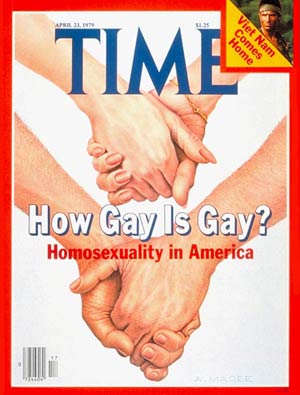
The idea had literally never crossed my mind. It wasn’t that it was a thing that couldn’t or shouldn’t or oughtn’t be done; it wasn’t a thing, at all. It didn’t exist. Inconceivable. —After? Well, take your pick: I’d stepped through a door that slammed shut behind me; a seed had been planted; I’d taken a bite from the apple; the world got just that much the bigger. I was that much further down the slippery slopes that fall away on all sides from Innocence and Grace. I knew a little more of what it was I didn’t know.
When did I see it? Hard to say. It’s dated 23 April 1979, but I remember it alongside the cover they ran just over a year later, when Mount St. Helens blew its top. Magazines were kept in pretty much the same place, on and around the corner end table, so I might be remembering them together because I saw them (two powerful, iconic images) in the same place and not necessarily at the same time. So it was somewhere between April of 1979 and June of 1980, sometime just before or after my 11th birthday, that I first became aware of the idea of homosexuality.
(I don’t remember the article itself, which is a shame, though you’ll note it isn’t so important that I’ve gone to the library to look it up, or indeed perform much more than a desultory googling. It’s noted here as a “relatively sympathetic post-Bryant cover story,” and I suppose it’s a measure of our post-Bryant age that we’re now fighting over basic rights for homosexual relationships instead of basic rights for homosexualists. —I do remember wondering at the the pair of female hands, there at the top: I was confusing the Latin homo for the Greek homos, even if I might not have put it that way at the time, and further mistranslating homo as man. So the male hands made sense as “homo” sexuality, but not the female. Ah, lesbian invisibility! —If I did discuss the cover with either of my parents, it was merely to clear that up, but I’m mistrusting the memories that suggest such a conversation occurred, and where does that leave us?)
How about you? Any one moment or thing in particular? A watershed, or did it just seep in, with no clear eureka between knowing and not? Or have you always known, and do you find the idea of not knowing in your bones that this is one of the ways the world works to be quaint, odd, disturbing? —It’s important, I think, to note these things.
Your first lesson in leaping with a laughing heart:
It may be justifiable anger, but I won’t trade the rest of my world for it.
Hmm? Oh. Just pasting this on my virtual refrigerator. Don’t mind me.
By the way, if anyone here is in advertising or marketing... kill yourself.
“It’s becoming silly for an actor to think, ‘If I do a Japanese commercial, the American audience won’t be aware of it,’” Kaminsky said. “It’s becoming a tiny, tiny world. Now actors think, ‘Why should I do a commercial for a foreign market and be ashamed to do a commercial for America?’”
“Audience and consumer attitudes have changed,” added Jonathan Holiff, whose Los Angeles firm, the Hollywood-Madison Group, pairs companies with celebrity endorsers.
“We have all become much more jaded and are no longer taken aback to see celebrities from all walks of life jumping into the advertising game.”
Apparently, the paparazzi really wanted the Heineken. Isn’t that funny?
Oh, wait—there’s one more piece you need:
Lenny: I brought a bag of money in case he wants us to burn it again.
Homer: I hope he tells us to burn our pants. These are driving me nuts!
It’s going to be one of those weeks.
In which I take the words of an old friend woefully out of context.
Actually, I probably shouldn’t refer to Rob as an “old” friend. I’ve known him longer than almost anyone I know now outside of family, true; Phil’s the only one who beats him, and that’s only due to a chance encounter when I went up to Oberlin my senior year of high school as a prospective. (“Is that ‘Memories of Green’? I said, and he looked up from the piano and said, “Why, yes. Yes, it is.”) —Rob was (briefly) in my froshling Russian class, first semester, and I actually officially met him when I responded to an Infosys post about a neat-sounding PBM game. He sold me his position, which I never did anything with, and later on when he was shedding all his Heinlein books I bought his copy of Have Spacesuit, Will Travel. Not because I had an especial thing for Heinlein—as all liberal SF aficionados must, I’d shed him like an old coat, leaving only “The Menace from Earth” and The Moon is a Harsh Mistress behind, and Spacesuit, because the protagonist’s name is, um, Kip.
But that was all a long time ago, and while I dropped out and wandered off this way for a bit, he headed off yonder, and our paths have crossed only a couple of times since, in the occasional Seattle living room. And we can argue all night about whether you ever really change or just become more of who you always already were—I’m pomo enough to know that things look different from different points of view, and so while I might shrug and shake my head and say (with some little wistfulness) that he’s gone through the looking glass and over the edge off the deep end, he’d smile (I’d like to think he’d smile) and tell you I’d always had too much heart and not enough head, and what there was was woolly, at that. (Of course, by that standard, Giordano Bruno was postmodern. But I digress.) —The facts on the ground are this: he’s pretty much as right-wing and reactionary as you can get from my linchinography, he is by a long shot, and he’s only there because I knew him when, and he knows jokes that most of you don’t, and it was through him I met Elkins and Barry and Phil (again), and through them everybody else; without him, I wouldn’t be who I am today. A link on a blogroll is chickenfeed, next to that.
(Charles? Charles had the room under me, froshling year, and borrowed my copy of The Darkest Road, and he still swears Carl Muckenhoupt was the one who broke my slinky. So I would still have met Charles, and could have through him everyone else etc. But that’s not how it happened. So Rob gets the glory, and the blame.)
This is what Rob had to say, in another context, just recently:
You are certainly entitled to treat other people as you see fit.
The broad political grouping that I find myself a part of has adopted a different approach. We don’t all agree on everything, but we have agreed to support one another on the issues that we do agree on. And, as part of our compact, we each try our best to refrain from casting aspersions at one another—so I don’t call my bozo fundamentalist friends bozos, for example. It makes coalition building much more effective, as we’re able to reach out to groups with whom we have any common ground at all.
Other political groupings adopt a different strategy—one where ideological purity on a wide range of issues is required before there can be any cooperation, mutual respect, or basic courtesy. This prevents idiosyncrasy and heresy from infecting the loyal troops; you can’t be infected by the evil meme if you drive off the memebearers with vitriol.
So far, my side has taken control of the government, is setting the national and regional agenda on many-to-most of the items that are important to us, and is daily making huge inroads on the popular culture.
How’s your side doing?
Well, we aren’t trying to get Alberto Gonzalez in as Attorney General. That’s how we’re doing.
Leaving aside the stark fact any fule kno—that utilitarian arguments for torture crumble before its staggering uselessness as a means of generating trustworthy, actionable intelligence—there’s the craven, callow figure of a man Gonzalez presents, willing to bend any rule, write any memo, fill out any form that does what his boss wants done. Forget, for a moment, torture: Alberto Gonzalez, attorney, judge, Republican, insouciantly opined that the President could “set aside” whatever quaint laws got in his way—thereby setting aside almost 800 years of common law pretty much because a few bad apples might otherwise rough up the ride a little.
A woolly-headed socialist with anarcho-syndicalist leanings shouldn’t have to remind a libertarian what happens when you grant a government powers like that.
And maybe my “side” does demand a certain ideological purity, comparatively speaking; maybe doing so means we’ve pretty much lost on this one, and we’ll have Attorney General Alberto Gonzalez, and Secretary of State Condoleeza Rice, and the sick-making transposition of an “n” for a “q” in today’s Times will prove a harbinger, not a typo, and we’ll be talking about the horrible photos coming out of Evin in a couple of years. Maybe that’s not how it will happen. I don’t know. But whatever happens, however it happens, I’ll know I never valued liberty so lightly that I’d toss it out the window at the first sign of trouble. I’d know I still thought some ideals were worth a suicide pact. Torture is wrong; we should never, ever do it; anyone who ever tried to write it off as no big deal for whatever reason has no business as our Attorney General—and if my “side” fails to prevent that from coming to pass, well, that’s something we’ll have to live with, yes, but at least we’ll know where we stood, and for what.
And it says something cold and horrible that I even have to say these words, and take this stand. But anyway, that’s how we’re doing. Or what it looks like, from where I’m at.
X had been the editor of Upton Sinclair’s EPIC News, a political newsletter with a peak circulation of two million, and one of six men chosen by Sinclair to write a constitution for EPIC in 1935 as it set out to become a nationwide movement. Clearly this young man was no mere fellow traveler and certainly not “the moderate Democrat” he would claim to have been when he once referred to this otherwise deleted section of his curriculum vitæ. No, he was the genuine article, a ’30s radical leftist, and his name was Robert Heinlein.
—Thomas M. Disch, The Dreams Our Stuff is Made Of
Leather.
Apparently, that’s the traditional type of gift one gets and gives on the third anniversary. (The modern? Crystal, or glass. There’s a moral to be drawn, if you’re so inclined.)
I’ve been at this for three years now, which is roughly a twelfth of my existence, which doesn’t sound too bad, I guess, you put it that way.
Trying to move it all over to another server and use WordPress instead and prevent another round of galloping linkrot and maybe redesign the whole shooting match while I’m at it which means I’m trapped in an another round of why am I doing this again and what is it I’m doing, anyway, and wouldn’t I have more fun if I just committed to the shallow end of the cult stud game instead of trying to come off like a second-rate Rude Poor Man, except then I feel like I haven’t done the reading, which is usually why I fall back on coming off like a second-rate etc., and anyway shouldn’t I be doing more local politics? And culture? I could have sworn there was a resolution around here somewhere to that effect. Oh, and since the day job went back to what passes for normal, I’ve been trying to do more non-whateverthisis writing. Like City of Roses. Good God, has it really been that long?
Which would explain the relative silence hereabouts of late in part, I guess.
(No, it’s not pretty. It never is. Nor does it help to realize Barbellion said pretty much what I’m trying to say 102 years ago, or thereabouts.)
So.
Um.
Oh, head over here for some photos of our cats, and me in my new silly hat; “Hänger Långsamt I Luften,” “Raining Twilight Coast,” “Red Rain,” “Polchasa,” “Ask DNA,” “Caught Making Love,” “Dead,” “Letter to a John,” “Filipino Box Spring Hog,” “Pigeon Toes,” and let’s throw in the Nappy Roots / Mountain Goats mashup, since it’s fun; vote in the Koufax Awards, where I think I’m up for best writing, but also, I got nominated for a Perranoski for design, so vote there, too, I guess, and, um, I’ll be back. Browse the archives, or hit the blogroll, or, hell, you know how this works.
Out of curiosity.
Why am I suddenly overwhelmed (to the tune of over 300 hits before 9 AM Pacific) by requests for the meaning of IOKIYAR?
The year in review:
This, too, shall pass.
Whipsaw.
There’s a woman copping a smoke in the doorway of a building one stop up from where I get off. It’s right next to a Men’s Wearhouse. The windows are done up for Christmas already: one of those foxily silver male models looms in a window-filling poster, dapper in a dark suit, holding up a puppy with a big red bow around its neck. The next window over, he’s casual in a den somewhere, a nice bright sweater, a mug of something hot and spiced in one hand. He’s wearing the same airbrushed grin in both shots, and not a silver strand is out of place: a metrosexual CEO, his hands never dirty, his lucre never dreaming of filth. Someone just like him was hanging in those windows last year, and the year before that: the river is never the same, but it takes a while to wear a loop into an oxbow. As it were. I mean, it isn’t even Thanksgiving yet, but here’s the Christmas swag; the Payless down the street got its holly-swaddled signs up the Friday before Hallowe’en. I ought to be livid. It’s one of the harmless little things I let myself blow up over. (Not until Black Friday, people! Please.) But I’m not. I’m not. —And her? She’s standing there in her business drag, blowing smoke: taking a break from answering the phones, stepping and fetching, an early morning deathly dull sales conference with successorized PowerPoints, trying to sort 500 boxes of document production for the upcoming class-action suit. She might have been copping a smoke there yesterday, too, or last week, or the year before; maybe I just never registered her. Maybe I never looked up in time. Maybe her schedule changed; maybe she just started here. Maybe she was working in Tualatin last week. The river is never the same, but how different is it, really? A little ripple here, that’s gone before you know it? A different twig rolling down the current than the one that was there a minute ago? The scree shifted a little when you weren’t looking? What does any of that matter? Don’t these people realize Everything Changed last week? Don’t they see what happened? Doesn’t anyone?
The second of November, 2004: and nothing was ever the same again.
And sometimes what I’m listening to is Paul’s band, Arms; a lot of the time what I’m listening to specifically is “Build on the 9s.” And yes, I know, the song is built out of nine sections, and no take was ever more than nine bars long, and they chopped it all up and edited it back together, and they’re singing “Build on the 9s, build on the 9s,” because, you know, that’s what they were doing. But they recorded it in 1999, when the tail wind that carried us through that decade hadn’t yet begun to sputter, and even if a decade is a wholly artificial demarcation, a journalistic convenience that they use to trivialize and to dismiss important events and important ideas (important events, and important ideas), and just when did the ’90s begin, anyway? The World Wide Web? Clinton’s inauguration? “Right Here, Right Now”? That night the Wall came down? —Remember when all our wars were going to be for the right reasons? (They weren’t, but remember?) Remember when we were going to abolish stupid work and outsource ourselves in our pyjamas? (We never really could, but remember?) Remember when somebody would show up at your cubicle with an orange messenger bag full of DVDs and ice cream you’d just ordered online? When the hit TV show was “Northern Exposure”? When we were all going to move to Prague and become uncitizens of the Middle World? Remember when the clouds finally looked like they were lifting and the sunlight lit up the sky and the drums kicked in and then they blew that amazing horn break that sounded like it was going to last forever? Remember when we were going to save the world?
Those are the nines, right there: nine one, nine oh, nine three, nine five, all the way up to ninety-fuckin’-nine. (Eight nine, even, and the Wall, coming down. There’s a photo of me somewhere, with a ponytail, in the long dark coat I still wear to work when it’s cold, chipping away at that Wall with a hammer and chisel. When I was six or maybe five we went through Checkpoint Charlie and Mom was told she couldn’t photograph an old bombed-out church in East Berlin, so she turned around and caught its ruined reflection in the oranged glass cladding of the people’s office box across the street. —My God. Was it all really that long ago?) —Build on those nines, dammit: and the song lurches in its engagingly undrunken way from nine-bar to nine-bar, and all those names come thundering through the speakers, universal in their particularity. The increasing us and the decreasing them. The past didn’t go anywhere! The nines are still here, all about us. Build on them!
And I’m listening to that because it’s something I need to know, here and now. It’s easy to forget.
Remember Y2K? Remember why we were gonna party like it was 1999?
The twelfth of December, 2000: and nothing was ever the same again.
Later than eleven
Trying to make the earth into a heaven
So, yeah: saving is what misers do, and there’s something else I’m listening to, when I’m not listening to that. What I’m listening to is the Mountain Goats, and specifically what I’m listening to is “The Plague.”
There will be cotton clouds
Above the fields, as white as cream
There will be loud singing in the churches
As we all come out to take one for the team
And all our great schemes and plans
Will slip like fishes from our hands
And the rivers will all turn to blood
Frogs will fall from the sky
And the plague will cover
The country with its anger
La la la la
La la la
La la la