


Mollified, and yet.
Just because I feel some sort of obligation or something: one more Movable Type 3.0 post. —They’ve spoken, after all, and addressed a few of the concerns raised (rather vociferously) over the past couple of days:
- They’ve stripped the “one CPU” limit from the license.
- They count an author (the total number of which is now limited) as anyone who’s logged in within the past 90 days.
- They count a weblog (the total number of which is now limited) as a site visible at a single main URL; therefore, sideblogs set up as “separate” blogs with the software don’t count toward this total.
- They now offer Personal Edition add-ons, which will allow group blogs to purchase a somewhat cheaper personal license and add additional authors at $9.95 a pop.
This mollifies me not a little. I can still run it for free, since I now have “two” blogs, and not “five,” and it’s not inconceivable that I’d scrape together the 70 bucks necessary to upgrade to fully fledged. And the group blogs don’t have to buy the commercial license and trim their mastheads to upgrade the software they’ve been using; even sociology professors and natural philosophers should be able to pony up $12 or $13 a head to blog, right? (Though there’s a quirk in the special pricing: it’s cheaper to buy the middle license for 10 authors and 10 blogs and add on from there, than it is to buy the third license at 13 and 13. That quirk will no longer obtain in the regular pricing.)
But: the personal license at its regular price of 100 bucks is still 30 bucks more than 70, and I’m not necessarily going to upgrade right away. And you still have to be registered with TypeKey to download a free version. And—well, it’s weird. Jay Allen’s point is worth considering: this is called, after all, a “Developer’s Release”; it’s primarily intended for developers to get in early and start hacking together their third-party plug-ins, updating and upgrading to work with 3.0. A general release (it’s then theorized) of 3.0 is still to come. A fine point, but there’s some stuff left out of the equation: I, after all, am not a developer. I’ve already downloaded MT 2.661, so I can ride it out until this (as yet unacknowledged, mind) general release. But if I were just coming into this blogging game, and had heard MT was teh hella best, and went to get the program, I could download the Developer’s Release, or I could—
What?
TypePad, probably. —Not to climb to far out on a limb, but in the absence of clear communications, theory will fester: I think they’re trying to haul their income from one stream bed into another, roomier one with raw muscle power. Little blogs like mine ought to end up on TypePad; power users and “enterprise” folks can beef up the bottom line; de facto resellers like the fine folks over at White Rose can pay up or fall by the wayside. And this is SixApart’s prerogative. (Given the “oh you whining free-software hippies, it’s only 60 bucks for a cab ride, why don’t you just suck it up, you ungrateful internet freeloaders” rhetoric that’s spewing from some quarters, one feels it’s de rigueur to include a standard disclaimer with every post on the subject: “In our wondrous capitalist economy, a software company may charge whatever it bloody well feels like for its proprietary product,” or words to that effect. Also: Saddam is evil; the killing of Nick Berg was deplorable; and courage! Bush is a noodle.) But hauling rather than weaning an income stream from here to there is by its nature disruptive, and Jesus, I’m about to descend into punditry.
Fuck it. I don’t want TypePad; I like Movable Type; I’m not happy about paying $100 for it; there are alternatives out there; I’m going to start shopping around (WordPress and Textpattern, yes, and thanks for the recommendations). And that’s it; I’m spent.



MT 3.0.
Oh, hey, guess I’m sticking with MovableType 2.661 for a bit. —It’s not that I begrudge them their lucre and it’s not that I think software must (necessarily) be free or something like that; it’s just that I’m a cheap bastard. I mean, Jesus H. Christ in a jumped-up sidecar, the price breaks: $69.95 is steep enough, but that’s the introductory price. It jumps to $99.95 at some point after that. —It is still available for free, yes, but you’re limited to three blogs off one installation, and it only looks like I have two blogs running in MT: I actually have five, since three feed sideblogs to the other two.
I think maybe it’s time to bite the bullet and climb under the Textpattern hood to see what’s what.
And you know, the price breaks make even less sense when you consider the ever-growing popularity—and visibility—of group blogs.
Just to expand on the above point: two of the most popular and visible standard-bearers in the ever-growing trend toward group blogs are Crooked Timber and the Panda’s Thumb. Both of them run on MT. Both of them now face the following choice:
- stick with MT 2.661 until the cows come home,
- port their blogging and archives over to a different system, or
- pay $600 now, or $700 later, for software they’ve been using for free, or supporting with donations—
- and even then, the Panda’s Thumb would have to cut loose five authors to fit the top-end restriction. (Should they really be forced to get that Darwinian?)
Yes, SixApart is trying to account for the big companies that are using MT for things quite other than blogging, and that’s fine, go team! But the way they’ve gone about it—distinguishing personal from commercial uses primarily by the number of authors and blogs involved—leaves a big fat slice of their enthusiastic amateur base in the dust. Their prerogative; then, you can toss the baby with the bathwater whenever you want, so long as no literal baby is involved. There’s not a great alternative blogging tool (that I know of) which allows multiple blogs and multiple authors with such ease. Yet. —There will be, soon enough.
Oh, hey, more! Shelley over at Burningbird compiles a list of reasons why, even if I did only have three blogs, I couldn’t use the free MT 3.0: as it currently stands, you have to be registered with TypeKey to download it (which isn’t a prospect that thrills me), and you’re only allowed one installation on one CPU—and I have no idea how that fits with my hosting company. More phone calls and emails with technical support would be called for, with the possibility that I’d have to move everything elsewhere anyway (after further calls with their technical support, etc. etc.). Why hassle? My path is clear: 2.661 > some other solution. What fun!
One last update, and then I’m putting this topic to bed: Dean Peters has some very thoughtful things to say on why, exactly, there’s been such an uproar, and sketches an alternate pricing plan that would have made nary a ripple with me, at least (and not just because it’s cheaper, peanut gallery).
Maybe you had to be there?
So Morah got shot, see, and ended up dying in Venice’s arms, except it wasn’t really like you’re thinking, they’d just met, and anyway Morah wasn’t really dead, she ended up ghosting into Venice’s head, and maybe it’s because Venice is a powerful yet naïve telepath or maybe it’s because Morah is really a body-hopper and she’s been lying to us all this time, I mean, she is an agent for the Resistance, but I at least am predisposed to trust her if not for the best of reasons, but we’ll get to that, the important thing being that Morah’s now a matrix of data set askew inside Venice’s head, where she can be called up in secret with subvocal whispers, Venice’s own pocket oracle, but nothing more than that really, until Venice interfaced with that ancient computer and something happened which pretty much woke Morah back up again, so she wasn’t just a matrix of information, she was, you know, self aware, and she’d get up in the middle of the night and go walkabout in Venice’s body, which really freaked me out, since I was the Guard, and Venice was my charge, but a couple of tense conversations at gunpoint and we worked it all out because maybe I’m big and maybe I’m stupid and I don’t really remember all that much about myself at all which is why it was Burhan who had to come up with a name for me but I’m not the sort of person to go shooting at just anything that moves unless there’s drugs involved but that’s another story, anyway, after the bit with the baths and the tropical socks and the junkyard SATs which I’ll gloss over we ended up in the city that was under seige from the Madlands which are underneath, except when the Madlands beseige your city it looks a lot more like somebody’s trying to set up an embassy, unless of course the Nemesis of the folks from the Madlands is trying to scotch the whole thing by dressing up in the bodies of the city’s ruling class and working mischief after mischief, and there was the musicbox bomb that Burhan had to defuse, and I keep forgetting that K’ia has the tone plate from that bomb wrapped up in something soft and stuffed at the bottom of her pack, because one of these days she wants to get it up to one of the city ships that fly across the sky and ring it and see what it happens, but I really don’t want to think about that, I’ve got enough to worry about, see, because while we were sorting out the whole Nemesis-necromancer thing I shot the Zoxone of the folks from the Madlands and it wasn’t by accident, and I know I said I don’t shoot just anything that moves, I’m actually very careful about that sort of thing, because before I was a guard I was a soldier, and that sort of thing is what I know how to do and it’s important to do what you know how to do well, but let’s make this long story shorter than it is by leaving out the stuff with the soldiers who were just like me and who let me stand a watch or two at the emergency embassy, which was nice, but the point is at the end of it all the city was in chaos but the castle was still standing and the folks from the Madlands were pretty much okay and the Nemesis was dead dead dead, and we weren’t, only everybody else said Morah was still dead, because she was in Venice’s head and nowhere else, except I didn’t think she was dead, because you can’t talk to dead people, you know, and we’d been talking some when I was standing guard and nobody else was awake, and see the thing is Venice thought maybe the Nemesis wasn’t dead either, and Timbuk who was the one who thought maybe Morah was really a body-hopper also didn’t think the Nemesis was dead, or maybe he was, but see, nobody could talk to the Nemesis, right, so I mean he pretty much had to be dead, was what I thought, and anyway we were headed off elsewhere, we found the Resistance and Morah didn’t want to talk to them since she thought she was dead, too, and there was some more stuff with red dust and giant metal bugs and an ancient city, and the important thing here aside from the fact that we did in the end manage to stop the red dust from swallowing pretty much the entire world is that in the course of fighting off an attack by the soldiers from one of the city ships that fly across the sky I shot one of the soldiers who was doing something to the ancient computer we’d found except Timbuk really wanted him alive and Venice poured one of her potions on him and he wasn’t dead so much anymore except that inside the interface space where Morah didn’t look like she was in Venice’s head because I think when we were in that interface space nobody was in anybody’s head, anyway, Morah was able to race the soldier back to his body and beat him to it and now she had a body and Venice didn’t have anybody in her head except herself and the soldier was dead dead dead, except he was a matrix of data still fixed in his head which was now Morah’s head or at least the head where she was living for the moment, except when we were up at the edge of the Madlands while the rest of them were down inside the Madlands trying to make a copy of a dying village something happened which pretty much woke the soldier back up again, only it turned out that I was the only one who could talk to him, and even though I could see him and get him to feed the gorzah and follow him places where he’d been it turned out that he was in my head now, and I think it was because the Madlands made it happen, I mean I don’t think Morah pushed him, and I did feel responsible because I had shot him, you know, and he didn’t remember where he’d come from, like me, and he wanted to get back there anyway, like I did, but the sort of soldier he’d been had nothing to do with the sort of soldier I’d been, I mean, there’s a reason there’s a Resistance, and anyway I didn’t like him very much, he was supercilious and he called me his jailer like it was my fault, and so it was best for all concerned if we just got him the hell out, even if we didn’t have a body to put him into, because we’d left Morah’s behind way back at the beginning when she got shot and everybody was sure she was dead, so we decided to go deeper down into the Madlands, where Timbuk could lead us maybe to somebody who could maybe help, but Venice, who was pretty sure the Nemsis wasn’t dead, was also pretty sure that the thing I was talking to wasn’t the soldier, but was, instead, the Nemesis, only how on earth could the Nemesis have gotten into my head, you know, it doesn’t make any sense, but anyway we went down into the brightly colored copy of the village that wasn’t dying anymore and from there we got into a boat and we let it take us to the place where the windmills are, because a windmill was drawn on the plaque that we picked at random and stuck into the little frame on the back of the boat, because that’s how the Madlands are, and that’s why they’re down there and the city ships full of soldiers are up there, but anyway we were following the path because it’s very important not to get distracted or rock the boat and you must never, ever leave the path once you’re on it, and when we got to the end of this particular path Timbuk would get word to the folks we’d met earlier, who had been trying to open an embassy to that city, and whose Nemesis we’d killed until he was dead (dead dead), and because of that their Zoxone would come to us and help get the soldier out of my head, only we’d stopped to rest and I said the soldier’s name which I think was the name he’d had before he became a soldier, and he appeared, and everybody could see him now, because we were in the Madlands, which is like I think when we were in the interface space, only we all had our bodies with us, even him, and so K’ia who knows about smells and tastes and blood decided to do an experiment to see if she could tell the difference between me and him since we both smelled the same to her, even though Timbuk who knew the most about the Madlands didn’t think this was such a good idea, but he’s not the sort of person to leap in and say no, he just shook his head, and maybe he would have burned an orange duck again, but Venice, you remember, thought that it was really the Nemesis who was pretending to be the soldier while he bided his time and healed from what we’d done to him back in the city that was being beseiged, and she thought the best way to figure this out for sure (since Nemeses lie if you aren’t careful) would be to surprise him, and so while K’ia was tasting our blood and surrounded by silvery insects and while I was standing there shivering and while Burhan was holding his dog and while Timbuk was tut-tutting the whole thing and while the soldier was standing there shivering Venice drew the Nemesis’s sigil on a piece of paper and when she was finished she showed it to the soldier and the drawing grew claws and leaped after him and they both disappeared into me, because that’s how the Madlands are, and it doesn’t matter anymore if that’s the soldier or the Nemesis and it doesn’t matter if Venice is right or if K’ia is right because it’s damn well the Nemesis in there now and he’s only going to get stronger because a Nemesis draws strength from its nemesand and the Zoxone is on her way—
All of which and more is why I gasped and leaped up from the couch, and it’s why John grinned sheepishly and Jenn put down her pencil and Charles shook his head with that smile and Dawn got that look and Becca outright laughed, because when six different people take up different threads of plot and character like that and under loose direction manage to drop something that big and patterned and meaningful into place without quite knowing that’s what we’d been doing right up until the last minute when it was too late and it all snicked into place, well, it’s as close to magic as I think I’m ever going to get, and it’s why gaming is such an intoxicating pasttime, even if it took us over a year to get this far. —But it’s also why that intoxication is so hard to get across to anybody else, you know? Or maybe you can extrapolate.
‘Well, I’m back,’ he said.
Okay, so it was only two and a half days in Ocean Shores, Washington. But the Shilo Inn had no wifi and no broadband and none of my dialup numbers was a local phone call away. It was horrible, I’m telling you. Appalling. Unbelievable.
Really. It was. Had to walk on the beach and everything.
(At least the Spouse abided.)
Memery index.
- Number of trackback pings: 18
- Number of links spotted by Technorati: 19
- Number of people who mutated meme by leaving fifth sentences sans instructions in comments rather than posting to their own journal: 67 (hereabouts)
- Languages spotted: English, Italian, French, German, Swedish
- Number of people who mistakenly ascribed this blog as the originator of the meme: 8
(But I lost count. I gacked it from Elkins. She plucked it with some mutation from the Happy Potterer. And so on. A zygote is just a meme’s way of making another meme.) - Amount traffic jumped once meme was Memepooled: 488%
- Number of short fiction pieces written incorporating fifth sentences from other people’s posts: 1
A complaint.
So I’m zipping through my Bloglines list on my morning break and The Minor Fall, The Major Lift has a squib pointing to a Guardian article or maybe an interview or something about that guy from the Brass Eye. I think. See, I followed the link and found this notice that, well, since MediaGuardian.co.uk has slaved away putting virtual brick on virtual brick to build its reputation as the UK’s leading media news website, and by golly they want to maintain this reputation come hell or high water, they are planning to introduce registration starting March 11. Now, I was not until this moment aware of said reputation. —And on the one hand, I usually click away from registration notices, since I find them tedious, an unconscionable impediment to my flitting about the web on a morning break looking for diverting nuggets of infotainment quickly consumed and easily forgotten, and actively painful. But it is a profile or maybe a puff piece about that guy from the Brass Eye, maybe. And they promise the registration will be as quick and painless as possible. So I give them my email address and I make up a password and I get this notice saying that I need to validate my account with them; they’ve sent me some email, and all I have to do is respond to it.
Sigh. This is more effort than I really want to put into skimming a mild rewrite of a BBC press release, even if it is about the guy from the Brass Eye, as I think it might be. But. In for a penny, etc. So I bring up my email.
Bupkes.
Okay. Fine. Maybe it takes a minute. Yahoo has its quirks. So I skim through a couple more links off Bloglines and then check my email again.
Still with the bupkes.
I think you can see the punchline from here. My break is pretty much over and I’ve still not heard anything from the Guardian and I still don’t know what’s up with an as-yet unnamed person who might have had something to do with the Brass Eye once, and by the time the email does show up in my in box I’ll be all, what? What is this about? The MediaGuardian what? Why do they have my email address?
Yeah, I know. You should have such problems.
The banality of outrage.
Ah, the moral rot is clear: someone somewhere to the right of me is claiming the Japanese hostages taken yesterday were peacenik appeasers most likely working with their captors in a sort of Stockholm-on-the-Euphrates, so we don’t have to worry about it. We don’t have to worry about a thing, and I can puff up my chest and pontificate, I suppose, if I want. —What I want to do is watch another episode of Wonderfalls. We’d finally managed to catch an episode last week, and liked it a lot, and figured, hey, maybe we’d better make a point of catching this show before they cancel—
While it was on, though (and hey, you can still snag the theme song from iTunes: recommended), we did manage to catch a jaw-droppingly awful commercial for The Swan, “a new series where fairy tale turns into reality.” See, what they’re doing is—oh, hell, let’s let them damn themselves with their own press release:
THE SWAN offers women the incredible opportunity to undergo physical, mental and emotional transformations with the help of a team of experts. Contestants must go through an intensive “boot camp” of exercise, diet, therapy and inspiration to achieve their goals. Each week feathers will fly as the inevitable pecking order emerges. Those not up to the challenge are sent home. Those who are will go on to compete in a pageant for a chance to become “The Ultimate Swan.”
Each contestant has been assigned a panel of specialists—a coach, therapist, trainer, cosmetic surgeons and a dentist—who together have designed the perfect individually tailored program for her. The contestants’ work ethic, growth and achievement will be monitored. The final reveal at the end of each episode will be especially dramatic because it will be the first time that contestants will be permitted to see themselves in a mirror during the three-month transformation process. Two women will be featured every week and at the episode’s conclusion, one will go home and one will be selected to move on to the 1st Annual Swan Pageant.
The commercial makes a lot about how these “seventeen average girls” are all ugly ducklings being given a chance they never thought they’d ever have: competing in a beauty pageant! —Forget whether Bush manages to eke out (or seize) a victory in November: if there’s a Swan 2, I’m leaving the fucking country. Y’all can have it.
But that’s not the worst of what’s coming our way on “reality” TV:
Child-protection experts and media watchers are alarmed about an effort by a reality-TV producer to create a CBS show that attempts to find and recover abducted children with a team of former military and former law enforcement personnel. [..]
Individuals and organizations that work on behalf of missing children, including the National Center for Missing & Exploited Children, say the show’s premise runs contrary to the commonly held principle of relying on legal authorities to handle recovery cases. They also were scathing in their criticism of using such cases for any entertainment purpose. [...]
Rick Smith, a former longtime FBI agent, said he thought using a private team to recover children was “a terrible idea,” but also he could see it working “if it was in conjunction with law enforcement and law enforcement had the lead role.” [...]
A story in the entertainment trade publication Variety, which included comments from Burnett, said the show has been under development for 18 months, but “kept under wraps so as to not endanger the secret rescue missions conducted for the pilot” episode.
I, um. Yeah. I know ragging on reality TV is something of a pasttime for bored, dilletantish pseuds (hence), but. I mean, I. Um. I’m honestly, I mean—
Hey! Look! Evil lottery!

Part of an online ad for playyourdebt.com. Oh, type it into the URL bar yourself, you want to go take a look at it. I’m not about to juice them.
So I go to Kevin Drum, forgetting he’s not doing the cat blogging anymore now that he’s hit the Big Time, and I discover he thinks it’d be cool to write off the fifth amendment if we get stringent about videotaping all police interviews. Which, minor little thing, hardly even merits a squabble, just a shrieked “You WHAT?” and, you know, we move on, but I’m dispirited. I’m in a Mood, now.
Luckily, the Three-Toed Sloth is there in a pinch.
This brief note describes the discovery of an apparent joint burial of a human being and a cat, c. 7200 to 7500 B.C. (Some of the details that follow come from the on-line supplementary material.) The human being was aged at least thirty, buried facing west. Whoever it was, they rated a lot of Neolithic swag: “a marine shell, a stone pendant, a very uncommon discoid flint scraper, two small polished axes (one of them broken), a pumice stone, a fragment of ochre, a large flint piercing tool, and several non-retouched flint blades and bladelets,” plus, in a near-by pit, twenty-four sea-shells from three species: “One shell of each species had been artificially pierced; the remaining 21 shells had not been worked. All the 24 shells had been arranged around a central raw fragment of a green soft stone used for jewellery [sic] (‘picrolite’)”. “This is the only burial with such a high number of offerings for the whole Preceramic and Aceramic Neolithic in Cyprus.” The cat was aged eight months, apparently buried at the same time, definitely buried in the same orientation as the human, and was definitely not butchered. —The significance here is that this pushes back the period for which we have firm evidence of the taming of cats considerably.
Ah. I feel better. —A bit, anyway.
Oh, that wacky Shadout Mapes!
A few changes, here and there, to this blog-like apparatus: most notably, I’d like to direct your attention to the little Danegelt box there in the right sidebar (down a bit, past Achivery, past the Deltolographs, just above Permanescence, which you’ll find refreshed with links to pre- and non-blog content: Herschberg [now with discussion forum, oh my], that thing I wrote about Buffy, my second 24-hour comic [be gentle], and the somewhat-less-hiatused-than-last-week City of Roses). Recent linkage has bumped my traffic something fierce; I actually had to buy extra bandwidth last month. Not that I’m complaining much. Or making an overt plea. But: if you were so inclined, there’s a couple of tip jars on the edge of the pier, there: PayPal will let you slip some virtual folding green in (if not make an easy text-based permalink in the course of a blog post); BitPass will let you chuck in a nickel—heck, a penny, if that’s what you feel like. (It’ll also take nothing at all, yes. —It’s a micropayment system, if you missed the brouhaha: you have to put a minimum of I think it’s five bucks in, but you can spend that in nickels and dimes and quarters on mp3s and comics and prose and toys and tipping the occasional weblogger, wherever you see the BitPass sign.) —There’s also a link to the requisite Amazon Wish List, which is more so friends and family can find it easily than anything else, but hey: bait never laid traps no bears.
Other than that: an updated colophon, to reflect the broad array of syndication possibilities available (two flavors of RSS and Atom, whoo!) whose nuances I still haven’t a clue as to; also, I finally remembered to add a link to Mark Pilgrim’s Dive Into Accessibility, which is a good starting point for making your site better than it is if you haven’t yet. And I remembered to close some image tags and line breaks; the sort of stuff that you can’t see at all, but makes validators clutch their pearls and shriek instead of just tutting darkly over the same phrase being used as link text for more than one location. —But hey, it took up most of yesterday morning, so I figured, what the heck. Make a note. (I couldn’t mow! I’ve got a busted elbow!)
Eating crosswalk.
I have quite possibly fractured my right radius (which is strange, since it was the ulna that hurt). Stepped off the bus on the way into work, waited for the light, stepped blithely into the crosswalk, caught my toe on a sandbag the city had left by the stormdrain, and went down hard. The immediate pain faded rather quickly, which is good; I haven’t been in that much pain in years. But now it just feels—weird. One doctor seen, x-rays shot, the orthopædic doctor this PM, thank God for health insurance, and since I work for a litigation support firm, one of my fellow project managers nipped out on the double with a camera to snap photos of the offending bag. (Many thanks; they all rallied with alacrity when I stumbled into the office, grey of face, cradling my arm; my only regret is that I misplaced the bag of frozen peas and carrots and broccoli somewhere in the Portland Clinic, but until then, it served admirably to keep the swelling down.)
But fuck the arm. The important thing was, I’d been carrying my iBook, and even as I was lifting my face off the pavement I was sick with worry—the bag had bounced. So the first thing I did (as my co-workers were rallying round, scaring up phone numbers, calling the clinic for me, digging up various bags of frozen vegetables) was yank open the padded case, pull out the computer (wincing not at the considerable pain but at the sight of the CD drive, popped open), and fire it up.
It was fine.
Anyway. Blogging and suchlike will be light the next few days, I think. (Most of this typed left-handed, which, well. Not recommended for the dextrous.) Further bulletins yadda yadda. —Oh, for those with my medical history at hand, keeping score: it’s the right elbow, which means if I’ve broken it, it’s a first. (The left elbow I’ve broken twice, and it’s better if I tell that story in person, since it involves gestures. The right has only ever been severely contused a couple of times.)
Severe contusion; tiny, minor fracture; wear a sling, work the elbow now and again to prevent stiffness, don’t lift anything heavy, and see the doctor again in about 10 days.
Oh, and typing is not contraindicated.
You’ve been to a marvelous party—
I must say the fun was intense;
You all had to do
What the people you knew
Would be doing a hundred years hence.
You talked about growing old gracef’ly
And Elsie, who’s seventy-four,
Said a) it’s a question of being sincere
And b) if you’re supple you’ve nothing to fear,
Then she swung upside down from a chandelier—
And you couldn’t have liked it more!
With humble apologies to Noël Coward, by way of Neil Hannon. Now go, let Patrick Farley tell you more about what went on—
It was in the fresh air
And we went as we were
And we stayed as we were
Which was Hell.
I’ve been to a marvelous party…
There once was a sleigh from Nantucket.
A cautionary graphic: here’s what it looks like when a tossed-off link from the Mighty Casio tsunamis through a sleepier backwater of the Islets of Bloggerhans in the late PM of a slow-news Friday:

Cocks crowing; dogs barking.
Five days after 9/11, I got my birthday presents. They Might Be Giants were supposed to play the Crystal Ballroom that night, so there was something of a theme: Mink Car and McSweeney’s no. 6, the one they did the soundtrack for. That McSweeney’s came as a long, low, hardbound book, and the front cover is stamped with the following:
WE NOW
KNOW WHO
I still get shivers.
So I open it up to Breyten Breytenbach’s essay, “Notes from the Middle World,” which, he says, “is, and is not, the same as the Global Village.
Let’s say that those of the Middle World—I think of them as uncitizens, the way you have un-American activities as opposed to non- or anti-American—are global village vagrants, knights of the naked star. They are defined by what they are not, or no longer, and not so much by what they oppose or even reject. They ventured into zones where truths no longer fit snugly and where certainties do not overlap, and most likely they get lost there.
Which was rather shockingly rendered obsolete five days before I first cracked the cover. (Except it wasn’t: nothing was changed that day, not anything like that, because the terrorists didn’t win after all, not yet, and the Middle World is still very much where we left it; what else is Eastern Standard Tribe about, if not life in the Middle World?) —Breytenbach quotes a letter from the poet Ka’afit:
The word “peace.” Ah, how voluptuous. Like “democracy.” It just fills the mouth with its familiar, well-sucked, inoffensive, satisfying taste. As if one were experiencing one’s goodness. No indigestion. No burnt lips. It won’t cause constipation and you won’t grow fat on it either. In fact, it carries no nutritional connotation whatsoever. And guaranteed to have no secondary effects: it won’t provoke a rash of freedom, let alone the aches of justice. Ah, “peace,” “democracy,” soft drugs of self-absorption—how we love to talk sweet nothings with them tucked in the cheek hard by the tongue, chew them, take them out at international conferences to lick the contours before plopping them back in the mouth…
And then I close the book, because that’s about all I’d want to say to anyone who seems to think it’s somehow unseemly to have an election as scheduled after a terrorist attack. —They’re sucking on different words, but the effect’s much the same.
Always remember that genre lies; that a division is made to keep apart that which would naturally flow together; that something there is that does not love a wall. (“Art in life is not life,” Ad Reinhardt is kind enough to remind us, at the end of that McSweeney’s. “Life in art is not life. People in art are not people. Dogs in art are dogs.”) The 60-year-old and the 16-year-old are the same person, really, for all that they’re at each other’s throats. I’ve put aside Breytenbach’s cosmopolitan utopia so I can read you some Dennis McBride—this is a poem called “The Future of Rome,” and I keep it clipped up on the commonplace board above my desk:
Let’s say having increases hunger,
that light makes it harder to really see.
Then suppose, like me, you don’t have eyes,
suppose you don’t have ears to hear
and there is no nose.
Imagine, like me,
you don’t even have a mouth
to put the sweet soft black berry in.
But suppose there are Red and Green and Yellow,
that you feel them.
Then suppose you had a lamp
bigger than you are to lean against,
a dark maroon red carpet to sit on
and a blue teacup large as your chest.
Then imagine, like me
you were made of gold,
that you were willing to be idle
and were the one to come after Man.
Think of having only to sit,
of the heart’s thoughts,
of fear leading finally to safety,
speech to silence.
Think of enough.
And so I do, I close my eyes and suppose for a minute, and then, well, that’s enough, right? And so I get up and head back out into—what?
I don’t know. It’s after midnight. I’m putting off other work.
But I’ll let you know as soon as I figure it out.
Another data point in the wall.
Jim Henley, after touching on the issue of homeschooling in a shouts-and-murmurs entry, points us to this year-old column by Eve Tushnet, which spins a sort of anti-CW vortex about the whole phenomenon: Blam! Kapow! Homeschooling isn’t just for religious isolationist freaks anymore! —I’m being unfair. Her basic point—that homeschooling has the potential of involving kids far more and more healthily in the real world than the highly artificial madding crowds of American public schools—is sound; it’s muffled, though, by gauzy layers of op-ed hyperbole and impersonal generalization. Not her fault; it’s a limitation of the punditsprech form, one that palls rapidly once you’re accustomed to a varied diet of blogging, with its cranky, loopy unpredictability and its raw personal viewpoint, and this isn’t supposed to be an “Advantage: blogosphere!” piece, so I’ll cut that out right now.
I was homeschooled for a few years.
It started in Kentucky, where the local elementary school was small enough that there were two grades per classroom: while the sixth grade was having its English class, say, the fifth grade was free to do their homework, or read, or draw the really cool van they’d buy when they were an adult and a defense lawyer traveling from city to city saving desperate, innocent folks from wrongful accusations (it pulled a Dodge Charger on a trailer—the van was great for sleeping in, and office space, but you needed something with more get-up-and-go for the inevitable car chases), or scribbling a revolutionary sci fi magnum opus in a loose-leaf notebook (pseudonym of choice: Christopher Kyndyll. Don’t ask), or whatever, so long as you were quiet and not disruptive. —My mother, noticing my sister and I didn’t seem to bring any homework, you know, home, and maybe concerned we weren’t getting as much out of our day as we could be, picked up on something—I’m betting it was an ad in the Mother Earth News—and decided to give the Calvert School a try.
(Mom: feel free to pitch in. I wasn’t taking notes at the time—I started out with Art History [this is a Doric capital, and this an Ionic; I, of course, liked Corinthians best; and I just now remembered what entasis means], but was that all I took, that first year?)
—A brief digression, to frame the anecdote: we were living on a 70-acre farm on the Kentucky side of the Ohio River. The nearest town was Ammons Bottom: a Baptist church and a post office with a gas pump out front and if my memory’s insisting on sticking one of those waist-high coolers full of old Coke in green glass bottles by the screen door, well, it might not be far wrong. The aforementioned school had a rule: if your driveway was more than a mile long, the bus had to drive down it and pick you up outside your house. Ours was three-quarters of a mile. We walked. There were hills. It snowed. —We leased most of the land to a couple of local farmers who planted corn and soy and tobacco, and we had an acre and a half of organic, pesticide-free garden, which I got mighty tired of hoeing. I used to duck chores by hiding in the tobacco barn: when the leaves are harvested, they’re hung on a grid of rafters in a big empty barn to dry. You could climb a good two storeys off the ground and be completely hidden between giant, fleshy leaves that smelled like really good, damp cigars; I read a lot of Ian Fleming up there, which seems only appropriate. We got a lot of our staples shipped to us from Walnut Acres, and between their old skool packaging and Calvert’s retro-Edwardian design sensibilities, I’ve got a Pavlovian thing for muted colors and clean, simple, strong typography: integrity, it says to me; purity. Authority. Whatever it is, it’s going to be good for me.
(Oh, and lest you get the wrong idea: Ford, Reagan, Reagan, Bush, Dole, Bush—insofar as I can tell.)
In 1983, we upped and left Kentucky for the Carolinas. We first stopped in a thereless suburb of Charlotte (Quail Hollow, was it?), camping out in a cheap little rental while the folks went house-hunting. This was my first introduction to a really big school, where you went to a different room for each class: seventh grade. I wasn’t there long enough to be especially traumatized by any particular peer, but my revolutionary sci fi magnum opus—up to 300 loose-leaf pages at that point, grubby with old graphite—was stolen from its three-ring binder. The crime puzzles me to this day: weirdly particular, and yet no one knew me, and I didn’t know anyone; I was just this quiet kid who was there for, what, six weeks? Eight weeks? (All I remember learning for sure at this school were the names of the five Pythagorean solids and how to cheat a Rubik’s cube by popping a corner loose, taking it apart, and snapping it all back together again. Well, that, and the kid I sometimes hung out with from across the cul de sac, who ended up giving me his D&D books because his mother had decided they were tools of the devil or something, and didn’t that turn out well.) —When I discovered the crime, I did what anyone would do: I went immediately to the authorities to report it. I didn’t even make it past the receptionist in the administration office. Some kid’s notes had been stolen. Weren’t even anything to do with a class. Big whup. Next! (And if I have some sympathy for the other side, now—how big was that school? how many kids? how impossible to track down this particular needle? And if I can look back and realize now that it was nothing more than a kid’s pastiche of Brian Daley’s Han Solo books? It does me little good, standing in front of that desk, trying to get somebody, anybody to listen to what had just been done to me.)
I doubt the theft of my magnum opus had much to do with the decision to pull us out of the school system entirely, once we finally settled over the state line in Rock Hill, South Carolina; I think it had a lot more to do with the fact that the public schools in Rock Hill, South Carolina sucked. I’m not sure how much of a pioneer we were. There was some (testy) negotiation. A newspaper article or two was written, and a photographer dispatched. Local political races were scrutinized for the slightest hint of where they stood on homeschooling. It all worked out, in the end: we had to maintain an accredited curriculum (again, Calvert), and at least show up to take whatever standardized tests the state mandated for whatever grade we were in whenever they were scheduled. (I seem to recall we also had to have a formal name, to cross some t or dot some i; and so we were the Cherry Hill Academy. Mom had letterhead printed.) —We were off.
What was a day of homeschooling like?
Mostly, I sat in my room and read. Bliss.
Calvert’s curriculum, at the middle school level, was pretty much self-directed: you followed the guidelines, did the reading, and when you were ready you took a pretty thorough exam which was sent off to Baltimore, graded, and sent back. English, geography, math, history—Cathy, if you’re reading this, chime in with what you were up to; heck, Tim: I have only the vaguest of notions of what second or third grade were like. —It wasn’t entirely me up in my room: I had a Latin tutor, two or three times a week, and the folks picked up a huge chalkboard for five bucks at a college auction: it was set up in the back den, and I’d conjugate on it, or Dad would show us the dangers of dividing by zero by proving that 1 equaled 2. He brought home a TRS-80 Model III, and I learned BASIC so I could figure out how to mess around with computer games and I learned Scripsit so I wouldn’t have to scribble my various revolutionary sci fi opera in vulnerable notebooks anymore. I made soap as a combination craft and science project. Calvert didn’t have much of a high school program then, so I jumped to a new correspondence school (whose name escapes me) for my freshman year (though I kept with Calvert’s Latin course); one of my projects was to thoroughly research the town’s water-treatment system. Mom set up the appointments and we made family field trips of checking out pumping stations and filtering ponds.
But mostly, it was me, up in my room, reading.
We weren’t isolated, though. There was youth group at the church and handbell choir, and Cathy and I were on the YMCA swim team. There was summer camp—church-based trips to Washington, DC; YMCA camp at King’s Mountain. There were the neighborhood kids. We weren’t sitting with them at desks lined up neatly in small rooms for hours at a stretch, but that was fine by me: we had as much of a social life as I wanted, pretty much. I was a quiet kid. I stayed up in my head a lot. I liked sitting around reading, mostly.
Which, you’ll note, is mostly what I was doing.
—But that was a large part of what eventually became the problem, I think. The only regular benchmarks I had were those tests, which I took whenever I was ready; it was all too easy not to be ready, just yet. It didn’t help that the one class in which I did have regular contact with someone else was Latin, with my tutor, was the one I was not doing very well in. For just about the first time ever, I wasn’t skating to an easy A. Heck, I was having a hard time making the B. Sometimes, the C. For someone who’d matriculated at a number of Gifted ’n’ Talented programs, this was decidedly Not Good. My tutor sighed (gently, but he sighed); the red ink puddled; the malaise spread. It got easier to say, and not just about Latin: I’m not ready yet. I need to do some more reading. Go over it again. In a week. Maybe another week. (And of course what I was doing was reading other stuff, instead: John Varley; Julian May; Piers Anthony; Robert Heinlein; Blakely St. James; Ursula Le Guin; Orbit—anything but hic, hæc, hoc, huius huius huius. —Why would I need to hide my cheap genre trash behind a propped-up copy of Nations of the World? I had the whole room to myself! —Okay, every now and then Mom would check up on me. But otherwise.)
Anyway, what with all the me sitting up in my room reading, it took three calendar years to get through eighth and ninth grades. There was disappointment (more sighing); vituperations were imparted; the malaise spread further; my heels dragged ever deeper. My sister was having similar difficulties (though I do not wish to speak specifically to them—vide supra re: being in my room reading all the time; not taking notes—so maybe we should edit that to “my sister was similarly having difficulties”)—after another round of protracted negotiation, it was agreed that we would re-enter public school. The Cherry Hill Academy was closed.
Now, what we were negotiating was that me and Cathy wanted to go back to public school. Sitting up in my room reading all day was wonderful; fucking up course work and disappointing my parents wasn’t. I didn’t know whether I’d be happier in the day-to-day grind of Northwest High School, but I knew it was a system I could do well in. And doing well, or the appurtenances of having done well, were what was important. —Funnily enough, one of the arguments Cathy and I made was the one about social deprivation: we’re cut off from our peers, we said. We need to be shut up in small rooms with twenty or thirty of them every day. (Perhaps we didn’t phrase it quite like that.) I doubt that argument turned the tide—it was bullshit, pure and simple; we went to youth group, after all, and the YMCA swim team, and a lot of the kids we saw in these social circumstances would be shut up in those small rooms with us. So much so that my reputation as a quiet bookish weirdo preceded me: I was picked last for tennis and bowling in gym and picked on for whatever book I was reading at lunch and, well. But how was the education, in this school system that so notoriously sucked? I couldn’t take Latin—it wasn’t on the curriculum—and I couldn’t research the town’s water treatment facilities in-depth (instead of one frowning, serious sixteen-year-old asking you questions about charcoal filtration, imagine 30-some-odd vying for your attention). But I could go on a field trip to Bull Island; I could make a series of bizarre short videos with classmates based on some e.e. cummings poems; I could learn the time-honored techniques for making it out of American Lit without ever cracking the cover of Ethan Frome. And I was making As again. So.
That said.
Looking back, I didn’t do too well with the homeschooling thing, did I. —But did it do well by me? What would have happened had we not tried it? Well, I’d be different, but better? Worse? We’re talking a counterfactual here, so any variant outcome is as true as any other: my spirit might well have been ground into gloomy alienation by the massed cruelty of my peers, a fate that months of reading by myself spared me; knuckling under and working to meet the regular goals imposed by an inflexible system might have helped me develop my focus and persistence, two qualities I still have trouble with today. (What?) Heck, there’s nothing to say that both those outcomes wouldn’t have been the case, and more besides! Better? Worse? —Different. But it’s the road not taken, and the snow’s both dark and deep; all the little horses are starting to think it’s queer. Let’s see if we can wrap this up.
Blam! Kapow! Homeschooling isn’t just for religious isolationist freaks anymore!
Then, it never really was. Nor is it necessarily isolating or insulating in and of itself. Homeschooled kids have plenty of other options for a kid-based social life, and any family that turns to homeschooling as a means to keep their kids safe from the world will a) have lots of other techniques for blocking the quotidian and b) inevitably end up disappointed. I don’t worry so much about home school in this regard; I worry about tiny little towns in the middle of nowhere and thereless cul de sacced subdivisions and nothing but strip malls and frontage roads.
Homeschooling is hard!
And not just for me, suddenly bereft of all structure and left floating with my own inadequate devices. Dad worked, Mom stayed at home—with four kids, three of them school-aged. Even with an externally supplied, accredited curriculum, even with outsourced grading, even with a Latin tutor, we were a full-time job and then some. And without casting any aspersions whatsoever, there’s something to be said for making as clean a break as possible between familial expectations and scholastic expectations: the complications of the one can interfere with attempts at the other. Parents teach, and teachers act in loco parentis, but the role of teacher is very different from the role of parent, much as child differs from student. Which is not to say this is an insurmountable problem; just that it’s one more brick on the load.
Homeschooling is a viable option!
Of course it is, and more attractive now than ever, what with zero tolerance and all. Of all the responsibilities that a kid entails, figuring out the hows and whys of securing a school that won’t be an utter hellhole is the one that quails me the most. Why not chuck it all? Why not hand your kid a desk and a library card and tell her not to come down till dinner? It would have to be an improvement over officious vice-principals and obsolete teachers and cruel pranks and stultifying monkey-work. Right? —Seriously: Tushnet’s exemplar (taking chemistry and calculus classes at a local private high school, receiving instruction in English and history from his mother, participating in an all-homeschooler French class taught by a neighborhood father, having a tutor for oboe lessons, playing on a public school sports team) is an ideal, but it’s an attractive ideal. There’s something at once communitarian and DIY punk about it all. And it would have to be better than cruelly stultifying, officiously obsolete pricks. Right? It would take money, and a firmly stay-at-home parent, but it would be worth it. Right?
And yet.
It’s too easy to blame public education. It’s a shattered, crippled, dangerous wreck; it’s also one of the best ideas we ever came up with. Education is vital; opening it up as much as possible, making those opportunities available to every kid you can reach, is not only the morally right thing to do, it’s the best way possible to make sure you as a society can best capitalize on the potential of each of your members. Anything that fragments that ideal risks punishing kids for the ineptitude and bad choices of their parents (or guardians). No, we can’t protect everyone from everything bad, and no, we shouldn’t have schools where careless parents can drop their kids off and pick them up, well-rounded and ready for college, after 12 years. But we haven’t done right by our best idea in decades. It’s shattered and crippled and dangerous, but for every officious prick waving the zero-tolerance handbook around, there’s still a half-dozen smart administrators making the best of a very delicate juggling act; you never hear about them because they do their jobs well. For every obsolete teacher, there’s a dozen doing good, solid, thankless work, and a couple that are brilliant, in spite of every reason in the world not to be. For each piece of stultifying monkey-work, there’s also, here and there, inspiration and serendipity and joy that you couldn’t find anywhere else. The ideal of the American public school is one worth fighting for. Not giving up on. And homeschooling feels all too much like giving up.
(But: teaching to the test and No Child Left Behind and teachers buying their own paper because the school budget can’t afford the copies they need to make and for God’s sake the religious isolationist freaks are taking over the school boards and demolishing text books left and right! When is enough enough? When do you leave the sinking hulk and try to launch a brand new ship? Would I homeschool my own kid, in spite of all the hardship and shortcomings? Would I sacrifice them at the altar of a broken idea? Would I take it as it came, trusting in the basic resilience of kids and the power of reading to them every night from infancy to muddle us through, much as we’ve all managed to muddle through, one way or another, more or less? —Ask me when the time comes.)
This is what marriage looks like.
So I learn from the ineluctable Kevin that Larry Lewis, ad salesman extraordinaire for Just Out (and the tireless engine of commerce that drove Anodyne to its giddy heights), married Cshea Walker. They’ve been together for over eleven years. Congratulations, guys; it’s about time you made honest men of each other. —Here’s the photos.
Mars
or, Mappa Mundi (the vague direction thereof).
- There are striking differences between “Canal” Martians and “High” Martians. Putting it bluntly (which, you should remember, almost always is misleading), Canal Martians are much more like Earthlings than High Martians, who are rather, well, not. Some might call them two different species; it remains to be seen how true this is. There is some intermarriage, but it’s almost entirely of a ceremonial nature, and almost never results in offspring; when it does, said offspring are always venerated as near gods or hated and despised as demons incarnate. Or so the stories go, anyway. There aren’t all that many around these days for anyone to go and do some objective verification. Perhaps because intermarriage is almost unknown, these days. Population pressures have fallen off to the point that they just aren’t as necessary as they used to be, to secure alliances and formalize territorial claims. Perhaps.
- Then again, that could just be horseshit (or the nearest Martian equivalent), and those ghettoes of pie-bald untouchables by the abandoned canal sump are the result of what happens when High Martians rape and pillage a Canal Martian caravan or suburb or bazaar and then the kids are turned loose to fend for themselves. Who knows?
- Of course, it isn’t “Mars.” Or “Martian.” Or “Ares.” Depending on who you ask, it’s Melender, or Gheltok, or Lipirh, or Laskar. The first two are terribly old, and though they pop up all over the planet, one can trace them to High Martian languages if one is patient enough. “Lipirh” and “Laskar” are more recent coinages (as old as Babylon, say); found more commonly among the Canal Martians, especially where tensions between the new school monotheists and the old school pantheists are high. (Lipirh being the Widowed Mother, name of choice among the pantheists; Laskar, the Blood of God, and we know who likes to go for that kind of crap.) But most Canal Martians—to whom actively asserting a religion is either intellectually gauche or not really something they think about, from day to day—just call the planet Melender, or some derivation of same, more often than not; it’s the closest equivalent of “Earth” here on, well, Earth. (Erde. Myr. Terra. Etc.)
- Which begs the question: what do they call Earth?
- High Martians—those I’ve bothered to think about—speak a language rather remarkably like Cornish, or so a linguist might well note. Thus, I will call them by their “proper” name: the Gaurgathi. There are, of course, as many names for Gaurgathi as there are languages among them, and as many nasty little nicknames as there are nasty little imaginations to dream them up. (Koska and Plati leap to mind, for instance.) Similarly, the Canal Martians—at least that branch whose locus happens to be in and around the religious dispute alluded to earlier—speak a language which, remarkably enough, would seem to partake of Carolinian and a smattering of Indonesian; they are referred to (as a race, in these parts) as Gehelender, or Choltoc, or Opais, or Liannan. None of which came from either of the actual languages which I’ve pillaged. So sue me.
- Most Liannan (to pick one; we’re talking about the Canal Martians, here) are sallow: pale yellows, oranges, ochres and reds abound in skin tones. Eyes are typically gold, hazel, yellow; the occasional dark hazel, green, or exceptionally rare brown are named “mud-eyes” and are generally considered to be terribly lucky. Pupils are slit, like a cat’s. Most have a faint down on their skins, and what hair they have tends to grow close and tightly matted, like thick curly hair or short fur. (There’s a qualitative difference between hair and fur, or so I’m told. Damned if I know what it is.) Gaurgathi have low brows (criminal intelligences) and high-set ears and noses that tend towards the big flat squashed variety. They tend to be much more hirsute and actually grow long manes and facial hair (males and females). They tend to be slim (most inhabitants of Melender are ectomorphic) but with enormous, bellows-like chests to better breathe the thin, thin air.
- There are also some “blue” Melender. Mostly among the Gaurgathi, though they occasionally pop up among the Liannan—mostly far, far away. (From where we stand here and now, by this as yet unnamed canal, near this brewing religious conflict.) Their skin is a deep indigo black, the color of the sky at zenith; they are known as Bhel, Dulas, Sienni, Bwong’iit, and they tend to keep to themselves.
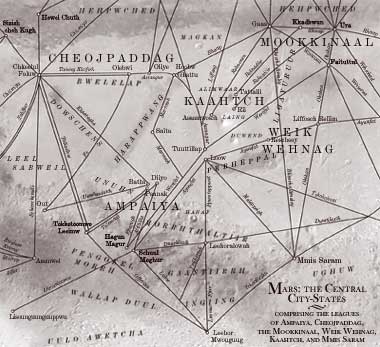
Elysium and the surrounding environs.
The inhabitants of the city-state of Ammwel follow a bizarre cult-like set of strictures: the Ocqotong. They must keep detailed journals of their daily transactions, and diaries of their innermost thoughts; these writings are gathered together, encoded and read through some sort of double-blind system (so that no one currently living can be identified with their writings—well, not easily), annotated, collated, cross-referenced, and shelved among the collective memory of the entire city for the past couple of millennia in the great Perpus Takaan, a magnificent example of Later Hy’attit design. These are used to examine recurring patterns in history and to correlate and attempt to identify reincarnations of previous Ammweli; once someone dies, their writings are released to whatever priestly hierarchy runs the Takaan (the Ppappalepal, perhaps, who are dour, and wear silly codpieces), and an attempt is made to fix their past identity, their place in yon Great Scheme of Things. (Since ancestor worship is a big deal, having a relative who just died turn out to have been the reincarnation of someone important from eleven hundred years ago—based on the similar style with which they composed their grocery lists—well. This can be quite prestigious, if not lucrative.)
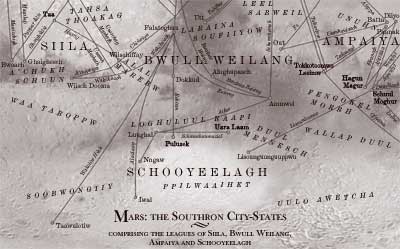
The Hellas Basin.
The Ampaiya League— Comprising the city-states of Tokkotoomwo Leeimw, Out, Batta, Diiyo, Paanak, Hagun Magur, Schuul Moghur, Leehoralowah and Leehor Mwouguug, the Ampaiya League is one of the richest and most cosmopolitan on Mars, vying with the Schoorhugullang in industry and agricultural output. Its network of canals is also arguably the best maintained, counting among its number the Offriina, the Liibw, the Uumhaidasch, the Werefat and Ayuufat, the Ffranogh and Afittikka, and the mighty Talimaat corridor. Ampaiya is a major source of liftwood, and, through trading along the Werefat and Ayuufat canals, is one of the only outlets for the narcotic attigha, grown in the cool, dry foothills of the Kaahtch. Though Lisounguunguuppwu is these days considered more a member of the Schooyeelagh, thanks to the Duul Mennesch caravan trade, close ties are nonetheless maintained with Ampaiya, and the water pumped from the Ppilwaaihet along the Lisounloomw canal is another important factor in Ampaiya’s vitality.
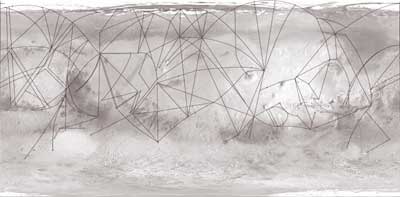
The planet Mars, with major canal systems indicated.
Bells and whistles.
So. The new design. Still kicking the tires and working out the kinks; if you wander too deeply and fall into a morass of undigested code, just remember: the back button is your friend. Anyway. This is a lot closer to what I’d wanted when I first decided I wanted a blog for myself: those who were around in the mad old bad old days might remember this little ditty, from back when the entries were few enough and far enough between that I could hand-roll the CMS without too much effort. When I made the switch to Movable Type—blessed be its name—I tweaked the style sheet and the templates just enough to look more like me than not, but as a temporary measure, see, with the ever-present intention of crawling under the chassis and tinkering under the hood and whipping it into shape. Any day now. Gonna get right on that. Yup.
Sixteen months later.
The important point to note right now is this: we’re in the middle of switching the accounts that host Long story; short pier. As I understand it, this means little packets of information are as we speak circling the globe, dropping in on DNS servers from here to Timbuktu for a little tea, some gossip, and oh, by the way, when you get around to it, could you change the pointer for longstoryshortpier.com? Thanks. —This, apparently, takes a few days.
So: for now, you can get here directly by using the subdirectory itself: thecityofroses.com/longstory/, much as you could (and still can) get to the old pier through jennworks.com/longstory/. But longstoryshortpier.com is the more robust link: it will always end you up at the pier, wherever the pier might be, while more specific subdirectory URLs might land you at old, outmoded, unupdated piers. So: use thecityofroses.com/longstory/ as an interim link; feel free to keep longstoryshortpier.com in your blogrolls and such; and if you had jennworks.com/longstory/ as your bookmark, you’ll want to update it. (Of course, longstoryshortpier.com is at the moment pointing to the Spouse’s site; the mysteries of what’s being discussed in those DNS kaffeeklatschen are beyond me.)
Bored yet? The rest gets numbingly technical. That was the important bit, so feel free to bail out.
The first thing I had to do was fix MT’s file-naming system. Straight out of the box, Movable Type uses a numerical key based on the entry’s place in the database as the name of the HTML file: the first entry made is 0001.html, the second 0002.html, and so forth and so on. Which is all well and good, until you delete the sixth entry because of a mistake and so 0006.html is scrubbed and now the sixth entry is 0007.html. And then you let your best friend run a blog off your MT install, and her first entry is seventh in the database, which means it’s 0008.html, and your seventh entry, posted right after hers, is 0009.html, and, well. —This works fine so far as it goes, because who pays attention to the actual file names when you’re following hyperlinks? But! Say you want to move your install. Say your best friend wants to host her blog herself. Say you got a better deal on bandwidth. Whatever. So you export all your entries and you install MT elsewhere and then you import your entries and rebuild—and all the links other people have made to you out there in the Islets of Bloggerhans are instantly rotted away. Because your new MT names all its files based on the order the entries were made to its database, not some other database you used on a server in another state that it never met before.
Luckily, there’s lots of ways to massage MT’s archiving system. I followed Mark Pilgrim’s recipe for cruft-free hyperlinks: now, every entry builds its file name out of the entry title itself, or keywords—if, as is frequently the case, my entry title is just a wee bit too long. Plus, I hacked off the .html extension: that way, I could (someday) upgrade to, oh, php or some other bite of alphabet soup. But: no matter where I move or what I use, the permalinks will stay just that: perma. No link rot!
(Unless, of course, one’s main URL points inexplicably to one’s Spouse’s index page, as little packets of vital information waste time tea-and-crumpeting with DNS servers. But we’ve been over that. It’s temporary. All will soon be back to normal.)
Of course, there’s the problem of the legacy archives—all the old permalinks out there that point to the old, entry-number-based file titles. Those links are rotten at the moment; those old entries are orphaned. I have an idea, though: the old MT install is still operative, with the old file names. If I were to change the individual entry template to nothing more than MT tags that would generate the new file name, then rebuild the old site, then copy the files generated and drop them onto my new host—that should work. Then, each old link would bring up a file that says, “Hey, the discussion moved, go here,” and link. —That, at any rate, is the plan. But it would involve a lot of typing of key words from the new install into the old install. So I might not get to it just yet. On the other hand: it really doesn’t pay to have Brad DeLong annoyed with you. So I might just prioritize that.
Next up: accessibility. I dove into Mark again (and I really need to add him to the colophon over yonder) with his clear and terribly helpful Dive Into Accessibility series. Some of this stuff is already bog-standard on MT, some of it isn’t, but if you run a website, you owe it to yourself to take it all to heart. —Most important: the simple and elegant liquid three-column display I gacked from Floatutorial requires the main content of the blog—this stuff you’re reading here—to be coded after the more nattery stuff in each of the two floating sidebars: pretty much ass-backwards from an accessibility standpoint. Mark’s hidden skip link was a lovely little solution that salved my conscience as I went for what passes for gusto hereabouts.
Also, I decided to add underlines to the links, after years of inveighing against them, and I decided it would be a good idea for the links in the main blog portion to be a different color if you’ve already visited them, after years of inveighing against that. It’s supposed to be a tiny discreet brown line that is easy to skip over if you’re reading, but still easy to see if you’re looking for a link, that changes to an even more discreet blue if it’s a link you’ve already visited—from Eschaton, or Making Light, probably. But different boxes and different monitors are rendering the simple CSS in very different ways; my Windows box at work wants to make all the lines thick and black, for some godawful reason. So while I’m warming to the theory, I may scrap the praxis. —Then, my Windows box is fucking up the CSS something awful in IE 6.0: it ignores all my calls for Georgia and (since it doesn’t have Lucida Grande) Verdana in favor of rendering the whole site in Times Roman. And let’s not get into what I had to do to get it to render the boxes right. It’s still fucking up the frame colors on the deltolographs to the right there.
Other niggling background stuff I did: I scrapped the MT code that opens comments and trackbacks in new, little windows; I always hated that, and try never to click on those links on other people’s MT blogs unless I have to. If I want the content opened in a new window, I’ll bloody well use a new window. Otherwise, just use the one I’ve already got open. Oy.
I also added permalinks to comments: not that there’s a lot of traffic hereabouts, but there’s the occasional meaty addendum, and it’s nice to point to it specifically. There’s a little graphic ding at the end of each comment that serves as the handle for the permalink, and bad me: there’s no text backup for it yet. So I’ll be adding the word “link” there shortly, that will also serve as the handle for the comment’s permalink. Oh, and I scrapped the catalog archive pages—since MT doesn’t yet have a handy pagination function, each category page just kept getting longer and longer and more and more difficult to browse. Monthly archives are much more user-friendly. Feel free to graze.
Other stuff: I’m using an MT sideblog to maintain the linchinography, since the lack of ability to meaningfully alphabetize the stuff coming out of blogrolling.com—a great little service otherwise—was really getting to me. Basically, I set up a new blog in Movable Type, then stripped out all the archiving functions, and set up the main index to look like this:
<ul>
<MTEntries sort_by=”title” sort_order=”ascend” lastn=”999”>
<li><$MTEntryBody$></li>
</MTEntries>
</ul>
Each link is entered as an entry in the blog, and given a title that lays out how it should be alphabetized (“Wilson, Trish” for Trish Wilson’s Blog; “Rittenhouse Review” for The Rittenhouse Review). MT then builds an index page (called linkroll.html) that’s really just a bare-bones snippet of HTML: a UL list of each entry in the linchinography. Then, on the main index template for the pier, I stick
<$MTInclude file=”<$MTBlogURL$>linkroll.html”$></>where I want the linchinography to go, and voila!
I’m using a similar technique to maintain the Deltiolography sideblog to the right there.
And otherwise: there’s some rough bits to file off the comments preview page, for instance, and the trackback ping report, and some of the links on the monthly archive page are wonky, and there’s content and links to be added to the right, there; I’m still mulling over the suggestions in this handy sketch of semantic markup—I want to be better about using <cite> properly, say, but then I need to make sure I have a .noitalic class when I want to cite short stories or plays, and I still don’t know for sure how I want to set up blockquotes, and so forth and so on, ad infinitum. But the work progresses. One is never done with anything, after all.
What’s that? Entries? You want me to actually make entries, too?
Oy.
How fast?
Yeah, I know Atrios has his finger on the pulse of the Islets of Bloggerhans. He’s a superstar, man, the Beatles of blogging, he’s the first and last stop on my hourly must-read list.
But: when the RSS feed for his entry pointing to the announcement of the Koufax winners shows up a good ten minutes before the RSS feed for the Koufax announcement itself?
Well, you just gotta wonder, is all.
(Congratulations to all and sundry; no always-the-good-friend-of-a-bridesmaid-who-helps-her-into-her-awful-sea-foam-taffetta-gown-but-never-a-bridesmaid bitterness here. Nossir.)