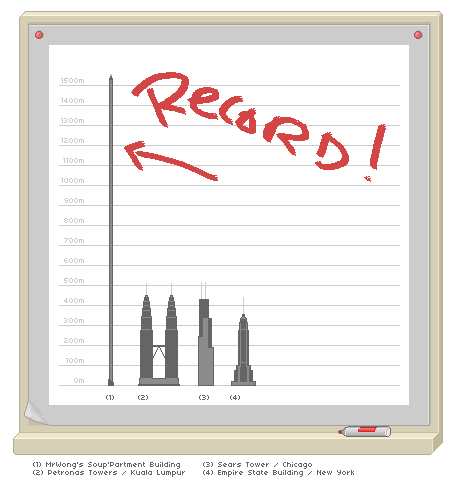


How I got to be where I am at the moment.
¡Journalista! is a daily must-read during the week. Dirk Deppey regularly pulls together an entertaingly varied assortment of comics-industry and comics-related news items, with occasional flights into spot-on if cantankerous analysis; just the thing for someone too terribly lazy to keep himself on top of The Comics Journal boards and Comicon.com’s boards and the Pulse and Talkaboutcomics.com and Comixpedia and Sequential Tart and all the other sites I’m leaving out, God knows. (To say nothing of the ever-burgeoning comics blogosphere.) This morning, in addition to a great John Barber rant I’d missed the first time out, Dirk pointed out an article from my own backyard: the Portland Tribune profiled Craig Thompson, whose Blankets is not to be missed. In the profile, Thompson mentions in an off-hand fashion the three books his father has read: “a book by Jerry Falwell about the economy in the apocalypse; Rush Limbaugh’s autobiography, the first one; and the Promise Keepers manual.” Those last two didn’t really engage me—I mean, Rush, you know? And if you’ve seen one stadium full of men in Tommy Hellfighter T-shirts, you’ve seen them all. But the first: Jerry Falwell on economics during the Tribulation? Damn.That’s one of those must-haves for the library, you know?
Unfortunately, some desultory coffee-break Googling (and Amazoning, Powellsing, and aLibrising) failed to turn up a likely candidate. However: I did turn up this interesting-looking essay on the politics of Christian domination—to be dug into later; it seems to speak nicely to this post over at Body and Soul—and Frontline’s site for its show on apocalyptic belief in the Western world, which includes a page on Hal Lindsey and his coattail riders (among which is numbered, of course, good ol’ Jack Van Impe), as well as some much-need historical perspective: Cliff’s Notes backgrounders on the Millerites, the Great Disappointment, and John Darby’s dispensationalism—which features a scrummy-looking chart by Charles Larkin that bounced me through Making Light to the Planet Kolob, from which hasty retreat was beaten back to the Museum of Jurassic Technology—and would you look at the time? So I rounded it off with a dose of Apocamon, Patrick Farley’s manga-bright retelling of the Revelation of St. John the Devine. (Coming soon—Part 3: Attack of the Locusts.) Gotta get ’em all!
Now, if you’ll excuse me, I’m feeling a little dizzy.



Bandwaggonry.
I’m on board—are you? (Yes, mine is an involuted joke. Referencing this, and this [by way of this].) —And now I’m on to something else. (For the record, akashic or otherwise: “FAIR and Balanced, Deceased.”)
And the whole dern thing has been condemned by ’Merican Express.
I think I found this over at Geisha Asobi: Mr. Wong’s wonderful Soup’Partments, quite possibly the world’s tallest virtual building. Download a basic template (one- or two-storey models available), renovate to your liking (pixels only, please; no anti-aliasing), and email it in; Mr. Wong will find a place for you.
Which reminds me of something from back in the day: the Muckenhoupt Hotel, frequented by a large part of my circle of friends (and others, of course) at Oberlin. Now, keep in mind this was back in the late ’80s: there was no web, world-wide or not, and students bringing their own computers to school was rare. We had a couple of rooms in the library full of cheap idiot terminals all plugged into a VAX 11/780—with a separate room for some MS-DOS boxes, and, my sophomore year, the experimental Macintosh lab, full of cute little SEs. Getting email out of the local network and onto the Internet (it made more sense to capitalize it then) took a little finagling—corresponding with the Runic Robot was always something of a feat, at least for me—and when you made a post to Usenet, it could take 3 or 4 days to show up. And those cheap idiot terminals had monochrome displays: you could pick an amber-on-black or a green-on-black display. No graphics, anti-aliased or otherwise.
Each student could sign up for an email address and a directory with a couple hundred kilobytes, gratis. And we rapidly found other ways to use that k than email storage and statistical analyses—there were emailed serials (most notably the late, lamented Pulp); Infosys, the bulletin board, was full of long-winded, little-read arguments on politics and religion; and of course, games: Hack (or Rogue, or whatever) and Wumpus-hunting and IF and setting up utilities for Champions character generation.
Carl Muckenhoupt pulled an interesting experiment. He set the protections for reading and writing to his directory structure to all, wrote a text file describing the lobby of the Muckenhoupt Hotel, and threw open its doors. Anyone could set up a subdirectory under his directory, and put whatever text files they wanted in it. So people would set up their “rooms,” with text descriptions of what they looked like, and files describing various objects within the rooms. People began leaving objects in each other’s rooms, since you could set your own subdirectories to allow others to write to them (I seem to recall a minor kerfluffle over an anonymously created rose). Crude hypertext hacks allowed you to move through the directories, and even set up “secret passages” that would work in the background to move you unbidden from one room to another. Someone—Carl, I think—cobbled together an ASCII elevator that could move you from one “floor” to another.
This was all in 1987 and 1988, or thereabouts. And while he was far from the only one to come up with the basic idea, and it was terribly ad hoc—there was no coding involved beyond the operating system and the directory-shunting hacks—still, it’s worth noting: this was one of the world’s first MUSHes. (Or MUDs. Or whatever.) Proto-MUSH? Maybe?
(Confidential to Amy: Yes, it is.)
It’s a spy plane! It’s a rock band!
Actually, it’s the table where I’ll more likely than not be hanging out while in San Diego for the next few days: U2, in the Small Press corner of the ridiculous expanse of the San Diego Convention Center. It should be listed under “Baldwin and Lee” in the program. Do stop by if you happen to find yourself in the area.
It depends on what the meaning of “blog” is.
I’m supposed to be freelancing, since I didn’t get a chance to put that ceiling in, and the painting took longer than I thought, and don’t ask about the wiring, and I’m also wondering how on earth I can find appropriate references to the Family and the Sygn in my tattered, dog-eared copy of Stars in my Pocket Like Grains of Sand—wouldn’t it be cool if there were some sort of engine that could scan the letterforms on the page much more quickly than I could myself, alerting me to those passages which contain “Family” and “Sygn” in close proximity, so that my search would be that much the easier? —But you can never have too much procrastination, says I, so here I am wasting time to say: Happy blogoversary, Alas.
An open letter to Figg Vanderhyde, among others.
I don’t have a septic tank problem. Not even a “septic tank problem (bWqx2M).”
I don’t even have a septic tank. Okay?
So I don’t need to dramatically increase its life and effectiveness with SPC, which breaks down large waste materials into smaller particles and liquids so they pass through a septic system that doesn’t even exist. So I’m not going to try it out by clicking anywhere.
Given that, you might want to stop with the septic tank spam. Utterly wasted on me. Moreso than most.
(I mean, at least the barnyard lesbian lolitas attracting men with larger breasts that went all night were momentarily entertaining…)
Tuppence.
I’m sorry to see Wampum go. Come back soon, MB.
While I maybe don’t read Ruminate This or the watch on a daily white-knuckled basis, they’re invaluable pit stops for every-coupla-day perspective-taking. Keep up the good work, folks.
I used to have Mac-a-ro-nies in my linchinography. Like a lot of people, I find her a sharp-witted writer on political issues, with a knack for digging up (criminally) overlooked perspectives. But her tongue’s as sharp as her wit—too sharp, perhaps. Links drift in and out of my blogroll all the time, for the most whimsical of reasons; it isn’t a secret club, or an intellectually rigorous snapshot of me as a political animal, or a networked affinity group, or even an accurate representation of what I’m reading how often. It’s just a collection of stuff I want to remember to keep coming back to. For a variety of reasons, including what I saw to be disproportionate reactions to others’ posts (friends and not) and dispiriting ad hominem attacks, I decided a while back to remove the Mac-a-ro-nies link. —I still read her from time to time, when pointed to fresh posts by others.
So I wish MacDiva the best of luck. We each of us can only fight the world the way we see it, after all.
But every now and then it’s a good idea to stop and take a look at the way we see the world.
—And that’s all two cents is worth, I think.
Scott McCloud is right!
We do, on the whole, look less dorky in his photo than Erika’s.
We’re back.
Oy and gevalt, but. One week ago successfulhosting.com updated various software packages, including its basic database program. Unfortunately, in so doing it rendered the database upon which Long story; short pier, Alas, and Jennworks depend unreadable. (Also, every other non-MySQL Movable Type database on a successfulhosting.com server.) Now, there’s a terribly simple fix—but you have to have command-line access to do it yourself.
And, uh, we don’t.
So. —It’s been a week of testy phone calls and sudden epiphanies and nail-biting tension and glowering looks and links missed and memes unblogged and a lot of Sports Night episodes more on which in a bit, maybe.
Anyway. We’re back now. Miss us?
Quirks.
On the one hand, I don’t imagine it’s all that common to hear people talking about slipstreaming their stories and think you’re going to stumble over the poor piece of fiction with fifteen other naked men at the back of Wilson’s bakery. —Oh, that poor Danny Slepstrini…
On the other, I can’t be the only person in the world with a mad mad crush on Miranda Richardson’s imperiously petulant Queen from the Elizabethan Blackadder. Can I?
-y? -ie? Or shall we call the whole thing off?
So which is it? “Hoody”? Or “hoodie”? I could maybe if kicked marshal a half-baked argument either way. (Is it better to be wholly baked or not baked at all?) Google (what a wonderful spell-checker it is) shows us popular sentiment leans toward hoodie, which makes me partial to hoody for no other reason than maintaining my contrarian cred. Is there a specious argument I’m missing that would authoritatively tip the scales?
I do have my reasons for asking, but they are dull and meager, not worth sharing with the class. —Miss Kittin wants to know how you can call yourself a DJ if you don’t shake your ass in the crowd, and that’s as good a non sequitur as any with which to get back to work.
Where you been?
Out.
Whatcha been doin’?
Nothing.
Pretty much nothing, I suppose. Fiddling with this and that, desultorily, half-assedly. (Is it better to have a full ass or no ass? Didn’t David Chess already look into this? Like, last year?) Like Bean and Jake, I’m going through one of those “fuck tha humanz” mood swings. (You want a link? Here’s a fun one, 2 weeks old, courtesy a not-quite-as-old plug over at Unqualified Offerings. Yeah, I’ve been keeping up with my reading. Removed Where is Raed? from the linchinography Wednesday AM on the grounds that, well, no one knew where the hell Salam was; and who comes back to post that very afternoon, which I don’t find out till this morning? Which, I mean, yeah, I found out about it, and pretty quickly, too, but still. Loop outtage.)
Hmm, lessee: Friday, came home to find a large chunk of the downstairs livingroom ceiling on the floor in a puddle of water and gypsum dust. Nigh-immediately decamped to a farewell party for Johnzo and Victoria and got discreetly (?) smashed. —And I need to rescue my Sif Safaa at some point. I must say, there’s a certain je ne sais quois to the combination of Spitting Image video wallpaper and a toneless computer voice reading Roy-Orbison-in-cling-film smut over ululating Iraqi pop that, well. Facilitated said smashedness.
Saturday: went and bought a used reel mower because the new one I’d bought just over a year ago upped and died. (How do you kill a reel mower? You bend the handle beyond recognition, trying to push it through admittedly tall and wet grass.) —And I would have written about the joy and delight of buying a simple machine that works so well: solid, dependable, with a great adjustable-height widget that means I can cut tall grass like buttah with nothing more than muscle power, I would huffily have discoursed on Newfangled Crap Purchased in a Moment of Desperation at Home Depot Which Failed in the Course of the Humble Duties for Which it was Intended (though it did last over a year, and the grass was tall. And wet) versus A Solid and Dependable Piece of Fine Workmanship from Back in the Day When People Cared about the Products they Sold (and did I mention that neat adjustable-height widget?), and I probably would have reminisced about the utter loathing I had of mowing the grass growing up (as the eldest kid it was one of my many designated chores, the one I perhaps most loathed, or at least most loathe as of this writing): the way gas fumes and oil smoke and bruised, crushed grass mingle to make a nose-tickling stench which, when combined with dust and sweat and stifiling South Carolinian heat make up for me the signifiers of Summer, the Cruellest Season; I might have brought up the mighty oath I swore, struggling behind the ratty gas-powered mower that would kick the occasional bit of gravel or shredded branch zinging off the grass catcher with a retort like a TV rifle ricochet, the oath never again to mow the grass when I got to be old enough to say and do and live as I pleased, and how the reel mower has ended up a regrettable compromise with that disgruntled younger me, having all the elegance of any hair split by necessity; I might even have knocked off a tin-foil-hatted excursion into It’sallabouttheoilstan, muttering darkly about the advantage oil companies gain by convincing lawnmower manufacturers to make reel mowers today much more flimsily that reel mowers of yore, so that anyone who tries to kick the gas habit is sorely disappointed and comes slouching back to the guzzling fold—I might have done something with all of that but for the fact that a crucial plastic thingie snapped on the solid, dependable, used reel mower’s maiden excursion into the grass it was otherwise cutting like buttah. Luckily, I have a warranty on the reconditioned parts. But. Still.
Sunday, and I was laying out my weekly freelance website gig (remind me to tell you about that some other time), and we rented the X-Men DVD because Jenn hadn’t seen it yet and everyone’s buzzing about X-Men 2 (it has Nightcrawler, you see; the Spouse, an X-fan from much further back than myself, is a Nightcrawler groupie, sigh), and something about comic book movies made me go back to revisit perhaps the pinnacle of the misbegotten genre (as distinctly opposed, mind you, to movies based on comics): Batman Returns. —With which I am all too familiar: the summer it came out, I was living in a two-bedroom apartment with (counts) five other people, one of whom I desperately did not want to spend any time with at all (love gone awry, long story, I do it every now and again as a party trick, as me the next time you see me). When one does not want to go home, and one has a flexible work schedule, and anyway it’s summer and hot and home has one over-worked air conditioner and the movie theater’s in the blessedly climate-controlled mall, and they’re showing a movie that not only has Batman but a blond woman dealing precariously with issues of empowerment and sanity (because one is still sifting through the ashes of another episode of love gone awry, the tragedy of a year prior that presaged the contemporaneous farce, which involved a [taller] blond woman dealing precariously with issues of empowerment and sanity, about which remind me to tell you some other time, and can I admit, just between you and me, that among the many little pleasures in this giddily glorious mess of a movie is the decidedly guilty shivery one when Michelle Pfeiffer pulls the derringer from her garter and picks up that broken, desperate giggle, and all Michael Keaton can do is wrap his hand around the gun to hide it and pull her close into the cold comfort of a kiss—Ladies! Gentlemen! Beware the White Knight, who thrills so keenly to see a damsel in distress…)— You spend a lot of not-so-discretionary income on half-priced matinee after matinee, is what I’m trying to tell you. I’ve seen those penguins march more times than I’ve seen the Millennium Falcon save Luke’s hide, and I was, what, nine when that came out? The point, though, is not to dredge up old memory-artefacts of cruel summers past, firing like the ghost-reflexes of a long-since amputated part, but to revel in the rich though neglected vein of political commentary that I keep forgetting is larded throughout the film, whether it’s Christopher Walken giving advice to his sock-puppet mayoral candidate Danny DeVito—“But to get the Mayor recalled, we still need a catalyst, a trigger, an incident. Like the Reichstag fire, the Gulf of Tonkin”—or DeVito’s bleakly hilarious exhortation to his remote-controlled penguin army:
My penguins … We stand at a great threshold. It’s okay to be scared. Many of you won’t be coming back … Thanks to Batman, the time has come to punish all God’s chillun … first, second, third and fourth-born, why be biased? Male and female … hell, the sexes are equal with their erogenous zones blown sky-high … Forward, march! The liberation of Gotham has begun!
—From a movie released in 1992, mind; a little over a year after the last time we intemperately announced the liberation of Baghdad. Add to that the minor subplot involving manipulation of the energy market and, well, I’ll just leave any parallels to be drawn between monstrously vindictive sock-puppet politicians in the hands of cartoonishly evil plutocrats as exercises for the reader. So: my appetite for socio-political satire whetted, the freelance work yet to be completed, I dropped Shock Treatment into the VCR as a follow-up, and that, pretty much, was my Sunday.
Monday, Tuesday, Wednesday. Eh. Got the plumbing fixed. The leak that made the ceiling fall. Thursday? Here I am. Biggest laugh of the day? Stumbling over this old piece from languagehat on “cheese-eating surrender monkeys” which has added “barking scrotum monsters” to my rhetorical quiver. (How can you say something sensible and worthwhile about a political discourse one end of which is upheld by a crew that moniker fits so well? —Which brings us rather neatly back to square one: Where have I been? Out. What have I been doing? Nothing.)
—Actually, can I change my vote as regards the pinnacle?
Talk amongst yourselves.
I’ll be back Sunday. Or maybe Monday. —If you need me, I’ll be in Ucluelet.
Radio Free Portland.
I was a DJ for a while there. Street-legal and everything: Barry and “Jake Squid” and I, plus assorted various and sundry others, were in the mood back in 1992 or ’93 to do a spoof of a radio-soap-corporate-sponsor-variety-hour show: The Granny Applethorpe’s Fluid Hour of Power, said fluid being a snake-oil nostrum that could do anything, derived from some mysterious seepage from grandmothers everywhere. —Granny Applethorpe’s sponsored “The Cravingtons,” a weekly soap opera about a bunch of UMass Amherst inside jokes, as well as musical interludes and other stuff, the details of which escape me. There was some good or at least fun writing in it all, looking back on what doesn’t escape me with the benefit of rose-colored hindsight: Scott DiBerardino’s snappily brilliant commercial for Product (“It makes life adjective!”), say (and I would be remiss if I did not tag the sine qua nonpareil talents of Pete Fernandez, who wrote all the jingles and performed them single-handedly; I’ll be further remiss if I didn’t get his name right, geeze), or the outrageously tongue-twisting battle of inverted doubly and triply looped regressively ingressive super-duper Pig Latin battle that Barry and I mapped out (and then wrote out phonetically, so our cast wouldn’t kill us), and I still regret that we never got around to recording “Jake Squid’s” hilarious political commentary, Count Pointer-Point, which would have run something like this:
STENTORIOUS ANNOUNCER: And now, Count Pointer-Point, on the Bush Administration’s will-we or won’t-we stance towards Syria.
[Pause.]
COUNT POINTER-POINT: There! It’s right there! Jesus, what’s wrong with you! It’s right in front of you! Are you blind or something? Look! There it is!
Ah, youth. —We broadcast four episodes and got a fifth in the can (am I remembering this right, folks?) before the unremunerated strain killed it, but before we broadcast it, we had to get FCC licenses as DJs, which was easy enough to do through the UMass Amherst community radio station. We logged our hours running fill-in shows throughout the summer before Granny Applethorpe’s was set to premiere, which was a lot of fun: rummaging through the station’s collection of CDs and vinyl for stuff to play on a whim or cueing up stuff lugged in from our respective private stashes, replicating our favorite cuts and juxtapositions from mix tapes of yore. “Jake Squid” masterminded a race between the Donovan and Butthole Surfers versions of “Hurdy-Gurdy Man,” sliding the volume in and out between two different turntables, which was about the height of our avant garde experimentation (at least, while I was in the booth). (I seem to recall that the Surfers won, but I’m not sure what.)
The reason we did this, of course, was that radio sucked. —It was gratifying to get phone calls telling us that we were playing great music, that Granny Applethorpe’s was the weirdest goddamn thing they’d ever heard on the radio, or the one time I was in the booth alone at three in the morning reading “The Last of the Winnebagos” over a randomly ambient soundtrack and then at maybe half past four I got a phone call from a guy who’d pulled over in the parking lot of the diner outside of Greenfield and stayed there, listening, so he wouldn’t risk outrunning the signal till I was done, and I’d like to think it was because we were doing something special or cool or good but for God’s sake we were just fucking around, we were grabbing stuff at random off the shelves and slapping it on the turntables because it looked cool. The only reason any of us community-based small-town DJs got any traction at all with those shows is because everything else sucked worse.
—That, and Connie Willis is a great writer. “Winnebagos” will break your heart.
Radio still sucked in 1996, of course; even out here in Portland, where everything is better except the fall foliage. I was writing for the nascent Anodyne at the time, which had offices in a certain building downtown with a politically conscious landlord; we shared space with such rabble-rousing troublemakers as the Cascadia Forest Alliance and a pirate radio station.
Radio must’ve been on my mind, because for our press pack I’d written up a “review” of KNRK’s one-year anniversary concert at popular nightspot La Luna; a review that had turned into a jeremiad against the encroaching corporatization of radio and its concommitant increase in sucking. —NRK (“Anarchy,” get it?) was one of Entercom’s stable of “alternative” radio stations, though at the time the term (which had doubled me over in paroxysms of laughter the first time I saw it as a category in a Sam Goody’s) was being phased out to make room for “modern rock,” They were most famous for a giant mural ad painted on a building downtown of a tattooed back: tattoos, yeah, hip, cutting-edge, pierced, black leather, ’90s, yo.
Anyway: that piece never saw the light of day, really, except to prove to potential advertisers that we had street cred or something, so when I learned there was a real live pirate DJ in our building that I could interview, I was amped to do something with all the notes I’d amassed about corporate schlock radio. It took a little doing, and I don’t think I ever learned his real name, but I managed to spend a day with DJ Schmeejay and tour the facilities of Subterradio, 88.7 on your FM dial (those facilities consisting of a 100-disc CD changer hidden in an unused janitor’s closet in said certain building downtown; he told me the transmitter itself was “in the West Hills,” but he knew I knew he was lying), followed by a week-long research binge on pirate radio thanks to the Multnomah County Library (which had an amazing small-press history of pirate radio that doesn’t seem to be there, now—maybe it was an early edition of this?). I interviewed Paul Griffin of the Association for Micropower Broadcasters over the phone, and learned all about Stephen Dunifer and his tussle with the FCC over Free Radio Berkeley, which had won its first battle in court (but would go on to lose the war; the peace itself is as ever muddled and undecided).
I ended up being more happy than not with the article. It was only my second piece of actual reportage, and it shows (as do the reasons why I’m now a second-string blogger and freelance cultural critic, rather than a journalist; that shit is hard). It got a brief mention in another local rag, which was nice. —About a month later I got a note from Larry, our ad salesperson extraordinaire, to call the FCC. Which was weird. Weirder still was that the phone number left turned out to be disconnected. At the time, I thought maybe it was something similar to an incident from a few years before, when a select group of friends was using that phone card number which charged back to some asshole lawyer creep who’d fired one of those friends, and another one of those friends thought it’d be really funny to prank call everybody else as “the phone police”—but Subterradio then went dark. Turns out the FCC spotted his antenna on the roof of that certain building. —He came back, skipped up the dial, moved his transmitter to a couple of different places, inspired the Pander Bros. to do a comic and then a compilation album, and then, well.
KNRK’s still around though. Hip? Cutting edge? It appears to be Cuervo and Bud Light and Maxim, yo. Ah, well; plus ça change and all that.
Subterradio’s gone; Dunifer lost; Clear Channel won the Oklahoma land rush Clinton sparked when he signed the 1996 Telecommunications Act into law. Decades of law and regulation designed to keep broadcasters mindful of their responsibilities to local communities were undone, and stations could suddenly be traded like million-dollar baseball cards, and radio now sucks worse than ever. The micropower struggle I wrote about in 1996 had one notable victory, of sorts: the FCC grudgingly set up a low-powered FM broadcasting license that was compromised enough to make no one at all happy. (In a shocking display of indecorous hardball, NPR fought strenuously against it.) —You might also remember a flap over internet radio, which is still trying to make some noise.
Pirate radio still flies its Jolly Rogers, and LPFM community stations are doing some good, but the fight has moved on: to television, now. FCC Chairman Michael Powell wants to do to television what the 1996 Telecommunications Act did to radio. And it might seem like there’s nothing to save on television—after all, the news is all winnowed down to a couple of points of view, the right and the far right, and whole chunks of the upper channels are blasted wastelands, some Big Content corp leveraging its back catalog of panned and scanned movies and clipped TV reruns down its own boutique cable pipeline into your house—but keep in mind: things can always get worse. And they will.
What’s disheartening to note is the shift in the battleground: with radio, it was a fight for the chance to say what we want, over who had a hold on the transmitters, and whose voices got a chance to be heard. With television, for God’s sake, it’s a fight for the chance to watch what we want. We’ve given up on the means of production. It’s out of our league and out of our hands. We’re struggling to record what we want when we want, to find shows that aren’t numbingly dumb or bowdlerized not for content but to make room for new ads, to dredge up some news that looks like it came from the planet we’re currently living on. We’re being lectured by network execs about minimizing our bathroom breaks when commercials are on.
Things can always get worse.
The one line from this piece I wrote back in 1996 that stays with me has nothing to do with radio or piracy or corporate hegemony, whatever that might be. It’s something Schmeejay tossed out with a studiedly off-handed lilt when the subject of politics came up. He was all about the music, but he didn’t mind running commentary, live or taped; he just had one dictum: “We just want to make sure that whatever we do, it’s educational, that it isn’t just about the wrong that’s going on, but about what we can do about it.”
The wrong that’s going on. —Sometimes, of course, the very act of talking about the wrong that’s going on is doing something about it. That is in a sense what this sinistral end of the Islets of Bloggerhans is all about, Atrios and Digby and Skimble and their ilk; the incomparable Bob Somerby; David Neiwert and his astonishing survey of “Rush, Newspeak, and Fascism,” which has everything to do with radio and 1996 and Clinton and monopoly and fighting for the right to be heard. (I don’t pretend to know what the dextral end is all about. Puffery and amateur McCarthyism, I imagine, but that’s my own shortcoming. Isn’t it.) But sometimes, of course, that isn’t enough; sometimes, all that is required for evil to triumph is that good people do nothing but bitch and moan.
Radio sucks; this is a given. There is no local content. There is nothing exciting or new. The talk is nothing but dextrously nasty ditto-chamber bloviating. There’s 20 minutes of bad commercials for every hour, and there’s few enough advertisers that you’re hearing the same commercials every goddamn hour. (Or more.) Record sales are down, way down, for the major labels who play the payola-lite games that are the only way to get on the radio these days, and you can’t just blame P2P and CD burning; sales are up for indie labels who rely on word of mouth, on small-venue concerts and giveaways, on internet distribution. Arbitron ratings show that overall Americans are listening to radio 10% less than they were in 1996.
(The thing about things getting worse is it’s not just us that get the short end of the stick.)
Radio sucks. That’s one of the wrongs that’s going on. —And this, then, is one of the things that can be done about it.
Anyway. This was supposed to just be an introduction for the article I wrote back in November of 1996 about Subterradio and micropower and the FCC, and it’s ended up almost as long as the thing it’s introducing.
Sorry.
If you want more, keep reading.
DJ Schmeejay:
- is of middling height, and neither his hair nor his eyes are of a startling or unusual color, nor is there anything distinctive about his voice;
- came up with his moniker because he was tired of—but no, he doesn’t want me to mention that;
- was once kicked off the air for saying “erection” into a live mike;
- loves music, and has big plans for Portland;
- once bought a 15-watt transmitter from Steve Dunifer, of Free Radio Berkeley, which he is using to broadcast 24 hours a day at 88.7 on your FM dial. Without the benefit of a license from the FCC.
DJ Schmeejay doesn’t want you to know who he is. He doesn’t want you to know what he looks like. He doesn’t want your adulation or recognition.
He just wants you to listen to his radio station.
“Well, look,” he says to me at the end of our interview. “Thanks for the publicity. I think.”
His ambivalence is understandable. This is what most folks call pirate radio, outlaw radio, clandestine radio. Its practitioners tend to prefer the term “micropower,” these days, claiming that what they do is legal under the First Amendment, but the FCC does not as yet agree. Steve Dunifer has been handed a $20,000 fine for operating Free Radio Berkeley; Richard Edmundson has been fined $10,000 for broadcasting San Francisco Liberation Radio. Napoleon Williams, who runs Liberation Radio in Decatur, Illinois, woke up one night to find cops battering down his doors and guns waved in his family’s face; local papers reported the next day that he had plotted the murder of a couple of vice cops, though no formal charges were ever filed. Perhaps more to the point: Paul Griffin, who runs the Association of Micropower Broadcasters, tells a story about a Spanish-language micropower station who thought a little publicity on the cable station Telemundo might be a good idea; they let TV cameras film them at work in their broadcast space, then watched as “a little publicity” turned into a three-night-long sensationalistic exposé on “radio illegál” and a visit from the FCC.
So Schmeejay was only half-joking when he took me to see the home of Subterradio and said with a half grin, before unlocking the first door, “You’re really just this FCC guy who went undercover with this magazine so you can pose as a reporter and get me to let you in here and then bust me, right?”
Maybe three-quarters joking. But still.
My editors want me to talk photo op with him: “No way,” he says. “Not if I can be recognized.”
“Maybe from the back?” I suggest. “Working with your equipment?” This is before I hear Griffin’s story.
“No,” he says firmly. “Not in the space. Besides, from the back…people would know. Some people would know.”
“Maybe with a bag over your head?” I say, and we both laugh at the image of the Unknown Broadcaster.
“No,” he says. “No pictures.”
The FCC doesn’t want you to hear Subterradio, or anything like it. “The law is very precise: no one can broadcast without a license.” Or so says David Silberman, an attorney for the Federal Communications Commission. The only problem is that such a license can cost around $10,000 once you’ve paid all the application fees; it’s been estimated that start-up costs for a radio station to meet bare-minimum FCC specs are in the neighborhood of $250,000.
Kinda out of the reach of folks like you and me.
There is a rationale, of course; you don’t want the airwaves too crowded, and there are over 6,900 licensed conventional FM stations in America already. Besides, there’s big money in radio, what with advertising and all. The airwaves are a national resource, given into the stewardship of the FCC—why not sell them as dearly as possible?
Of course, the people who’ve bought a slice of the airwaves want their investment protected from upstarts who might step on their signal, or compete with them for an audience “unfairly,” without the benefit of a license. “The operation of unlicensed radio stations is in direct violation of FCC Rules and Regulations,” says an FCC “notice of apparent liability,” the letter they send to warn unlicensed radio stations to cease and desist. “Their operation may endanger life and property by causing harmful interference to licensed radio operations.”
Obviously, Schmeejay and Subterradio are not endangering anyone’s life by pumping out fifteen watts of music 24 hours a day on 88.7. It’s that second word, property, that’s the key. Broadcasters pay big money for their licensed slots on the dial, and that chunk of the national resource now belongs to them. And they don’t want anybody messing with their property.
What are they so scared of?
“There’s nothing good on the radio,” says Schmeejay. “It’s all the same. You listen to NRK here, and then you go to San Francisco, and you hear about Live 105, their alternative station, and you think it must be cool, and you tune in, and it’s the same shite. The same old shite.”
It doesn’t hurt, of course, that NRK and Live 105 are owned by the same company. More on which later.
“Ever since I was a kid—I used to have a kit, from Radio Shack or something, and I would broadcast a show in my house. I’d wait by the radio, you know, to record just the right song off it. It’s always been my boyhood dream to share music with people.”
So when he heard about Steve Dunifer and Free Radio Berkeley a year or so ago, he began pestering Dunifer to sell him one of the micropower transmitter kits which Dunifer manufactures and sells. “I had to bug him for about a year. He only sells to certain people, who understand what he’s trying to get at with micropower broadcasting. I finally had to meet him in person, travel down to Berkeley and talk to him, face-to-face, before he decided I was the right kind of person to have one of these.”
That was a few months ago. With some help from a couple of somewhat more technically savvy friends, Schmeejay installed the transmitter, got it up and running, and Subterradio, the Space Station, was on the air. Schmeejay estimates about $3,000 of his own money has gone into getting the station on the air. “I’d bought a real state-of-the-art amp, but for some reason that made everything sound awful. Way to bass-y. So we switched to this piece-of-shit thing that was kicking around, and it sounds much better.” He shrugs. “Maybe it’s because we broadcast in mono.”
For the past three months or so (dates, like so many other details, are vague), the station has been in a sort of test mode, automated for most of the time, with only occasionally live turns. “It’s hard to categorize the music we play,” he says. “For me, there’s really only two kinds of music: good and bad. I hate labelling and categorization.”
When pressed, he will admit that a lot of what they play would fall into the “rhythm culture”: acid jazz, techno, trip-hop, ambient. We’re listening to the station as we talk; a Luscious Jackson remix comes on. “But we also play stuff like this,” he says, “or Ani DiFranco, or Beck, or the Beastie Boys—but we play what doesn’t get played on other stations. Different mixes. Or ’50s stuff. Charlie Parker, Stan Getz. Esquivel.” He looks a little uncomfortable after this spate of labeling and categorization. “We play music that needs to be heard,” he says, simply.
Response has been, well, “horrific” is the word he uses to describe it. He estimates, from the volume of calls they’ve been getting, that Subterradio may have as many as 500 to a thousand listeners on any given day. “We gave away tickets to the Meat Beat Manifesto show, a 10th caller kind of deal—we got a hundred some-odd phone calls for that. Horrific. I feel this tremendous responsibility to return all of them.”
He grins. “Crazy people call us. We’ve got this guy, Marty, he’s adopted us, he’s our ‘roving listener,’ he’ll call in every day and let us know where and when he’s picking us up. ‘Hey, guys, I’m up on Mt. Tabor, you’re coming in loud and clear.’ Or this other person, who calls in to say they are moving downtown, they’ve heard us, but they can’t pick us up where they’re living in Beaverton. I’m not kidding.
“We do get some complaints. We have this show we do from 10ish to 2ish evenings called ‘Joy in Repetition,’ and sometimes people will call and say that we play too much of that techno stuff. And there was the time we were on autopilot, and Marty called in to let us know a song was skipping. But even the people who complain say that it’s better than everything else out there.”
When Subterradio is on “autopilot” (like so many of us, Schmeejay has to contend with a day job; even with his associates, there can’t be somebody there, live, 24-7—at this point), it is left in the care of a multi-CD changer hidden behind a wall in an unspecified location “somewhere in the west hills.”
Think about it: this CD player, loaded with somebody’s favorite CDs and set on random shuffle, has been delivering what some folks think is the best radio Portland has to offer.
“We even got praise from a DJ at NRK, who shall remain nameless, a self-described ‘corporate radio whore’ who’d love to come do a show on our station, and play the kind of music he wants to play, instead of what they tell him.”
It didn’t used to be like this, of course. An easy thing to forget, but. Alternative music—excuse me, modern rock—didn’t exist until about seven years ago. As late as 1969, FM radio was considered a passing fad, something that would never topple the mighty AM Top 40 stations. Epic battles over the ethics of the very idea of supporting a mass medium with advertising dollars and product sponsorships were still being waged in the ’30s—losing battles, to be sure, but. And in the ’20s…
In the early ’20s, the magic of radio was still something visceral; its power to obliterate distance and bring people together had folks huddled over contraptions made from cheap crystals and wires and oatmeal cans and gutted telephony, tuning in programs from far-off Kalamazoo or Parsippany. A real sense of community was felt; magazines like Radio Broadcast sponsored contests in which listeners competed to see who could pull in the furthest signal. And radio stations participated in what were called “silent nights”: for one night a week, radio stations would go off the air, to allow people who lived close to their antennas to pick up distant signals that were otherwise overwhelmed. These silent nights weren’t legislation, or regulation—they were a suggestion from the Department of Commerce, which had jurisdiction over radio broadcasts at the time.
Things changed, as they are wont: mostly in 1934, with the passage of the Communications Act and the creation of the Federal Communications Commission. By this time, money was talking, and radio stations had long since stopped the silent nights. Give up airtime to a competitor? How quaint. The task facing Congress and FDR’s New Deal was to create and regulate a national radio while avoiding the looming spectre of monopoly—and without nationalizing radio, as every European country had done. Giant broadcasting companies had already invested a great deal in radio, and those investments had to be protected. There was an attempt to preserve something of the community of ’20s radio: the Wagner-Hatfield Amendment to the Act, which would have set aside 25% of the airwaves for nonprofit community stations, and allowed them to sell airtime to defray expenses—but the path of least resistance was taken. The Federal Radio Commission was renamed the Federal Communication Commission, and given unrestricted powers in the granting of broadcast licenses.
In 1978, in the interest of regulating the sudden boom of FM radio, the FCC banned all FM broadcasts of less than 100 watts. In the deregulatory frenzy of the ’80s, the three-year rule was stripped away (used to be that someone purchasing a radio station had to hold onto it for three years before selling it, to ensure that broadcasters would take a long-term interest in the community they served; no more). And early this year, Clinton threw out the restrictions on the number of radio stations any one corporation can own, launching a station-buying frenzy which culminated in the highest price yet paid for a single radio station: 90 million dollars for WAXQ in New York City, by Entercom—which promptly traded it to Viacom for three stations in the Seattle area: KBSG FM, KBSG AM, and KNDD, which joined the Entercom family of KMTT FM and AM, in the Seattle area, and KGON and KFXX and KNRK here in Portland, and Live 105 in San Francisco, and more, in Houston, Pittsburgh, Tampa…
How many newspapers in Portland aren’t owned by Newhouse? How much of the television you watch isn’t owned by MTV and HBO? How many companies are ultimately responsible for the movies Act III chooses to carry?
“It’s based on the First Amendment,” says Paul Griffin, describing the defense strategy in United States v. Stephen Dunifer. “There are so many radio stations being bought up by media conglomerates that minority opinions, anything that might offend the advertisers, are being shut out entirely. There’s a real lack of diversity, a real danger to our right to free speech.”
Dunifer is the man behind Free Radio Berkeley, which began broadcasting in 1993. He wanted to start a populist movement of low-power community radio stations, while challenging the FCC’s ban on low-wattage FM transmissions, and so he began building kits for 5- to 15-watt transmitters which he sold to interested groups throughout the US, as well as Mexico, El Salvador, and Haiti. Thus was “micropower” born.
Griffin read about Free Radio Berkeley, and Dunifer’s fight with the FCC, and began volunteering wherever Dunifer needed help; this help ended up becoming the Association for Micropower Broadcasters, a loose affiliation of about 20 or so micropower stations throughout the country, which publishes a newsletter and a taped radio show, both called the AMPB Report, tracks records currently played on micropower stations, and offers updates on Dunifer’s court case and other news of interest. It also helps coordinate record company promo discs and materials. (Yes, in a classic case of the right hand not caring what it does to the left, record companies love having pirate radio stations play their music as much as any other. Air time is air time, whether legal, il-, or quasi-, right?)
Dunifer isn’t interested in (utter) anarchy on the airwaves; remember, he’s very particular about who gets his kits. What he wants is for the FCC to create a micropower FM registration service. If you found a clear spot on the dial, you’d mail fifty bucks and a registration form and boom! Radio Free You. (Canada already has something similar in place.)
The FCC doesn’t agree, and in 1993, shortly after Free Radio Berkeley began broadcasting, they served Dunifer with a notice of apparent liability. Unlike legions of unlicensed radio broadcasters before him, Dunifer didn’t shut down, he didn’t shift to a new frequency, he didn’t move his transmitter to a new location, or put it in a van, or stick it on a boat and sail out into international waters. He introduced them to his lawyer, Luke Hiken, of the National Lawyers’ Guild. And whether you reduce it to free speech, or the voice of the community, or the image of Hiken holding up one of Dunifer’s transmitters in court and proclaiming that people have a right to use these things, or to the fact that there’s just nothing good on the radio, dammit, the defense worked. So far. In a hearing in January of 1995, Judge Claudia Wilkin handed the FCC a significant defeat when she denied their preliminary injunction to prohibit Free Radio Berkeley from broadcasting.
Both sides currently await her decision on the overall case.
DJ Schmeejay fills me in on the Subterradio plan for world domination:
“Reggae and dub in the mornings. Because that’s the way we like our mornings to be. Afternoons: a little bit of conversation, editorial, discussion. We do a bit of this already, but we want to do more.”
“Yeah,” says one of his associates, passing behind us on some mysterious errand.
“He wants more conversation,” says Schmeejay. “We already play something called Truth Serum, we just want to make sure that whatever we do, it’s educational, that it isn’t just about the wrong that’s going on, but about what we can do about it.
“Then evenings would be trip-hop, acid jazz, drum and bass—like a really good party, we’ll build it up, and build it up, to maximum bpm, and then bring it down again. And then from 2 am to 6 am it’s ambient, to sort of cool down.”
This is, of course, a rough approximation. “We’ll play anything that’s not too booty, local bands, local DJs that aren’t getting airplay, the more the merrier. Send us your tapes. We’ll also be doing weekly shows, like Courtney Taylor and Pete Holmstrom will be doing a space rock show on Sundays called The Space Station.”
And further ahead? “More power, or relays to additional sites, for more coverage, definitely. I want this to be for everybody. Everybody who wants to be involved.” Another grin—”The more the community writes in, the more the community supports us, the more leverage we have.”
I might have exaggerated the danger to Schmeejay just a tad. Make no mistake, free speech over the airwaves is powerful stuff: the Menomonee Warriors’ Station provided a center for Indian rights in Wisconsin in 1975; Napoleon Williams’ Liberation Radio has spoken out against police brutality in his predominately black neighborhood, and helped lower the number of police abuse cases there; Radio Zapata broadcast news of the Chiapas rebellion gleaned from the internet to sympathetic farm-workers in the Salinas Valley. Even when it’s just the music, the impact can be dramatic: Radio Caroline, an English offshore pirate station, splintered the BBC’s hold on radio when it became the first source to play the Beatles, the Who and the Rolling Stones to an English audience, back in 1964. Radio One, Two, and Three have been playing catch-up ever since.
But the FCC is lying low these days, waiting to see which way the wind will blow on the whole issue of micropower, and as long as nobody raises a stink they can’t ignore, Schmeejay and Subterradio should be safe from threatening letters, multi-digit fines, and trumped-up police raids (please imagine your faithful correspondent crossing fingers and knocking wood simultaneously as he types this; he hopes you do the same as you read).
It’s just the romance of it all; the undeniably satisfying “Fuck you!” to the powers-that-be which comes along with the secrecy, the paranoia, the code names and the transmitters hidden behind secret walls. That, and something else:
“It’s about the music,” Schmeejay tells me, shortly before he’s called away. “I don’t want to be recognized for this. I’d like to just overhear some people talking about the station, and about what they thought about it, and for them not to realize it was me. That’d be great.”
And that’s all it ever really took for most pirate radio stations throughout history: stations like Radio Free Radio, the Voice of Laryngitis, the Crooked Man, the Crystal Ship, WGHP (With God’s Help, Peace) or the Voice of the Purple Pumpkin, Secret Mountain Laboratory, the Voice of Voyager, Radio Ganymede, the Voice of FUBAR (Federation of Unlicensed Broadcasters on AM Radio), or WUMS (We’re Unknown Mysterious Station, perhaps the longest-lived pirate ever, who broadcast from 1925 – 1948, and whose equipment, upon retiring, was requested by both the Ohio Historical Society and the Smithsonian); and now Free Radio Berkeley and Subterradio—
The realization that nothing good was on the radio, and the drive to get up off their collective ass and do something about it.
The thing of it is, we could have been spending it on books all along.
Watched the most recent episode of Angel (which is fun these days in a way that Buffy, sadly, isn’t) through a haze of static.
We watched Angel through a haze of static because a couple of weeks ago I asked Jenn if we’d gotten a cable bill recently. —We’ve just swapped bill-paying duties from her to me, so a couple of things still needed sorting out, and while it was possible that a cable bill had slipped through the cracks, it seemed odd that two whole months’ worth would not turn up. So I called AT&T Broadband and discovered via the chirpy answering recording that it had been bought out by Comcast or somesuch.
So sue me. I don’t read my junk mail.
I asked for a new statement and got it, last week. For four months’ worth. $134 and change. Wrote them a check back. Mailed it off. Came home today, checked email, checked voice mail, twiddled with a couple of things. Got dinner ready. Turned on the television for some background yammer. Got the blue screen of death.
So I called and was on hold while the pasta water boiled and when the nice person came on the phone I asked why we didn’t have cable. And was told it was because I hadn’t paid my bill. There was no record, apparently, of my previous call, when I’d asked for a new statement, and told them I hadn’t been getting one. “We’ve sent them out every month on the 14th,” she said. I tried to explain the bit again about how we hadn’t been getting bills and I understood that maybe it was because of the changeover from AT&T to Comcast which I hadn’t even been aware of until I’d called to ask for a new statement. “We’ve had TV commercials and everything,” she said.
She never got around to explaining why I’d never gotten a notice of cancellation mailed to me, or a phone call from them wondering where my money was.
We haven’t been watching cable all that much, lately. That ’70s Show in reruns while I cook, maybe, because Jenn likes it so much; Buffy reruns on FX. First-run Buffy and Angel. Gilmore Girls now and again; if the damn thing doesn’t get turned off on a Thursday night, an episode of Scrubs. I tried that new Lucky the other night, which, eh. But Firefly is dead and Farscape is dead and anyway coming out of college when we never had money for cable; we watched videotapes every now and then and otherwise, the box was cold. TVs, we discovered, are big dead presences in rooms when they aren’t on. If you put them up high—on top of those rickety pressboard entertainment towers you buy at Circuit City, say—it’s paradoxically less noticeable; or you can cover them with a tapestry or something when not watching them. Just flip up the cloth when you want to put in Duck Soup or Metropolitan for the umpteenth time. Video wallpaper. Comfort food. —We went to Sara and Steve’s one night to watch Tom Waits on Letterman. They hauled out a tiny television from some back room and hooked it to the cable jack coming out of the wall in an unused corner. I cocked an eyebrow at the relatively large color set sitting dark on top of their VCR and under their DVD player. “Doesn’t hook up to cable,” said Steve. He pointed at the little set, where Letterman was sweeping a dud joke off-camera. “We’ve hauled that thing out twice, for New Year’s,” he said. “And September 11th,” said Sara.
“So why do you have the cable jack?” asked Jenn.
They shrugged. “Comes with the condo,” said Steve. “We couldn’t get them to turn it off.”
And the thing of it is, we haven’t been watching television all that much. —It was Buffy that got us back into the habit, dammit. Jenn and Barry way back in 1997 caught the first showing of episode two on a whim and said hey! This doesn’t suck! And cajoled the rest of us one at a time into watching it. By the time of the first season finale, we were group-watching, a microcosmic echo of those massive geek outings back at Oberlin, where we’d sign out the massive projection TV in the Mudd Library AV Room for showings of Star Trek: The Next Generation. (Only much more satisfying.) (And you should probably note the rather sloppy use of the first person plural throughout; at times it means me and Jenn, at times it means me and Jenn and Barry and Sarah and Charles and Matt and Brad in various subsets, and just then it meant a whole helluva lot of people I knew in college who all teased me mercilessly for looking like Wesley Crusher. Verb. sap. and all that.) —By the midpoint of second season Buffy, we were hooked, and hooked good. Tuesday nights were sacrosanct. You didn’t call any of us at 8 pm because we just wouldn’t answer the phone. It is not at all an exaggeration to state that Jenn and I first got cable ourselves so that we could watch Buffy without the static and occasional unwatchable nights we’d had with a simple antenna.
But the thing about having cable is once you’ve got it, you might as well use it. We got caught up on DS9, say, which is the best of the various Treks, yes, but I don’t think has aged all that well. We watched a lot of Friends in reruns, and Seinfelds, and Roseannes; we got hooked on Xena for a while. Tried Farscape on a whim and found it was better than not, and then somewhere in its second season we got that ohmygod rush again: this show rocked. Friday nights, out on the town? I think not. At least, not without setting up the VCR to record while we were away. Angel we started watching because, well, it’s a Joss Whedon show, and ended up enjoying it in its own right, but Tuesday nights were an utter wash when both it and Buffy were on the WB: that’s two hours of television right there, not counting the hour or so of syndicated sitcoms in the 7 – 8 cook-and-eat bloc. G vs. E we both liked a lot, but it got cancelled. Jules Verne was fun until it got weirdly obsessed with Dumas and shunted to one o’clock in the morning and then cancelled. Cupid—remember Cupid? I don’t remember why we started watching it, a whim again, I guess, maybe because we’d liked Jeremy Piven in Ellen which, you know, we’d been watching, but it was a great little show, and it got cancelled, too. We loved Sports Night, until it got cancelled, and Sports Night led us to West Wing which we loved even more. We never clicked with Smallville, despite the cheeky amusement value of a show that knows it’s nothing but an engine for slash; we checked out that Iron Chef show, which we did click with. Wow. AbFab reruns on Oxygen? Okay. Commercial break—skip up to AMC, there’s an old spaghetti Western on. Surf back down to the mid 50s, where TNT and FX and the Superstation hang out—what the fuck? Wesley Snipes, with a sword, slicing Stephen Dorff in half with lots of bad computerized blood effects? Jesus, this is so bad you have to watch. There’s a Law and Order on every hour tonight. Or we could skip back down to the Cartoon Network—Dexter’s Laboratory, Powerpuff Girls, Samurai Jack…
We got really excited about Firefly. The idea of Whedon and co., stretching their wings a little, the background and backstory we’d seen bits and pieces of, what we knew about a couple of the actors (Gina Torres, Ron Glass, Adam Baldwin) going into it—it had us buzzed. The first couple of episodes were a bit rocky, and then it started hitting its stride, and it got better and better. We were getting that ohmygod rush again. Friday nights were going to be shot once more. —And then it got cancelled.
Which wasn’t the straw here, no, but as I said, we hadn’t been watching television all that much. We’d been leaving it on, looking at something out of curiosity, surfing up or down to the next interesting thing. The times you actually watch television—when you sit down and know you’re not getting up for a half hour, or a full hour, or until the tape ends, when you’re committed to ride whatever story’s unfolding in front of you—we hadn’t been doing that through cable all that much. Buffy still, yes, but out of grim loyalty these days more than anything else, and anyway it’s about to go gently into that good night. Angel, but it isn’t a big deal to miss a week or two. West Wing—what happened to that one? Right, we just sort of stopped watching. Farscape? Gone. Firefly? Gone. And what else was up there on the television screen?
Right. Law and Order and Wesley Snipes sneering under some badass sunglasses. Morimoto rolling some deft sushi with asparagus in it or something. Bubbles and Buttercup and Blossom riffing on old Beatles songs. Axminster hunting MacGuyver, and Christopher Lloyd channelling Reverend Jim under inches of Klingon makeup for the umpteenth time.
For this we were paying nearly $40 a month.
So I told the nice woman on the other end of the line, who insisted they’d been sending us bills we hadn’t gotten, who seemed to think it weird that I hadn’t seen the TV commercials telling us Comcast had bought AT&T, who couldn’t explain why we’d gotten no mailed notice about cutting off our service, or a phone call ditto, I told her to cancel our account.
We can get The Sopranos on videotape from the library, you know.
The estrane.
[A piece of fiction as world-building exercise. Cross-posted to Anamnesis.]
The sky was yellow. The air was heavy and smelled of rain. I was sitting on the woman’s porch writing a letter to the boy who’d stayed behind in Evangeline. The screen door opened with a ragged croak and the woman stepped out to the porch steps, sniffing. She dusted flour from her fingers and went out into the yard to take down the laundry. Her son’s shirts snapped in the wind, struck a brilliant white by the last of the sunlight. There was a burst of flute-song from an unseen pipe. She stopped, stood still, her wife’s dress the color of turmeric heavily damp in her hands. They came over the hill then, one two many of them, under the lowering oak.
The first was pale and wore a dirty sheepskin vest. He carried a flute in one hand. With his other he drew a long skinny knife from a sheath bound to his bare thigh. Behind him a girl carried a tambur like a small club. Her hair was matted with blood from an old wound. The man capering behind her, eyes wide, arms dangling, wore filthy dungarees and a tall black formal hat. A tarnished trumpet flopped loosely in one hand.
The woman did not move as the boy with the knife slunk up to her. He reached out for the heavy orange dress in her hands. No, she said then. One of them yipped. The boy tugged at the dress. Please don’t, she said. He waved his knife in her face. She flinched. —Stop that, said someone, loudly.
Under the tree stood the tuner.
He wore a pack on his back that towered a foot or two above his frizzled head. As he stepped out from under the tree pots tied to the bottom of the pack clanked hollowly.
Stop it, he said. Let her alone.
The boy with the knife whined. The grey-skinned woman in the striped singlet sang a harsh mocking seven-note phrase. I set my letter aside and stood up.
Storm, said the tuner. Blowing in. Could we borrow your roof awhile?
The woman looked up at me. There were seven of them, all told. Her wife was gone with the truck. Her sons wouldn’t be back for another ten days. No one else was staying at her house, not that late in the season.
Yes, she said.
The rain was loud. Gusting winds dumped rattling loads of it that drowned out the low mutter of far-off thunder. The woman whose house it was sat at the kitchen table shelling peas, dropping them into an orange bowl, the shells into a plain metal can half-filled with polchassa stems, coffee grounds, eggshells, olio husks. The boy in the sheepskin vest sat across from her, grinning, tugging at his half-hearted erection.
The youngest of them, an adolescent girl, leaned against the icebox. She wore grimy yellow socks and a single kneepad that might once have been white, and breathed a tuneless rill in and out of the ocarina she wore on a string about her neck. The grey-skinned woman in the striped singlet sat at her feet, rocking back and forth. The wide-eyed man did tricks with his hat, sweeping it off his head and sending it tripping back up along his arm, knocking it off with a seemingly clumsy finger that caught it and spun it like a ring. He began to hum a deep, maddeningly rhythmic line, the same note pulsed six times, bottoming out suddenly, returning to hit a note midway between them and over and over again above the drumming rain. I would later learn that it was one of his contentment-songs. The grey-skinned woman began to rock a little faster, keeping time with the wide-eyed man. She started to chatter some fast-paced sing-song nonsense that tugged the girl’s ocarina after it, turning her breathy rills into a hesitant, repetitive tune. The boy at the table looked at the woman who was still intently shelling peas. He looked at me, still stroking himself absently, lifting one hand to chew at his thumbnail. Abada, he said, very clearly, and then he wiped both hands on his knees and picked up his flute from the table and began to play.
I sat there on the floor of the woman’s kitchen, listening, my pen unnoticed in my hand, the letter to the boy in Evangeline forgotten in my lap.
The girl with the scabbed hair nudged my hip with her foot. Hey, she said. I looked up at her. She waved her tambur at me. Hey, she said. She nudged me again.
Can you tune it? said the tuner.
He stood in the doorway of the kitchen sipping from a clay bottle of the woman’s homebrew. The music around us had ebbed away. The grey-skinned woman’s chatter was ragged, meaningless. The girl’s ocarina tootled randomly. The boy’s flute squeaked and shrieked as he blew angrily into it, his fingers twitching along its clattering keys. Only the wide-eyed man kept humming his eight-note contentment-song, his hat still dancing in his hands. The girl with the wound on her head squatted before me, holding out the tambur. I said to the tuner that I didn’t know. He shrugged.
The rain’s fury had since passed. I took the tambur. Its twelve strings seemed sound, but made a sour, nasal jangle when I strummed them.
Tune it, she said.
I looked up at her, startled. Tune it, she said again. The wound on the side of her head glistened a little in the electric light. It was an ugly puckered red around the edges that I could see. The dried mat of blood was a dull dead patch of black in her glossy black hair. The tuner hummed something almost to himself, too quickly for me to catch. They all began to laugh, all of them. The grey-skinned woman looking up at the young girl who bit her lower lip and giggled. The wide-eyed man barking pounding one hard heel on the linoleum. The angry boy leaping up from his chair, looking me directly in my eyes, shooting his laughs at me from his belly like stones. Then spinning around and stomping past the biggest of them, the quiet shaggy one who smiled into his beard, stomping past him to the back door and throwing it open and leaping out into the gentling rain.
Well? said the tuner to me.
The young girl blew a note into her ocarina. She blew it again. I plucked the lowest pair of the twelve, tightened the over-and-under pegs, plucked them again, sweetening them to match each other with the young girl’s ocarina. The girl with the wound on her head lay down on the floor in front of me, on her side, pillowing her head on one arm folded like a wing.
When the rain stopped I told the woman whose house it was that I would be leaving with the estrane. I asked her for the balance of the cash that I had paid up front. She frowned. Outside in her yard the wide-eyed man began to play his trumpet, fast blatting little runs of notes that never went where they were going.
It’s not, she said, chewing the words slowly, my concern that you are not to stay the entire time you’ve paid for.
I see, I said.
So I don’t think, she began to say.
I see, I said.
Her wife drove up as we were leaving, the hard white lights of the truck catching us at the edge of the polchassa patch. The tuner strode on into the copse beyond. The rest stood still looking back at the house. As the woman’s wife shut off the engine, killing the lights, the biggest of them, the quiet shaggy one, lurched forward suddenly, throwing his arms wide. Roaring. The woman whose house it was stood on the porch, peering out into the darkness at where we were. Her wife stood by the truck in a yellow dress and black rubber boots, one hand still on the truck’s ladder. The engine tocked and gurgled once in the silence.
Bitch! I yelled then. Thieves!
The woman did not move from the porch. Her wife looked up at her. I might have said something else, I’m not sure what, but the boy in the sheepskin vest shoved my shoulder, knocking me off-balance. The rest of them were ghosting off after the receding clatter of the tuner’s pots into the copse and beyond.
For the next hour or so as we picked our way between the little farms that littered the valley floor the boy would erupt with surprising bursts of laughter. Thieves, he would say, stretching the word into meaninglessness. Thee thee theeeef theeeeefs! The wide-eyed man hummed a hypnotically rolling eight-note marching-song.
There were glorious sunsets that year. Late the next afternoon we stopped, the estrane, the tuner, and I, up under the heavy rock ridges grey as stormclouds that beetled the southeast end of the valley. A chill darkness hunkered somewhere behind us, but we lazed on warm rocks in a pool of orange light. Above us the day-blue sky spilled into a lavender marbled with violent orange. Long cloud-fingers rippled like wet sand at low tide hung over us from the north. Strange colors chased their bellies, yellows and reds and oranges like fresh paint, piercing greens, blues like ice, greys like some rare smoke. The girl with the wound on her head sat behind me on the same rock and leaned back against me. At midday, resting by a stream far below, I had taken her hand and led her to a calm, sunstruck pool where I carefully washed the old blood out of her hair. She flinched, and jerked her head, and yelled, and leaped away from me, her feet splashing. I stood there patiently with my sponge in my hand. She would always come back and lay her cool cheek against my open palm. Fresh blood still seeped from the gash when I was done, but only a little. I cut the tail from one of my cleaner shirts and gave it to her to hold against it. Better than nothing. A few hours later, climbing the knees of the ridge, I noticed she’d already lost it.
As the sun set she cradled her tambur and strummed three lofting chords. It was out of tune again, but the jangle was pleasant, somehow. She found two pairs bent into a weird new discord and worried at them.
Hey, said the tuner. He was doing something to the intricate valves in the guts of the wide-eyed man’s trumpet, but he was looking up and out. He pointed west with the jerry-rigged pick in his hand. Hey, he said. Quiet. Ships.
I didn’t see them at first. And then I spotted one, so far away it hung immobile in the fiery sky, and then another, and then a dozen: like grains of pepper, like grit caught in the smokey calluses of the cloud-fingers. A wing of them coming south with the clouds.
The girl with the wound on her head turned the sweetly sour notes into a thrumming rhythmic line that spread out like a floor for dancing. The biggest of them, his shaggy hair stubbornly blue even in this lurid light, began to slap the stone in front of him, striking a sharply popping tattoo. The boy in the sheepskin vest leaped to his feet and he and the young girl sent their pipes skirling madly after each other, fluting runs too urgent to bother with melody. Hey, said the tuner. Cut it out. The wide-eyed man reach up and snatched his trumpet from the tuner’s hands, bounding out to the edge of a stubby pier of rock. He lifted the horn and blew one long loud note into the sunset. The other estrane churned along beneath him. He lowered the trumpet. With one swift jerk he yanked the tall black hat from his head and sent it sailing out over the valley. Then he began to play.
It grew colder. The green washed out of the sky. The oranges cooled to reds and purples. The lavender bled away. The tuner stood then, said something, fuck this, you’re all idiots, go to hell, I don’t know. He spat. Took up his pack as the big one grinned at him, hands popping against his chest, his thighs under his big coat, the rock in front of him, rolling the clatter of the tuner’s pots into his drumming. The tuner stalked out of that little pool of dying light up towards the dark cleft in the rock. The boy with the sheepskin vest pulled his flute from his mouth and threw back his head and howled at the far-off, immobile ships.
We did not light a fire. The tuner clipped a little light to his collar and shone it on a bundle of thick rubbery felt which he unwrapped. Inside was a soft brick of quivering fatty stuff, greyly translucent in the white light, like old ice. He cut slices each as thick as a finger and passed them around. As he tossed me a slice, gelid and moist, already spotted with dark floury dust, he asked me if I had ever been to Cabester. I told him I had not. The stuff smelled like everything else this close to the battlefield: arid, harsh, like cold truck fuel, like shredded metal. The wide-eyed man laid his slice flat on his palm and slapped his hands together, then held it up. It jerked and twisted a little, pinched between his thumb and fingers, shivers of luminescence chasing across it. The grey-skinned woman slapped hers and wolfed it down almost at once. The girl with the wound on her head clapped her hands together twice then pressed the slice tightly between them and held it up before her nose and mouth, closing her eyes. The boy in the sheepskin vest slapped his slice against his upper arm and tossed it into the air. I began to smell something faint, something slick and warm, like frying oil. The young girl shivered and burrowed closer to my side, trying to wind my blanket more tightly about herself. I had already learned to plant the opposite corners under my foot and my pack to keep her from pulling it completely off us. She didn’t take a slice.
In Cabester, said the tuner, there is a festival. The Cloghogow. Estrane who play there and play well are given toys and trinkets, metal coin, meat, vitamin pills. I slapped my slice of the stuff between my hands and nearly dropped it as it instantly began to heat up. Then you could actually cook something in those pots, I said. I closed my hands about the stuff and let it shiver against my skin.
New instruments also, said the tuner. And warm clothing. Winter’s on its way.
So maybe you should head south, I said.
He smiled. The stuff was mushy and melted to a sludgy slick on my tongue. It tasted of nothing at all but left a vague astringency at the back of my throat. I gobbled it down. The girl with the wound on her head squatted beside me and tugged at my blanket. I lifted it and she crawled into my lap. The young girl whined. I had given my other blanket to the grey-skinned woman, who now curled up tightly within it, wriggling it up over her nose and ears until only her tufted hair could be seen. The boy in the sheepskin vest pulled out his flute but did not put it to his lips. He began stalking the darkness about all of us, grunting, waving it in the air. The wide-eyed man sat down in front of the biggest of them who rolled his coat about them both as they lay down together. The wide-eyed man breathed out a single phrase of slurry, sleepy music, another contentment-song. Hey, said the tuner, reaching up to grab the boy’s wrist. The boy glared down at him as the tuner carefully pried his flute from his hands. Have you ever crossed a battlefield before? he asked. From his pack he pulled two pairs of needled pliers. One of them was held together with a thick wad of black tape. In the sharp white spot of his collar light he used them to pick at the wire hinges that held the flute’s keys half open.
Yes, I said. With a guide.
There are no guides for estrane, said the tuner. In my lap the girl with the wound on her head had shifted a little and her hands under the blanket plucked at her tambur, unraveling the same chord over and over again. The boy, his fists tucked under his sheepskin vest, muttered something harsh and guttural, kicking rocks. We, said the tuner, holding up the flute with one hand, shining his light on his work, do not need guides. You can tune.
The girl with the wound on her head had nibbled her chord down to one note plucked slowly. Both strings just enough out of tune to make richly sour sounds. I suppose, I said.
Can you sing?
Not too well, I said.
The tuner smiled again. We’ll see, he said. He reached up and laid a hand on the angry boy’s bony elbow. The boy started. The tuner held up his flute and the boy snatched it and ran away, up to the broken slope of scree beside the huge boulder that overlooked our little campsite.
We could have lit a fire, said the tuner, listening to the rocks tumble and clatter from the boy’s feet. Wouldn’t have made a damn bit of difference. How’s she doing?
I looked down at the girl with the wound on her head, who had stopped picking at her note. Her eyes had finally closed. She snored, softly. The young girl curled up at my side reached out with one hand to almost touch the cleaned wound. Her skin still chilly against my arm.
The grey dust of the battlefield slouched down and away from the other side of those ridges under a high white sky. On the far side across the desiccated corpse of an old river looped along the floor of it could just be made out a thin haze of yellow and brown—old grass, burnt half dead by the relentless end-of-summer sun, but still the only thing alive that we could see before us. All the rest was grey dust and broken rock, a sharper, darker grey, marred with streaks of clean jet black and chalky white.
It took us three days and nights to cross. Some time in the cold thin afternoon of the third day the boy in the sheepskin vest left us curled in our blankets in shallow ditches dug by the wind. We found him that evening, an hour after we set out. He lay curled on his side in the dust. His skin was cold. Dust clotted his closed eyelids and caked in the corners of his face. The young girl squatted and tugged at his sheepskin vest. The wide-eyed man helped her, wrenching the boy’s arms up and back so she could work the vest off them without ripping it.
The tuner shuffled away from our little knot, his eyes on the dust. The wide-eyed man looked up from the boy’s body, his trumpet dangling from one hand like an afterthought. He lifted it to his lips, then, and held it there a moment, but lowered it without playing anything. The tuner stooped suddenly some ten or fifteen meters away and picked up the boy’s flute. He jerked to his feet, yelling at the rest of us. Go on, he shouted. Sing! Play! Do you want the soldiers to find us? —The silence I had not heard until he shouted was startling and terribly clear. I could hear the dust squeaking as the breeze rubbed it. The grey-skinned woman wrapped in my blanket began to chatter something, but it was jagged, harsh. Out of place. She stopped. The tuner stalked back toward us. Behind him the last fiery arc of the sun was curling under the horizon. The dead white sky had filled itself with all the colors the battlefield had leached out of the world, the reds and oranges, the yellows and blues, pure colors, powerful colors boiled up into the sky by some arcane distillation. Spread there like great flags turning to look a moment at the oncoming night before hurrying away to somewhere else. The tuner spat harsh squally notes from the dead boy’s flute. —Come on! he said, shaking the flute at us. Keep walking! Keep singing! Move!
But it was not until the boy’s body had been swallowed up behind us by the starlit dust that the biggest of them began once more to clap his hands along with his rolling, clockwork gait.
It had started there at the very edge of the battlefield. The biggest of them drew a great breath into his chest and sent it booming out in great deep notes that rolled out over the dust before us. The grey-skinned woman’s glossolaly chattered after him. Startled, I looked at the tuner, who shrugged. The young girl clutching my other blanket tightly about her lifted her ocarina to her mouth and blew random fluttering notes. The girl with the wound on her head hummed after, her tambur dangling from the strap I’d made out of a bit of rope. Aren’t you worried about them hearing us? I said to the tuner. He grabbed my arm and pulled me down to squat with him there on the edge of the dust. It’s not the hearing, he told me. Not here. Not now. The boy in the sheepskin vest marched past, his sing-song muttering under the hums and whistles and slapped beats. There’s nothing out there, the tuner told me, nothing to keep the soldiers from smelling our thoughts. So we have to hide them away. Can you sing?
The wide-eyed man spinning his trumpet around one finger began to sing then, and the boy in the sheepskin vest lifted his flute and together his flute and the wide-eyed man’s voice went looking for and found a song, a simple song, a nursery song, a losing, hiding, lost song, and they sent it billowing out into the darkening air about us. And we could not hear the dust squeak beneath our feet and we could not feel the cold bite of the wind and we did not mark the stars as they wheeled so slowly above our heads until the sky turned grey and yellow and even a little white and green at the edges of it and we found ourselves sinking into the dust, throats raw, lips caked, heads swimming, eyes gritted, legs shaking, arms inexplicably sore. A bottle of water was passed around. No one could muster the energy to take more than a sip. Some hours later, long before sunset, the tuner began cutting slices of the fatty stuff. Already singing, we took it from him. Walking on through the dust, we slapped them to life and ate them, singing.
For three days and three nights I sang that song. There was nothing in my world but dust and that song, the thoughtless song, the walking song, the endless I-am-not-here lost song. I can’t tell you what that song sounded like.
I don’t know if the girl with the wound on her head ever played her tambur along with it. I don’t think the wide-eyed man ever sounded his trumpet as we crossed the battlefield, but I can’t say. I have no idea if the song sounded different without the boy’s angry mutterings, his bursts of flute-song. I never heard the tuner sing, though. I know that. I never heard him play the boy’s flute himself as we walked. His eyes I remember never looked at us. They looked at the dust, the horizon, the harshly hazed sky, full of tense white light that would just before nightfall relax its hold on all its so many colors. His eyes never stayed put.
Some mornings I wake up and know that I have been hearing it again, just before I woke. Some days when I walk down the boulevard here, when I move through the medina on a rainy weekend afternoon when it is deserted, everyone inside with their coffee and radios, sometimes the way my legs are moving, the way my arms feel will make me realize that I am remembering something, but by the time I figure out that it is the sound of that song I will have forgotten it again.
I think sometimes that the reason I am still here and not somewhere else is because of those almost-moments. I can’t leave until I remember the song because here is where I’ve come closest to bringing it back.
It was late on the third night, near to morning, when the ship found us.
I stumbled out of the song and fell to my knees in the dust. The wide-eyed man—perhaps?—was singing something that faltered, fell away like the hands of the biggest of them dangling from his stilled wrists as we all looked up into the utterly starless sky. It was not silent, though. The air was filled with something too regular to be called noise, too heavy to be called quiet, too much everywhere at once to be coming from anywhere at all. The dust under my hands was vibrating, ghosting into the air, a soft fog about our toes and ankles. I felt queasy. A dull ache began in my eardrums and spread to my skull, my jaw, my chest.
The lights came on.
The ship filled the sky, the size of a city, and spots of blue-white light in lines like great avenues crisscrossing its belly flickered to life. We stood in a blue-white haze of drifting dust, our many shadows small and indistinct. A kilometer north of us or so and hundreds of meters above a pregnant ball the size of a stadium slowly began to turn, adding a grinding basso thrum to the whelming sound about us and within us. It was a gun, I think. Someone moved, then—the grey-skinned woman threw wide her hands, threw back her head. Her mouth hung open beneath her open eyes. Her throat and jaw jerked and trembled. She was howling.
The lights about the gun changed colors. Some flickered to green, some blue ones sparked, smaller, brighter, some long lines of neon yellow chased the base of the ball. Red lights flashed one at a time crawling down the curve of the ball toward its tip at the very bottom of the ship. All of us were howling, I think. I could not hear. I couldn’t hear anything but the smothering cocoon of sound from the ship itself.
We all looked down at the same time.
Whatever it was that came out of the gun lit the battlefield until the dust itself was white. Our shadows jerked madly as it flashed and snapped above us.
Somewhere far away as the light died there was a roar. Something fell.
One by one the avenues crisscrossing the belly of that ship went dark as it began to climb into the sky above us. The stars came out again from behind its receding edges. The emptiness about us had been stretched so closely to some breaking point by the size of it and the noise that still rang and thrummed in our ears, our blood, our trembling muscles. I spat something tasteless, thick, the color of water and watched it darken the grey dust, clump it to a wet greenish black, and realized then that the sun must be rising. We looked up and there before us in the light not a hundred meters away were the first brown leaves of dead baked grass.
When we got to Cabester everyone was already dancing.
There was a crowd of them milling about the square beneath the big electric clock. They’d clap their hands above their heads and move about with long, loping steps that changed direction with sudden, exaggerated swivels of their hips. They were out of step with the jouncing beat being squeezed out of the little red crate the small dark boy held aloft, as if the dances they danced were meant for other songs. They didn’t seem to mind.
The music was thin and scratchy, loud but somehow also far away. It jangled and bounced and someone was singing words that made sense until I tried to put them together. It all came from a round speaker there on the side of the crate that wasn’t much bigger than someone’s head. A radio, someone said. The biggest of them laughed and clapped along, there at the edge of the dancing crowd. The wide-eyed man lifted his trumpet and bounced it along with the music, suddenly sent a blatting run out to play with it, but the song ended suddenly as he played. Someone from the radio said something loudly and very quickly about liberation and the freedom of music and then a new song began, full of different jangles and thumps. The crowd cheered and laughed. The wide-eyed man lowered his trumpet, frowning. They were all dancing still, much the same. The grey-skinned woman hummed a sharp little eight-note phrase and then began throwing some of her clattering nonsense syllables together in nervous scats.
No one seemed to notice them, standing there.
The tuner pots clattering led us to a dark hall he remembered from the last time they’d been to Cabester. There was a radio there, too, playing much the same music, and men with white shirts and glossy mustaches dancing together without touching. The tuner asked the host of the hall what it was. A radio, said the host. The latest thing. A caravan brought them from Evangeline.
The soldiers won’t like this, the tuner said.
The soldiers have come and gone, said the host. The ships won’t be back for another year.
What about the festival? asked the tuner.
This is the festival, cried the host, and the dancing men all cheered.
When the pink and orange streetlights began to flicker to life we were all, the tuner, the estrane, and I, in an open-air cafe in the middle of the main boulevard. There was a counter where the keeper sold brown bottles to people who sat on stools and drank. On the counter was a radio, loud and fast and blue. The tuner still wearing his pack with the pots clattering leaned over the bar and told the keeper that the estrane would play music for metal coin, for vitamin pills and instruments, for food. The keeper shrugged. I already have a radio, he said.
What is that? asked the tuner. What music is that?
Who knows? said the keeper. It’s old music. Centuries old. Out of the air. The keeper fluttered his hands in the air as if to catch at notes. The biggest of them, wrapped in his coat, began turning in circles, stepping in time to the jouncing, humming tunelessly. The wide-eyed man kept running his hands through his matted hair, one then the other, tossing his trumpet back and forth. The young girl in the filthy sheepskin vest pressed herself up against me, tugging at my pack, until I reached into it and pulled out a blanket she could cover herself with. Some of the people on the stools were staring.
The blue radio was on a corner of the long counter. The tuner shrugged out of his pack and dropped it to the floor. He put a worn banknote on the counter, faded and rubbed to a furry smoothness like an old map, and pointed to the cooler behind the counter. The keeper swept up the note and fetched him a fresh brown bottle. The tuner drank half of it in one gulping swallow, set the bottle quite deliberately on the counter, walked down to the end of it, picked up the radio, and threw it to the floor.
There was a squawking burst of noise, but the music didn’t stop. The tuner picked up the radio again as a voice came out of it saying very rapidly something about the power of the old music and the liberation of the airwaves. The tuner brought the radio down hard against the edge of the counter. There was a crack and the new song dissolved in a hissing rush of thin white noise. Jagged bits of plastic spattered to the floor. Again, and again, until it broke open in a spray of colored wires and thin green beaded cards. The speaker lolled out of the shattered case, a flat brown cone of cardboard held by a thick black cord. The tuner dropped the radio to the floor. Well? he said.
Get out, said the keeper.
Well? said the tuner. Play!
The grey-skinned woman walked out of the open-air cafe, squeezing between a truck and a sedan parked there at the edge of the mostly empty boulevard. After a moment the wide-eyed man followed her out into the street.
Come back! said the tuner. The biggest of them shuffled over to the remains of the radio and prodded them with his battered boot. People were setting their bottles down on the floor or the counter and leaving as the keeper said again, get out, get out of here, you’re scaring my customers. The girl with the wound on her head slumped to the floor by the tuner’s pack. Well? said the tuner. The young girl looked up at me, pulled at my sleeve, mine, as the tuner said again, well? What are you waiting for?
I told the young girl she could keep the blanket. She bit her lip.
The tuner was the only one of them I ever saw again, though he wasn’t a tuner, not anymore. I walked past him without realizing who it was and by the time I did and made my way back through the noontide crowds, he was gone.
This is what I remember: his hair had grown long and matted, and he had lost his pack, his coat, he had long since lost everything but a pair of ragged coveralls and the dead boy’s flute, which he held in one hand and did not play. I don’t think the girl who shook the empty cup at passersby was the girl who’d had a wound on her head. She did not have a tambur.
There were glorious sunsets that year. I later heard from someone that it was because one of the soldiers’ great ships had gone down somewhere else, to the west, over past Menkil maybe. It had been shot down by another of those ships, they said, and it burned for fourteen, fifteen months, and the smoke filled the sky with those colors. I have not been able to confirm this, though, and by the time I was deep within my first winter here, the sky had turned mostly grey again, with only an occasional blue day, and the sunsets were nothing much to speak of.
Author’s note.
As my character in Becca’s game is only now coming to realize he might have a self to express, I don’t imagine I’ll be posting anything from his point of view any time soon. Instead, I thought I’d do pieces, or at least a piece, describing things he’d seen and been involved with from other perspectives. The first to elbow their way to the front were the estrane (also ostraine, estraney, strahna), with whom he spent some time before ending up haphazardly in Evangeline. (I would not recommend them as a “player character race.” Those who are so inclined are hereby invited, however, to do up packages in GURPS or the Window or whatever system strikes their fancy.) If you’ve read your Paul Park you’ll doubtless realize what a bad job I’ve done of filing the serial numbers off his antinomials and biters, and profuse apologies are owed; if you’ve read your William Vollmann, you probably won’t hear much of an echo in this, but the first scene was sparked by a glimpse from a Mexican train of “laundry under a tree in a sunken space” in “Spare Parts,” and the tenor overall has something to do with The Atlas, I guess, so.
Whuffie cap.
I’m playing the market—over at Blogshares, anyway. (You might have noticed.) It’s an idle fancy, another way of ranking oneself against this or that, and the bot issues and market foibles make it appealingly dicey. Bought 50 shares of Textism out of, I dunno, loyalty of some sort or another, and yes they were at an inflated price and I knew it, but still, the nosedive has been—disconcerting. One imagines rumors flying elsewhere about a sudden revelation of Mr. Allen’s fondness for creative accounting or Stoli-filled ice-sculptures of David. —Anyway, if you wanted to buy any shares of the whuffie hidden somewhere in Long story; short pier, now’s your chance. Don’t be scared off by my inflated P/E and rollercoasting valuation; some of that is due to quirks in the bot that scans the “market,” I think (note how long it’s been since my links were updated, and how the outgoing and incoming numbers shift weirdly). And heck, you could always buy some shares and then link to me if you haven’t already and thereby drive the price further up if you wanted, reaping the benefits of your generosity. —I’m just sayin’.