


Ironical.
“The model of irony which Wolff uses in understanding Marx is Socratic irony, which he defines as a statement made with two intended audiences, a naïve audience who assume that Marx intends the literal meaning of the statement, and a sophisticated audience who understand that Marx denies the literal meaning of the statement, and also understand why the naïve audience would be fooled. But this underestimates the extent to which irony is a rhetorical effect, taking the two audiences simply as given; what reason do we have to believe that there is such a naïve audience? The only reason we have to believe in the naïve audience is in the ironic writing itself; indeed, the naïve audience is purely imagined in order to produce the desired effect, in order to stage a confrontation between intention and literal meaning.” —Voyou Désœuvré



Dialing the phone like this.
Eh, you know. February. —Mostly I’ve been busy with the city, finishing off no. 17, thinking about the end game. There are quite a lot of plates spinning, aren’t there. Hadn’t really realized just how many till the last little while. Hmm.
I was intereviewed by Joey Manley (no relation) as part of a series he’s inaugurating on webserialists; lots of backstory, if you like. —And also I reveal the title of a putative volume three, about which there has been little to no comment, as yet.
And I should probably get back to the Great Work, shouldn’t I. (Further; talk; ambit; obversity; anent; parts.) —Trouble is, it’s time to take up the role of gender for real, and tackle the safe word, and my initial angle of attack’s over a year out of date. (Does that even matter?) —Trouble also is, Requires Only That You Hate has me instead musing over a thing that might compare Bakker’s Folly with a cheap Utena knock-off; that, however, would require reading Bakker, which has not begun well. (Petty? Perhaps.)
The other day Taran told me with the indescribable solemnity of a three-year-old that, while she was a cat, and Mamma was a cat, that I was a dog, and I’d have to stop meowing. I tried to explain how gender is performative, and meowing is a learned response, but I’m not sure it’s sunk in yet.
—On the other hand, presidents crawl on the table and have sharp teeth like beavers. So there’s yet hope?
That inarticulate sense for actuality which is our ultimate safeguard against the aberrations of mere logic.
So you asked Norman Mailer and Ann Pratchett and Jonathan Franzen and Claire Messud and Joyce Carol Oates to rank in order what they consider to be the ten greatest works of fiction of all time, novels or story collections or plays or poems, and David Foster Wallace told you with a straight face that the best such work ever writ is The Screwtape Letters?
There’s trees in the desert since you moved out, and I don’t sleep on a bed of bones.
“We clutch at the tough, dangerous heroines like Katniss because they offer an alternative to the bubbly romcoms and typically one-dimensional female characterizations. But it’s become too much of a black and white dichotomy that refuses the deeply flawed and all-too-human lead for the emotionally shut-off heroine who kills, and refuses to recognize any similarities in the two. I often hate to talk in terms of masculinity and femininity, but Blackwood is right that we tend to equate effectiveness with attributes that have been traditionally coded as male. I won’t go so far as to say Bella’s foibles are coded as traditionally female—they’re not. (As I noted above with my own memories—the most distinct weaknesses I see in Bella remind me of boys from the past, not girls.) But romance certainly is.” —Monika Bartyzel, “The Hunger Games, Twilight, and Teen Heroines”
28.6 million man-days—and growing!
Between 1970 and 2005, the number of people incarcerated in the United States grew by 700%. Today, the United States incarcerates approximately 2.3 million people. According to the Congressional Research Service, the United States has only 5% of the world’s population but a full 25% of its prisoners.
—“Banking on Bondage:
Private Prisons and Mass Incarceration,”
ACLU, November 2011
Always controversial, for-profit prisons were initially hailed by political conservatives as a cost-effective way to relieve the overcrowded penal system. And for a while private prisons relieved some pressure and initially turned a nice profit for such companies as Prison Realty Trust and Wackenhut Corrections Corp. Indeed, Wackenhut did too well for some. Its South Florida facility was publicly criticized for treating inmates as if they were on vacation, giving them access to televisions and gyms.
But today, the industry is in a rut, and its prospects have been severely trimmed. Overbuilding and ill-fated financial schemes have hammered stock prices. States, once eager to outsource their inmates, are backing out of private prison contracts. News of escapes and violence at private prisons adds to a climate of distrust. Execs at the for-profit prisons insist the concept still works. But the spate of bad news has given longtime critics such as Middle Tennessee State University criminologist Frank Lee a new platform. “Private prisons don’t work,” he says.
—Charles H. Haddad, “Private Prisons Don’t Work,”
Bloomberg Businessweek, September 11, 2000
Record 2010 Financial Results
CCA’s record revenues of $1.7 billion benefited from an increase in compensated man-days which generated revenue from federal and local customers. Our average compensated man-days rose 3.2% to 28.6 million in 2010 from 27.7 million in 2009 and reflected an increase in demand for beds from the US Marshals Service, the Bureau of Prisons, along with the states of California, Georgia and Florida. Our revenue from Federal customers rose 9.4% to $717.8 million and accounted for 43% of management revenues for 2010. Management revenue from state customers was $838.5 million in 2010 and represented 50% of management revenues. Net income was a record $157.2 million in 2010. Net income per diluted share rose 5.3% to $1.39 compared with 2009. The growth in our earnings benefited from our higher revenue base and an increase in our facility operating margin to 31.2% in 2010. We have invested a significant amount of resources in improving our operating efficiency that includes new prison designs that are more cost-effective to operate, cost-saving strategies from a company-wide initiative to improve operating efficiencies and best practices that we developed from our broad experience in the industry.
—Corrections Corporation of America,
2010 Annual Letter to Shareholders
Our growth is generally dependent upon our ability to obtain new contracts to develop and manage new correctional and detention facilities. This possible growth depends on a number of factors we cannot control, including crime rates and sentencing patterns in various jurisdictions and acceptance of privatization. The demand for our facilities and services could be adversely affected by the relaxation of enforcement efforts, leniency in conviction or parole standards and sentencing practices or through the decriminalization of certain activities that are currently proscribed by our criminal laws. For instance, any changes with respect to drugs and controlled substances or illegal immigration could affect the number of persons arrested, convicted, and sentenced, thereby potentially reducing demand for correctional facilities to house them.
—Corrections Corporation of America,
2010 Annual Report on Form 10-K
While private prison companies deny taking steps to affirmatively support legislation that promotes mass incarceration, and although CCA left ALEC in 2010, according to a recent news report, “for the past two decades, a CCA executive has been a member of the council’s [task force that] produced more than 85 model bills and resolutions that required tougher criminal sentencing, expanded immigration enforcement and promoted prison privatization … CCA’s senior director of business development was the private-sector chair of the task force in the mid- to late 90s when it produced a series of model bills promoting tough-on-crime measures that would send more people to prison for a longer time.
The number of immigrants detained annually has nearly doubled, to 390,000 since immigration enforcement was transferred to the newly formed Department of Homeland Security in 2003, creating a huge market for private prison operators, who house almost 50 percent of all federally detained immigrants compared with just 6 percent of state prisoners and 16 percent of federal prisoners.
—Rania Khalek, “The Shocking Ways the Corporate Prison Industry Games the System”
Recently, ALEC leaders have been involved with discriminatory immigration laws that carry potential benefits for private prisons. On April 23, 2010, Arizona Governor Jan Brewer signed into law Senate Bill 1070, a statute that requires police officers in Arizona to ask people for their papers during law enforcement stops based only on an undefined “reasonable suspicion” that they are in the country unlawfully. Senate Bill 1070, and similar “copycat” laws since enacted in several other states, have the potential to further increase the number of immigrants detained, thereby adding to pressure to build more immigration detention centers. Russell Pearce, currently President of the Arizona State Senate and a member of ALEC’s Public Safety and Elections Task Force, was a sponsor and moving force behind the Arizona bill, and he presented the idea for the law at an ALEC meeting. According to a report by National Public Radio (which is disputed by Pearce and CCA), the private prison industry engaged in a “quiet, behind-the-scenes effort to help draft and pass Arizona Senate Bill 1070.”
I think it’s clear that with the events of September 11 there’s a heightened focus on detention, both on the borders and within the US. More people are gonna get caught. So I would say the events of September 11, um, let me back up. The federal business is the best business for us. It’s the most consistent business for us, and the events of September 11 is increasing that level of business.
—Steve Logan, CEO of Cornell Corrections,
during a conference call with investors
two months after 9/11
We believe the outlook for CCA and the private corrections industry remain very positive. Public prisons are overcrowded and increases in the US inmate population are expected to outpace the addition of new prison beds. Historically, the US inmate population has also accelerated in post-recession years, particularly at the state level. Demand for new prison beds from the federal sector remains strong. The Federal Bureau of Prisons is operating at about 138% of its rated capacity and its inmate population is expected to grow. The US Marshals Service also expects meaningful growth in the coming years.
We expect the shortage of new prison beds coming on-line to be further constricted by government budget constraints in funding new capacity. No states during Fiscal Year 2010/2011 allocated funds for new prison construction.
—Corrections Corporation of America,
2010 Annual Letter to Shareholders
Up to now.
2008
Hope is not a plan – They’d enjoy eating, take pleasure in clothes, be happy with their houses, devoted to their customs – You can feel the end even as we start – People of quality – Say nothing – Any sufficiently advanced art is indistinguishable from poetry – 20 weeks out and counting – Always already – Hope is the new bleak – Let comics be comics – Proper
2009
Descriptivate, don’t prescriptivate – Otto’s rede – Appropriative – The essence thereof – The paradoxical genius of modern conservatism – Tlön, Uqbar, Custodis Tertius – Know ye not that we shall judge angels? how much more things that pertain to this life? – Cross-pollination – On a clear day you can see the ambiguous heterotopia – Crap – Upton’s rede – John C. Wright is recoiling in craven fear and trembling, and I don’t feel so good myself
From November 2009 until July of 2010 there was another interregnum.
2010
And I will spit on your grave – Why SF doesn’t work any more – I’m trying, honest, I am – Sacramento Morty’s – So, yeah, about that Patton Oswalt essay
2011
Trapped—in a world he never made! – Vive la différence – Truth in Typesetting Department – In Soviet criticism, terms come to you! – Testing elephants – Stupidity – My last political post – Then and back again – With thanks to Liz Wallace – Gramarye
The Great Work (2010 – 2011…)
The Great Work – Further up; further, in – What we talk about when we talk about what we’re pointing to – Ambit valent – Obversity – Anent the preceding – You can add up the parts; you won’t have the sum
Tin and diamonds.
The tenth anniversary retrospective, cont’d:
The Tomorrow File (2005)
And it came to pass – Could be belongs to us – The fulness of time – Unheimlichsenke
2005
The enemy is life – Like a seed dropped by a seabird – Those who forget are doomed – Upon hearing once more the serial bangs and muffled thuds of our crack circular firing squad, the words of—I believe it was Kissinger?—are called to mind – To Robbie Conal, “America’s foremost street artist” and staff caricaturist to the LA Weekly, on the publication of your profile of Portland’s own Mercury Studios (and guests) in Portland Monthly
From March until December of 2005, there was something of an interregnum.
2006
If I had a hammer, I’d do something about all these goddamn nails – Malleability – A fitter and generally a more effectual punishment – Enter Sandman – In 1649, to St. George’s Hill – A mighty princess, forged in the heat of housework – I bet you wish you had – Any sufficiently advanced technology is indistinguishable from magic – And, being troubled with a raging tooth, I could not sleep – 34°4'48" N, 49°42'0" E – First, they win. Then we attack them. Then we laugh at them. Then we ignore them – This machine bugs liberals – The grammar of ornament – Appositional
The koan (2005, 2006)
Koan – Let’s you and him fight – Bring him a penny, that he might see it
Jupiter drops (2006, 2007, 2009)
Jupiter drops (one) – Jupiter drops (some context) – Jupiter drops (two) – Jupiter drops (three) – Jupiter dropping elsewhere – Jupiter drops (some further context) – Jupiter drops (four) – Something to keep in mind (Jupiter drops) – Hitchcock, dropping Jupiter – Jupiter’s dropped
2007
“Vengeance is mine; I will repay,” saith the Lord – After the late, great unpleasantness – Is that a 75mm recoilless rifle on your Vespa, or are you happy to see me? – Tipping their hand – Unzeitgemässe betrachtungen – This is Sparta – Bruises and roundhouses – Chivalry, being dead – The one true only – racing down tracks going faster, much faster – Magical white boy – Fascists are people; Liberals are people; ∴ Liberals are fascists
I think one more will do the trick.
Three hundred fifteen million five hundred thirty-two thousand eight hundred seconds.
Oh good Lord it’s been ten years, hasn’t it. And here’s me not even ready. Tenth is, what, tin? Diamonds? Tin and diamonds?
Ah, I get to be a little self-indulgent. How about some greatest hits? We’ll run through up to the end of 2004, to start. —If I missed anything you especially liked, maybe point it out in the comments or something? Thanks. (Yes, it’s a cash bar. Sorry about that. Whaddaya gonna do.)
2002
Assume, for a moment, that I want to fling a haggis across a Canadian river – Boutique cynicism – Choice demographic – Ghosts – An attempt at sketching in prose what goes through my mind when Robyn Hitchcock begins to ramble in that engagingly undrunken monotone about the Isle of Wight before starting to contort a guitar in his own unmistakable, beautifully ugly idiom – It’s true. He do read wierd stuff (sic) – Fort Disconnect – Kid detectives. Also, how magic works. (Really) – Chickenhawks of the kulturkampf – What I have in common with Dylan Meconis – Ludafisk
2003
Too much woman (for a hen-pecked man) – •––• •••–• ••••– – Mixed messages, or, The incoherent text – Hell – Gobsmacked. William Shatnered – The rules of engagement – Ax(e)minster and other inconsequentialities – When the bough breaks, the cradle will fall – À la recherche du temps perdu – Rosencrantz and Guildenstern walk into a bar – The mindset in question – Smoking guns at Sylvia Beach
2004 (Jan. – Jun.)
Mars, or, Misunderstanding – Mars, or, Mappa Mundi (the vague direction thereof) – Auget largiendo – Sexing the pronoun – Another data point in the wall – Three simple rules for talking about comics – 300 – Braiding – We are all Frank Grimes now – Negative space, or, Why I don’t trust æsthetes – Thin blue race – Rage – Maybe you had to be there
Revolver (2004)
Revolver (one) – Revolver (two) – Revolver (one, an addendum) – Revolver (three) – Revolver (four) – James Howard’s Romeo and Juliet, or, Revolver (an intermission) – Revolver (five) – Revolver (four, revisited) – Revolver (six)
2004 (Jun. – Dec.)
But what I really want to do is direct – Biff, pow, yadda yadda – Together again for the first time – Men are from Mars; women are from Mars, too, just a different part – How do you do. Welcome to the human race. You’re a mess – Doubleplus sprezzatura – Further up, further in – Premature, perhaps, but – Whipsaw – Atlas leans back everywhere – What goes through your mind
So 2004 was kind of a banner year? I think maybe it slows down a bit after that. —More in a bit.
The tragic result of a need unmet.
I forget how exactly it crossed my desk, who tweeted it, or retweeted it: “If you’d asked me last week who’d do better by Irene Adler, I would have been wrong.” —Which is an interesting sniglet to unpack, depending as it does on your awareness of the general tenor of both Sherlock franchises that sophomored within a couple of weeks of each other a couple of weeks back, and your familiarity with the œuvres of their respective auteurs, or at least the reputations of those œuvres: Ritchie’s “Women? What women?” bonhomie; Moffat’s polarizing brio, burning bright and quick through two seasons of Who and his first Sherlock outing. —And once all of that’s been taken to account, the intent of the sniglet’s clear: Ritchie’s inept dismissal of Adler from the plot of his second Sherlock (if not, technically speaking, the franchise) had already long since disappointed; the only possible surprise could come from Moffat’s being moreso. —But of course fandom being what it is, and polarizations being what they are, only someone expecting to be so surprised would have bothered to make such a statement. Once we might have expected more, they’re saying, but look! I’ve got a new benchmark to express our disappointment. —It’s not a true statement; it’s not even an ironic statement. It’s ironical. No one who could parse it could mistake its meaning. The only reason to have said it is so all could nod along.
Certainly, I nodded when I read it, before seeing the Moffat.
His ignorance was as remarkable as his knowledge. Of contemporary literature, philosophy and politics he appeared to know next to nothing. Upon my quoting Thomas Carlyle, he inquired in the naivest way who he might be and what he had done. My surprise reached a climax, however, when I found incidentally that he was ignorant of the Copernican Theory and of the composition of the Solar System. That any civilized human being in this nineteenth century should not be aware that the earth travelled round the sun appeared to be to me such an extraordinary fact that I could hardly realize it.
“You appear to be astonished,” he said, smiling at my expression of surprise. “Now that I do know it I shall do my best to forget it.”
Never a big fan of Sherlock. Any iteration, really: he’s a bully and an asshole and his supposedly compensatory hypercompetence isn’t, so much: as a kid I never forgave him the above, and as I got older the blinkered, stratified, unbroachable classism his deductions required began to pall: how every charcoalmonger in the country must necessarily perform only the one job, the same job, in the same way, under the same conditions, that the characteristic sheen might properly be worn into the elbows of their only jackets, and the distinctive calluses of their trade manifest themselves on thumbs and index fingers, so that Holmes might once more demonstrate his skills. And his much-vaunted rede about the impossible and the improbable is nothing but a means of going wrong with ghastly confidence. —This inhuman student of humans who so haughtily disdains the humane: I suppose we had to invent him at some point, since he quite obviously doesn’t exist, but give me Dirk Gently any old day of the week.
The Ritchie Holmes amused and entertained (me, it should be understood; mileage, as ever, varies); big and noisy and engagingly designed, with preposterous plots that perform as plots ought in this sort of thing, and if I’m told the action sequences were choreographed to resemble the Victorian martial art of Bartitsu, who am I to quibble? —The chemistry’s the thing, and Downey and Law have it and to spare; I like my Holmeses manic, and my Watsons more sharpish than gruff, their fondness all but buried beneath the exasperation, and so. —I quite liked the Moriarty, far more than the warmed-over Lecter we’re given in Moffat’s. Mostly I like how in the background the whole urban world is constantly in the process of being built, modernity half unpacked from its shipping crates and left littered about the place. —And oh yes: I was indeed disappointed with his treatment of Adler, but mostly because the clumsy show-me-the-body “death” in the second film was terrible writing, and because I’d really liked Rachel McAdams in Slings and Arrows.
Moffat’s: I wasn’t going to bother watching it at first, but enough people said enough things about it that I did, and Cumberbatch and Freeman have chemistry to burn, and if Cumberbatch is a bit too controlled, Freeman’s exasperated enough to counterbalance it, and I was enjoying the first episode right up until it utterly ducked the sole responsibility a mystery story has, of solving its puzzle (for all the varied and possible meanings of solve, and puzzle): if I’d been watching it on the teevee I’d’ve thrown things at the screen (one does not throw things at one’s laptop). But something clicked, I guess; I watched the second episode, groaning the while, and also the third, though its mugging, pop-eyed Moriarty repels me. —But the chemistry; the sharp dialogue; the update game, which works more often than not; the way the current fad for sociopathic leading men in television lets them play appropriately nasty games with Holmes’s inhumanity; these I guess were enough to keep me coming back?
And the kick for deliberately not knowing the Earth revolved around the Sun didn’t hurt.
But: a relentlessly cruel Holmes grates, if you’re not all that fond of the character; and ever since the end of Jekyll I’ve been suspicious of Moffat’s ability to end anything: he’s aces at kick-offs, and wildly profligate with crowning moments of awesome, but all those improbably twisty plots end up just being, well, impossible to resolve. (I quite like how he solved this problem at the end of his first season of Who, by destroying corner and paint with one bravura fillip, but that’s the sort of thing you can only really do the once.)
So. That’s why I nodded along with the tweet (remember that tweet? This all started because of a tweet); but that’s also why I queued up “Scandal in Belgravia” and watched it one night when I should have been writing.
But like I said… fandom doesn’t do ambivalence. We want wholeheartedness. And if the thrust of the story is different than what we’re looking for, we’ll seize on only the bits of the text which tell the story we want to be told… the rest can just vanish.
Prepared not to be surprised at all by the benchmark that had been set, I ended up—well. Pleasantly surprised, by what I think I’d rate as the best episode of Moffat’s run (“Reichenbach Fall,” though one hell of a ride, was flawed, perhaps fatally, by its final shot). —And if I had to pick which of the two Irenes I’d say had done better by her Platonic, Akashic ideal, it’s no contest: I’d go with the flawed, compromised, pandering antiheroine over the tepidly inoffensive dispenser of plot coupons any old day.
—But blowing 1200 words to refute a tossed-off tweet to one’s own satisfaction is hardly debate, much less criticism. Let me do what I came here to do, which is commend to your attention  jblum’s essay, “A Scandal in Fandom: Steven Moffat, Irene Adler, and the Fannish Gaze,” which does an able job of reading Moffat’s Irene as something more than a gross caricature, but more to the point makes some good points about all-or-nothing criticism that don’t boil down to the tone argument, or fannish defensiveness: being mindful of our needs going in; noting how the ways they’re met or left unmet distort our readings of whatever it is; taking this all into account. —Any text of sufficient complexity is incoherent; Fisking is always too easy.
(What was it, that met a need for me, or didn’t leave a particular need egregiously unmet? —I suppose it would be the moment when Watson and Irene are squaring off in that iconic power station, and he says—and I should probably interrupt to say if Watson never again has another mildy cod–gay-panic moment over his friendship with Sherlock it will be too fucking soon by half and then some I mean what the fuck year is this anyway, but nonetheless: the moment he says, “I’m not gay!” and Irene says, “I am. Yet here we are.” —Those moments when people might share an acknowledgement that what they are is so much more than what they’re capable of saying it is they are; when desire—no, scratch that, “desire” gets all confused with sex, which is fine for storytelling, but lousy for criticism, even one so muddled as this—when yearning does the anarchic thing it does, heedless of the cost; that tyrant, heart, wanting what it wants no matter what. —For whatever alchemical reason, it sunk home, this exchange, this moment, and all I’d let lead up to it; and thus my reading was distorted. —That tyrant heart.
(But enough already.)
Oh, wait! Found the original tweet. Sorry, Brendan.
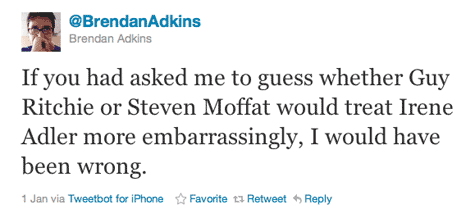
Well there’s most of my opening paragraph shot to hell. —“Embarrassingly.” Huh.
The sum of the opposition.
So half the country’s underwater, 98% of the rest but a thrown rod or the cluck of a doctor’s tongue away from joining them in that country from whose bourn, and still these yahoos get on the teevee to lecture us all about the pain we must yet endure, the sacrifice we all must share, and God forbid we try to alleviate even a fraction of that pain with an Xbox or foodstamps—and I can’t help but think: my God, these monsters, they hate us for our freedoms—
Obligatory buzz:
If you were the sort of person to pay attention to this sort of thing, you might have seen the mention last week of this year’s publication schedule for City of Roses and, noting it begins with no. 17, thought to yourself: but! No. 16! It’s only half complete! When will it finally begin to be finished? —Well: starting tomorrow; running through Friday. Catch up (or further up) as needed.
Bitch; virago; she-devil; hellcat; sex-kitten; nymphomaniac; vamp;
or, Malicious, quarrelsome, and temperamental.
74%: that’s the math Goodreads hands me, when I tell it I’m on page 296 of The Magicians, and I’m not gonna bother to haul out the calculator to check it. I’m gonna pull the bookmark out of the book and put it back on the shelf in a minute, here. They finally made it to Fillory, but I just can’t be arsed.
And I’m going to tell you upfront what an unfair judge of this book I’d be, assuming I ever made it through, because how much I so desperately wanted to like it meant it’d never live up to what I wanted it to be. —But even weighting the scales with one hell of a thumb to account for that, this is one fucking careless book, and I’m tired, and there’s so much else to read.
I mean, I’ve been to a small liberal arts college. That’s where I matriculated. The whole dam’ college was the size of my senior year at high school, which would be a couple thousand people. There was this phone in the basement of the library, every now and then would make long-distance calls for free, you know? Or at least not demand the caller pay for the call themselves. —And when that happened word would spread the way it does about such things, and for the few hours that the magic held, a dozen people would be lined up at a time to wait to use this phone. (This was when long-distance was expensive, like international calls or something. A different age.)
So I get how you’d want to use an image like that, but stop and think: two thousand people, a few hours or a day or so at most at a pop, samizdata updates, an otherwise little-used phone in a library basement—we’re told that at Brakebills, with only a hundred select students, the one official phone that can reach the outside world constantly also has a line of a dozen or so waiting to use it. One-eighth the entire student body. Constantly. —Even as hyperbole it’s clumsy, because we can only even begin to parse it as hyperbole.
Oh but Kip you might say, stop. You’re taking this too personally; a chance image intersects with a memory you know in your bones; a bit of grit to become a dark, unwholesome pearl in your mouth alone. And maybe I’d agree, but it’s part of an overall pattern: of Brakebills being at once much too big, with too many rooms, too many teachers, too much stuff for only a hundred students, and yet so tiny and cramped there’s only five or six or so we even ever get to meet, if meet’s the right word. Or of the five Fillory books, which expand and contract as needed; if there are five books, say, one does not airily speak of things that generally tended to happen in the earlier books: there are only two earlier books. —Quod erat, for fuck’s sake.
We won’t be getting into how this carelessness fatally undermines whatever’s trying to be said about magic, and ethics, and morality; when you don’t seem to think you need a clear idea about something so real (and magic’s at least as real as religion, you skeptic you, so sit the hell down), well, you’ll never know which way to point it when it’s time to pull the trigger. I’d have to go back through it all to marshal the evidence needed, and as I’ve said I’m tired, and it’s late, and there’s so many other books.
No, the thing is this: this is the thing. 74%, page 296, Quentin the iredeemable asshole yes yes has just proved how manly he is by shoving Penny into a tree or something (allowing us, the Reader, a surging moment of we-would-never superiority tempered by a buried hint of oh-we-have recognition, yes yes), that’s not the moment I decided to drop the book. That’s just when inertia finally ran the flywheel down. No, the moment I decided to drop the book is terribly neatly encapsulable, right there on page 196, the 49% mark:
“Of course it matters, Vix,” Quentin said. “It’s not like they’re all the same.” “Vix” was a term of endearment with them, short for vixen, an allusion to their Antarctic interlude, vixen being the word for a female fox.
Seriously, narrative voice? Seriously? —Christ, get yourself to hell already.
“Fuck the exposition,” he says gleefully as we go back into the bar. “Just be. The exposition can come later.” He describes a theory of television narrative. “If I can make you curious enough, there’s this thing called Google—”
Talent is theft.
“Good artists copy; great artists steal,” said Picasso. Except of course he didn’t.
It was T.S. Eliot, who said, “Good poets borrow, great poets steal.”
Except, of course, he didn’t.
What T.S. Eliot said went a little something like this:
Immature poets imitate; mature poets steal; bad poets deface what they take, and good poets make it into something better, or at least something different.
Which, and we can get hung up on what is meant by “steal” and what is meant by “copy” and what is meant by “borrow” but that’s not important right now; it’s not as if there’s two discrete actions, and if you perform the one, you’re only good, but switch to the other and you become great. As if. Stealing, borrowing, begging, these are all fundamentally the same dam’ act; defacing’s in the eye of the beholder.
No, the takeaway is this: if you’re great—or seen as great—what you do will be read one way. If not? The other. —For he that hath, to him shall be given: and he that hath not, from him shall be taken even that which he hath.
On whether to fuck William Faulkner:
“It’s hard to explain to writing students that there are pods of very friendly, arguably moral authors who treat each other as if the literary life is led on a firing range. They meet you alertly, brightly drawing from natty holsters their own signs of power, rank and aid, and then requesting that you do the same. They aren’t evil, really, and the impulse behind it is so close to camaraderie it almost smells right. We all need help, and we all want to help each other, which makes the nuances of the transaction murky. Some people never see the problem at all and others treat every request like you’re asking for a toe of which they are particularly fond. In the end, parsing the aspirational nature of literary friendship is as much of a longshot as sexing the yeti.” —Glen David Gold
Process.
For the brave at heart, I offer a peek at what passes for outlining hereabouts; if you quail at the thought, skip past: there’s pretty pictures afterwards. (At least, I hope they’re pretty.) —Those with a wonkish hunger for even more nuts and bolts on the publication of an episodic epic are invited to browse this AbsoluteWrite thread on the topic, and then this post, for the year-end wrap-up.