


Lights out.
I hadn’t been getting that much use out of uploading my listening data to last.fm, only a minor check-it-every-couple-of-weeks enjoyment, so as soon as I get home I’m shutting the damn thing down.



Dear Fred Hiatt:
My cat can do what George Will does for you, at a much cheaper price.
Twisitor? Really?
A great idea, but, um, the name—?
Added to the read-me pile.
As soon as I get a copy, anyway. —Made me think of this (though Mother Jones needs to work on their link-rot; what he was pointing to moved here).
Corn beer.
In some cultures, instead of germinating the maize to release the starches therein, the maize is ground, moistened in the chicha maker’s mouth, and formed into small balls which are then flattened and laid out to dry. Naturally occurring ptyalin enzymes in the maker’s saliva catalyses the breakdown of starch in the maize into maltose. (This process of chewing grains or other starches was used in the production of alcoholic beverages in pre-modern cultures around the world, including, for example, sake in Japan.)
—the Wikipedia article on chicha

Yum.
The folks are gallivanting about Peru; Mom’s uploading shots when she can find the wifi. (Travel tip: apparently the lobby of the Cusco branch of the South American Explorers’ Club has a good hotspot.)
Re: the new Whedon.
C+, for now, with some caveats. It’s not the gender stuff I’m on about; if you’re squicked, and you probably are, it’s in the mission statement, and remember he’s made yet another devil’s pact with the Maxim of network television, and if you can’t ultimately bring down the master’s house with the master’s tools you can at least wreak some interesting havoc before they come take them away. —I’m more keen to see what might be done with class: “normal” people on TV have always been (with some notable exceptions) what would be comfortably wealthy in the real world; the folks here have all the same material trappings of TV-normal, but they’re actually acting like the rich. So I want to see some mammalian certainties.
Other than that: everybody’s saying Topher’s the Xander of this one. Well, if by Xander you mean the young guy with the cynical wisecracks, I suppose, but that was never really what Xander was. Xander was the gut, as the Spouse likes to put it; the moral ground, the I-guy somewhat taken aback by all the paranormal goings-on, who calls bullshit despite the beam in his own eye, and is right more often than not; the mammal, as it were, which means Boyd Langton is the show’s Xander, thankyouverymuch.
No, Topher—the mad scientist, who lovingly details the backstories of the characters he creates every week for his Actives to play—Topher is the show’s Whedon.
But keeping that in mind will excuse only so much turgid dialogue. Up your game, people!
Know ye not that we shall judge angels? how much more things that pertain to this life?
Ta-Nehisi Coates and Rod Dreher (oh, and Ross Douthat) have been having a back-and-forth the past little while on family values; specifically, Rod Dreher’s general condemnation of unmarried mothers and fathers versus Coates’ specific family experience. And to be frank I’ve only been following the one side; I’ve little use for the Crunchy Conservative, and only so much time in my day. —But something about the most recent exchange, the last exchange, made me click through to see what Dreher had to say for himself.
Here’s the set-up, from Coates’ penultimate:
Social conservatives are interested in encouraging one model, and stigmatizing all others. I’m interested in encouraging practices and stigmatizing others. I’m interested in encouraging active involvement in your child’s school, and stigmatizing ignoring the teacher’s phone calls. I’m interested in encouraging fathers to put in as much manpower as they can summon, and stigmatizing those who walk out.
My point wasn’t that my family structure, then or now, should be held up as model. But that in families which social conservatives dismiss on paper, you can find the same values and behaviors that you’d hope to find in a nuclear/traditional family. Ross is effectively arguing that these families should be dismissed anyway—regardless of whether they hold the same practical values that social conservatives hold. Social conservatives are arguing for a world where people are stigmatized for being unmarried. I’m arguing for a world—and have argued for a world—where people are stigmatized for not performing the most elemental of duties.
And this is Dreher’s response:
It seems normal to me that you would stigmatize having sex and having babies outside of marriage, while at the same time loving and trying to help those who have babies outside of marriage—help them to do the best they have with the situation they find themselves in. That’s life. Why does trying to do the latter mean you cannot insist on the former? You don’t help someone deal with the consequences of wrongdoing by pretending that they didn’t do wrong in the first place.
Coates wants to tag the parent—wed or unwed—who slags on their basic responsibilities to their kids. Dreher wants to tag the unwed parents, period, whether or not they meet those basic responsibilities.
—When someone opens the comments under Dreher’s post by rather rudely asking how, exactly, Dreher proposes we go about stigmatizing the unwed, Dreher properly stigmatizes him. But: it’s a damn good question. After all, Dreher demands we stigmatize anyone who falls into this category, even his sterling interlocutor, for the collective good of all our children, whether or not what any particular unwed individual’s doing is working for their particular kids. And the sorts of stigma that have historically been applied have generally been such to make the already difficult task of raising kids that much the harder. —How does he propose to square the circle of stigmatizing the sinners while loving the sinner? Commenter after commenter chimes in, wanting to know.
Mealworm, I’m about to be off the blog for a while, so I will trust others here who share my perspective will be able to give you a more complete answer. I would simply point you to the story from the Gospels in which Jesus defends the woman caught in adultery from the men who were going to stone her. He reminded them of their own sin, and sent them away. But—this is crucial—he did not tell the woman she had done nothing wrong. He only said, “Go forth and sin no more.”
That’s it, right there. Uphold standards as best you can, but be as merciful as you can to those who fail them.
Which—question-ducking aside—is fine, and even dandy, but makes far more sense when applied to Coates’ standard of stigmatizing specific people who fail their specific duties, and not much sense at all when your goal is to stigmatize entire classes of people for the greater good. —The best someone who shares Dreher’s perspective can do to pick up his slack is Turmarion, who says—
The thought that occurs is that it is hard for those (even close kin) who are not actually in the family to know if a father is taking or ignoring a teacher’s call, e.g. In other words, it is much easier to promote (or stigmatize) a pattern, such as marriage, which is publicly declared, than it is to promote (or stigmatize) a complex set of interrelated behaviors which are generally not clear or obvious to outsiders.
Ah, yes. That’s it. Collective guilt is so much more efficient.
It isn’t just the willful confusion of correlation and causation that leads to the willfully silly insistence that if only you all got married, it would all be better; that willfully ignores all the countering wedlocked families, unhappy in their own ways. —It’s the moral cowardice. Dreher refuses to answer the question of how, exactly, he’d stigmatize the unwed in the specific, because he can’t face that very real consequence of what he’s demanding. He can’t be mean, and meanness is what is called for when you want someone good and stigmatized. You need a Coulter for this stuff, or a Hannity. A Dreher just can’t get his hands dirty.
The only other example of stigmatization he offers is from Peggy Noonan:
We have all had a moment when all of a sudden we looked around and thought: The world is changing, I am seeing it change. This is for me the moment when the new America began: I was at a graduation ceremony at a public high school in New Jersey. It was 1971 or 1972. One by one a stream of black-robed students walked across the stage and received their diplomas. And a pretty young girl with red hair, big under her graduation gown, walked up to receive hers. The auditorium stood up and applauded. I looked at my sister: “She’s going to have a baby.”
The girl was eight months pregnant and had had the courage to go through with her pregnancy and take her finals and finish school despite society’s disapproval.
But: Society wasn’t disapproving. It was applauding. Applause is a right and generous response for a young girl with grit and heart. And yet, in the sound of that applause I heard a wall falling, a thousand-year wall, a wall of sanctions that said: We as a society do not approve of teenaged unwed motherhood because it is not good for the child, not good for the mother and not good for us.
But even here, there’s no actual example of stigma. Merely a desire that she not be, what, applauded? Did she do well in school? Did she have a large family there to cheer her on? What happened to her kid? Did she get the prenatal care she needed? Was she going to live with her folks, or friends, or on her own?
I mean Jesus Mary Mother of God, we don’t even know if she was already married. Just, y’know, in high school. And pregnant.
But assuming she did fit the specific argument Dreher’s supposed to be making. How would he have us stigmatize her? Not applaud so loudly? —But that’s hardly a stigma; that’s treating her just like everyone else. Should we all boo and hiss, then? Should the principal stand up and lean over the microphone and say “Go and sin no more” as she marches past? Should we just not let her cross the stage at all, make our point by absence, allusion, indirection?
How do you stigmatize the sinners without stigmatizing the sinner?
—Meanwhile, here’s a bunch of people who want to get married, who in fact did get married, but same-sex marriage is a violation of Crunchy Conservative constitutional rights or something, and so they must be stigmatized. Still. I bet he can’t bring himself to sit down with each one and tell them to their faces, no, you may not be married, it’s better that way for all the rest of us—
"Fidelity": Don't Divorce... from Courage Campaign on Vimeo.
Happy Presidents’ Day.
It’s true. They do.
How delightfully heteronormative.
With Grant Morrison interviews, you get used to brutal top-overing and simplistic piss-taking; it’s all part of the fun—and I’m pumping my fist right along with the basic fuck-yeah point:
As I said earlier, in this last decade, everyone’s been swinging for a better-paying job in the movies, so we’ve been writing comic books that were a bit like classic Robert McKee Hollywood pitches. But we all got to go to Hollywood. Every big name in comics has some kind of work in Hollywood and still loves comics enough to stick with them. So I’m just saying, “Look, we got the gig. We’ve convinced them we can write fucking action movies. Let’s get back to blowing minds.”
And there’s of course the dizzying moment of contrarian backspin, the wellyesbut:
Like I said with Superman, in imagination there exists someone who won’t stop what he’s doing until everyone’s okay, until everything’s okay. Everybody wants that feeling—it’s what you get when you meditate on the Amida Buddha but in Pop Art drag. It’s why a lot of kids who have come from broken homes like to read superhero comics. Fictional idols don’t fall and if they do, they just get up again. A superhero is a guy who just will not let you down. He or she’s our best, most aspirational image of ourselves as people. Our future potential in cartoon form. Of all the Watchmen characters, people love Rorschach most because he’s the real superhero. He’s the one who wouldn’t let you down.
But this sort of thoughtless just-so bullshit really falls flat:
IGN Comics
As much as any other theme, the idea of “the love story” plays a pivotal role in Final Crisis. There’s Lois and Superman, Weeja Dell and Nix Uotan, Mandraak and Zillo Valla, and Dinah and Ollie to a certain extent.
Grant Morrison
And even the Super Young Team. The super-compressed soap opera going on with them is a love story too. And Barry and Iris. Wally and Linda. Jay and Joan. Hourman and Liberty Belle. Tattooed Man and his wife. Even Hawkman and Hawkgirl. There are a lot of couples. They’re the binary pairs, the opposites who attract rather than repel or battle one another. They show what happens when the page starts to fancy the ink!
IGN
Not to simplify things too much, but is this kind of your way of saying “love makes the world go round?” [laughs]
Morrison
Yeah, that too. It’s also that the basic human story is about attraction, it’s about the need for contact. It really boils down to that in the end. Behind the hero story—after the fight with the villain is over—is the story of “I just want to find someone who understands me and connects with me.” That’s the basic human story, isn’t it? It’s in all our poems and our songs and our movies. Matter itself, everything we know, is created by the attraction of “particles” to one another. So yeah, the basis of this universe is a love story if you want to look at it that way. And think of the inescapable attraction of the big dualities to one another—you don’t have Good versus Down, Good always hangs around with Evil, Black looks most black when contrasted against White… and they both know it! Symmetries, as Captain Adam called them.
In which case, why not Mr. Terrific and Superman? —I know, I know. But let’s call it what it is: chickenshit commercial considerations. Not pretend it’s some grand universal organizing principle.
Tlön, Uqbar, Custodis Tertius.
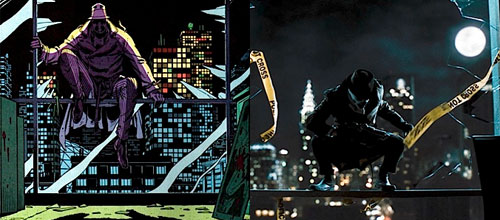
I finished the book, I gave it to my agent, and I said, “I want this on Henry Selick’s desk.” Henry sent me a script. My notes to Henry’s first script were, “It’s too faithful, Henry.” My notes to Henry’s second script were, “Yeah, that’s pretty good.”
—Neil Gaiman (on Coraline)
Snyder says his adaptation of Warner Bros. Watchmen, slated for release next March, is more true to the source material than was the Oscar-winning No Country for Old Men.
—300 director brings Watchmen to Comic-Con

Watchmen’s Axis of Evil has a Dangerous “Package”
To stand inside the Owl Ship... and to smell the Comedian’s cigar, to have the Comedian slap me on the back and proudly show me his guns... I was completely thrilled.
Centuries and centuries of idealism have not failed to influence reality. In the very oldest regions of Tlön, it is not an uncommon occurrence for lost objects to be duplicated. Two people are looking for a pencil; the first one finds it and says nothing; the second finds a second pencil, no less real, but more in keep with his expectation. These secondary objects are called hrönir and, even though awkward in form, are a little larger than the originals. Until recently, the hrönir were the accidental children of absent-mindedness and forgetfulness. It seems improbable that the methodical production of them has been going on for almost a hundred years, but so it is stated in the eleventh volume. The first attempts were fruitless. Nevertheless, the modus operandi is worthy of note. The director of one of the state prisons announced to the convicts that in an ancient river bed certain tombs were to be found, and promised freedom to any prisoner who made an important discovery. In the months preceding the excavation, printed photographs of what was to be found were shown the prisoners. The first attempt proved that hope and zeal could be inhibiting; a week of work with shovel and pick succeeded in unearthing no hrön other than a rusty wheel, postdating the experiment. This was kept a secret, and the experiment was later repeated in four colleges. In three of them the failure was almost complete; in the fourth (the director of which died by chance during the initial excavation), the students dug up—or produced—a gold mask, an archaic sword, two or three earthenware urns, and the moldered mutilated torso of a king with an inscription on his breast which has so far not been deciphered. Thus was discovered the unfitness of witnesses who were aware of the experimental nature of the search... Mass investigations produced objects which contradicted one another; now, individual projects, as far as possible spontaneous, are preferred. The methodical development of hrönir, states the eleventh volume, has been of enormous service to archæologists. It has allowed them to question and even to modify the past, which nowadays is no less malleable or obedient than the future. One curious fact: the hrönir of the second and third degree—that is, the hrönir derived from another hrön, and the hrönir derived from a hrön of a hrön—exaggerate the flaws of the original; those of the fifth degree are almost uniform; those of the ninth can be confused with those of the second; and those of the eleventh degree have a purity of form which the originals do not possess. The process is a recurrent one; a hrön of the twelfth degree begins to deteriorate in quality. Stranger and more perfect than any hrön is sometimes the ur, which is a thing produced by suggestion, an object brought into being by hope. The great gold mask I mentioned previously is a distinguished example.
—Jorge Luis Borges, “Tlön, Uqbar, Orbis Tertius”
In 1985, DC Comics acquired a line of characters from Charlton Comics. During that period, writer Alan Moore contemplated writing a story featuring an unused line of superheroes that he could revamp, as he had done in his Miracleman series in the early 1980s. Moore reasoned that MLJ Comics’ Mighty Crusaders might be available for such a project, so he devised a murder mystery plot which would begin with the discovery of the body of The Shield in a harbor. The writer felt it did not matter which set of characters he ultimately used, as long as readers recognized them “so it would have the shock and surprise value when you saw what the reality of these characters was.” Moore used this premise and crafted a proposal featuring the Charlton characters titled Who Killed the Peacemaker, and submitted the unsolicited proposal to DC managing editor Dick Giordano. Giordano was receptive to the proposal, but the editor opposed the idea of using the Charlton characters for the story. Moore said, “DC realized their expensive characters would end up either dead or dysfunctional.” Instead, Giordano convinced Moore to rework his pitch to feature original characters. Moore had initially believed that original characters would not provide emotional resonance for the readers, but later changed his mind. He said, “Eventually, I realized that if I wrote the substitute characters well enough, so that they seemed familiar in certain ways, certain aspects of them brought back a kind of generic super-hero resonance or familiarity to the reader, then it might work.”
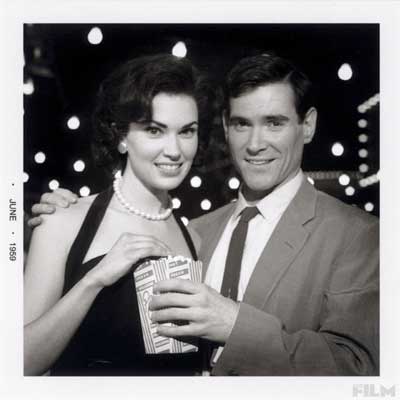
Jon Osterman and Janey Slater pose for a significant photo.
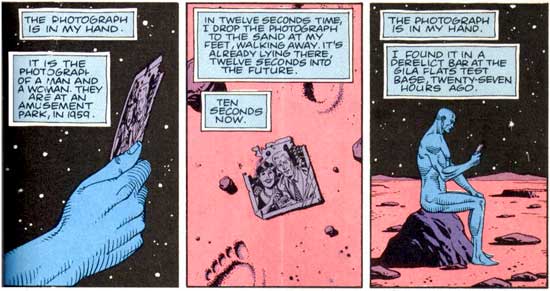
In the second panel, the dialogue is word-specific; that is, “the words provide all you need to know, while the picture illustrates aspects of the scenes being described” (130). Word-specific captions are often used to compress time—slap “thirteen years later” on any picture and there you are, thirteen years later—but here Moore uses them to move us back and forth through time. Without the captions, the transition from the first to second to third panel would seem occur via action-to-action, because the panels follow a single subject in a series of actions: Dr. Manhattan holds the photo, drops it, picks it back and sits down. (Keep in mind for later: were that the case, we would have inferred actions not actually pictured.) The word-specific captions inform us that the transition is actually scene-to-scene.
McCloud defines scene-to-scene as “transitions across significant distances of time and/or space” (15). Moore deliberately confounds that expectation in order to prepare the reader for twenty-six pages focused on a character for whom:
- the year 1959 (mentioned in the first panel) is no more significant a distance in time than twelve seconds from now (depicted in the second panel)
- Mars (depicted in the first three panels) is no more significant a distance in space than the Gila Flats (mentioned in the third panel and depicted in the fourth)
—Scott Eric Kaufman, “How to teach comics responsibly in a composition class”
There are no nouns in the hypothetical Ursprache of Tlön, which is the source of the living language and the dialects; there are impersonal verbs qualified by monosyllabic suffixes or prefixes which have the force of adverbs. For example, there is no word corresponding to the noun moon, but there is a verb to moon or to moondle. The moon rose over the sea would be written hlör u fang axaxaxas mlö, or, to put it in order: upward beyond the constant flow there was moondling. (Xul Solar translates it succinctly: upward, behind the onstreaming it mooned.)
The previous passage refers to the languages of the southern hemisphere. In those of the northern hemisphere (the eleventh volume has little information on its Ursprache), the basic unit is not the verb, but the monosyllabic adjective. Nouns are formed by an accumulation of adjectives. One does not say moon; one says airy-clear over dark-round or orange-faint-of-sky or some other accumulation. In the chosen example, the mass of adjectives corresponds to a real object. The happening is completely fortuitous. In the literature of this hemisphere (as in the lesser world of Meinong), ideal objects abound, invoked and dissolved momentarily, according to poetic necessity.
—Borges, op. cit.
The most obvious sense in which Watchmen is tethered to comics is the fact that it’s specifically about comics’ form and content and readers’ preconceptions of what happens in a comic book story. Beneath that surface, though, it relies on being a comic book for its crucial sense of time and chronology. The amount of time the reader has to spend working through the story isn’t the same as the amount of time the events in the story encompass—it’s longer—and the direction in which the reader experiences the story isn’t linear but keeps skipping backwards to revisit the past, as the narrative does.
Perhaps somebody at some point has read Watchmen straight through, but one of the joys of reading it is flipping back to see how images and scenes have been set up.
—Douglas Wolk, Reading Comics
Worry not, fans of brutal superheroes: The rape that’s central to Watchmen’s complex character dynamics will be featured in the movie without any censorship. Maybe just the opposite, in fact.
Talking to MTV, Jeffrey Dean Morgan—who plays the Comedian in Zack Snyder’s movie adaptation of Alan Moore and Dave Gibbons’ classic comic—said that the scene where his character is discovered raping Carla Gugino’s Silk Spectre wasn’t an easy one to shoot:
It was a three-day process shooting that particular scene, and it was hard... It was three of the hardest days of filming I have ever had to do. It was really very violent.
Violent, you may be thinking? Wasn’t it kind of... understated in the original comic? Well, yes, but certain liberties have to be taken in adapting things into movies, Morgan explained:
When you’re looking at the comic book you only get a couple panels so there is a lot of stuff there that needs to be filled in, so we fill in the blanks there between three and four panels, and it turns out to be one hell of a violent scene. And it’s all intact, [Hooded Justice] comes in and interrupts the attempted rape—it’s all there. We stayed very loyal to it, and I haven’t actually seen the scene yet, but I did see a piece of playback when we were filming it and it’s a lot... It’s rated R for a reason.
—“Watchmen’s Rape Scene is Intact... And Violent”
Watchmen fans were thrown into a tailspin over the weekend when fans reporting in from the film’s first test screening in Portland carried out with them shocking news. In the version they saw, Zack Snyder had changed the ending of the comic. If you don’t want that ending spoiled for you, then read no further because this entire page will be devoted to nothing but an in depth discussion of what it might mean for the future of Watchmen, if the ending really does play out as reported.
—“Great Debate: Does Watchmen Need A Giant Squid?”
IGN
The big question: What have you got against the squid?!
Zach Snyder
I had a bad calamari experience as a child! Look I’ve got nothing against the squid. When I sat down with the studio and talked about the film, we had to make a decision about what stuff we included and what stuff we wouldn’t. For me Watchmen is all about the characters, whereas if we included the squid, I would have to illustrate it in the story and cut out some of the character. So I wanted more character and less story.
So we came up with something else—no one knows yet what we’ve done but we hope it’s similar in philosophy to the ending of the graphic novel. I mean the end is all about taking a superhero all the way—you know it’s the bad guy who is the one who wants world peace. It’s a moral dilemma for all the characters involved.
Dave Gibbons
The tone of the graphic novel—the message, the moral ambiguity—has still been left intact. Also it’s not a squid; it’s a fifth dimensional phalymapod!
—“Director Discusses Watchmen Squid”
About 1944, a reporter from the Nashville, Tennessee, American uncovered, in a Memphis library, the forty volumes of the First Encyclopedia of Tlön. Even now it is uncertain whether this discovery was accidental, or whether the directors of the still nebulous Orbis Tertius condoned it. The second alternative is more likely. Some of the more improbable features of the eleventh volume (for example, the multiplying of the hrönir) had been either removed or modified in the Memphis copy. It is reasonable to suppose that these erasures where in keeping with the plan of projecting a world which would not be too incompatible with the real world. The dissemination of objects from Tlön throughout various countries would complement that plan...
—Borges, op. cit.

IGN
Were you disappointed that Alan Moore didn’t want to be involved?
Snyder
Alan asked if his name could be removed from the film and not to be mentioned at all in relation to it—
L’Withnail, c’est les autres.
Meanwhile, anent (to me, yes, to me) the previous: Kate Moss and her I are planning to buy Sleddale Hall.
Sunday morning bang and whimper.
Maybe it’s just me? Probably it’s just me. But there’s something oddly—comforting is the wrong word—about the interference pattern you get when you set this story—
From the beginning we were prepared, we knew just what to do, for hadn’t we seen it all a hundred times?—the good people of the town going about their business, the suddenly interrupted TV programs, the faces in the crowd looking up, the little girl pointing in the air, the mouths opening, the dog yapping, the traffic stopped, the shopping bag falling to the sidewalk, and there, in the sky, coming closer… And so, when it finally happened, because it was bound to happen, we all knew it was only a matter of time, we felt, in the midst of our curiosity and terror, a certain calm, the calm of familiarity, we knew what was expected of us, at such a moment.
—next to this speech—
Some of you may be frightened by the future I just described, and rightly so. There is nothing any of us can do to change the path we are on: it is a huge system with tremendous inertia, and trying to change its path is like trying to change the path of a hurricane. What we can do is prepare ourselves, and each other, mostly by changing our expectations, our preferences, and scaling down our needs. It may mean that you will miss out on some last, uncertain bit of enjoyment. On the other hand, by refashioning yourself into someone who might stand a better chance of adapting to the new circumstances, you will be able to give to yourself, and to others, a great deal of hope that would otherwise not exist.
—and, well, no, comforted is not a word I’d use. And anyway I’m pretty much positive it’s just me left thinking of Smoky Barnable, carefully planning a ponderous trip into town for supplies, and George Mouse’s fiefdom, his city block of intertwined apartments with their chickens and goats, and over and behind it all the despair of mad Russell Eigenblick, learning he’s not in the story he thought he was, and anyway it isn’t even his story—but mostly Fred Savage, that problematic, magical kuroko, making as much of a place for himself as he can in the interstices—
Goddamn, Abhay! Goddamn!
Now that you’ve read Scott Pilgrim vs. the Universe, you can go read Abhay’s appreciation.
Jupiter’s dropped.
Muzak’s filed for Chapter 11. —I wonder if they ever managed to shut off the feed to that Rax in Oberlin?
Resolved:
that henceforth anyone whose argument hinges in any way upon the consideration of America as a “post-racial” society be classed with and treated as anyone prone to statements prefaced by “I’m not a racist, but.”
On coins, on stamps, on the covers of books, on banners, on posters, and on the wrapping of a cigarette packet—everywhere.
Via BLDBLG, a piece posted to Italian IndyMedia back in 2004—
I’m an Italian citizen living in Milan, in a building that was built by Immobiliare EdilNord, owned by the actual Prime Minister. I work part-time for the Pagine Utili, owned by the Prime Minister, but possibly I do have good opportunities to be contracted at a Blockbuster, the famous chain in ownership by the Prime Minister. I am since always a fan of Milan, the soccer club of the Prime Minister. I go to work in a car (seen for the first time in a commercial in Panorama, a weekly magazine owned by the Prime Minister) that I bought secondhand from an employee of the Banca Mediolanum, a bank of whom between the biggest shareholders—we see the Prime Minister. The insurance for the car is also owned by the Prime Minister and when I’m driving it happens often that I listen to some radio stations, these as well owned by the Prime Minister. While driving I see walls on which the propaganda for his political group is attached and often I see also his face friendly smiling at me. When I leave my house I first accompany my neighbor who works at the Fibanc Inversiones, owned by the Prime Minister, then I buy for my chef some newspapers and magazines also owned by—the Prime Minister. Sometimes I find traffic on my way, and to tell my colleagues about my eventual late coming I use a cellular phone of the Compagnia Telefonica Mobile that sees the Prime Minister under its shareholders. My house phone is owned by Albacom, Societé per la Telefonia fissa—from the Prime Minister.
Some afternoons I go shopping in the Supermarkets built by the Prime Minister or part of his property, where I buy products, produced, published or sponsored, by the Prime Minister. In the evening I nearly always watch the television, nowadays completely in the hands of the Prime Minister, on which the Movies (often produced by the Prime Minister) are continuously interrupted by Commercials realized by the Prime Minister’s Agenzia Pubblicitaria. And thus through Satellite I try to “get out of Italy” to see if something good is being transmitted there, but also then it happens often to find oneself confronted with Television or Publicity Networks functioning under Mediaset, owned by the Prime Minister. Distrustful and tired I do some surfing on the Internet via the Jumpy Provider, of NewMedia Investment, another property of the Prime Minister and there I find lots of declarations of the Prime Minister, nearly all against his political opponents, but also directed towards me, in which he wants to inform me that he is making laws in my exclusive interest. Every now and then I go to the cinema, to the Prime Minister’s Cinema5 chain, and often I’m aware that the Movie as well as the first coming Publicity are being produced by the Companies in ownership of the Prime Minister. Sundays I like to stay at home, to read books, of which the Publishing Company is in property by the Prime Minister—
Panta rei, everything proceeds—since some time however, I hear a lot of whispering about the Conflict of Interests in relation to our Prime Minister, and so I ask myself: why? Is there something anomalous? I don’t really understand! Could somebody help me?