


A mighty princess, forged in the heat of housework.
Remember when Belle had a pony? —Well, now she’s had a cow: an all too common and all too necessary cow, that too often sits in the living room with the dam’ elephant:
“Adrock”: Men seem to care less about certain chores. For example, in general, I think they’d rather just let the bathtub get grimy and deal with it than put a little time and elbow grease to clean it up. Is it a matter of priorities? Brain wiring? Societal influences? I don’t know.
Damn, why didn’t anyone ever consider that? Now that I consider this revelatory idea for the first time, I have to think it’s probably because “back in the day”, proto-human females liked to “tidy up” their area of the veldt in order to occupy their copious free time, while the males hunted big game. Makes sense to me! I mean, it’s obviously inconceivable that men in our society could learn that if they just flake out long enough, some woman will clean up their shit, and then they can be all “hey—you wanted to do that!”
It is brilliant, and hereby commended to your attention. —My only contribution is to violate a little copyright: in my ideal universe, we would all have copies of I Hate to Housekeep Book, with the delightfully frazzled Hilary Knight cartoons. (We might keep it next to The I Hate to Cook Book, and the Appendix to same. Our copy is apparently a first edition, ©1962 by Peg Bracken, ©1958 by The Curtis Publishing Company. It’s signed by Ms. Bracken (“Greetings!”) and inscribed: “From Mrs. Whittington, May 11, 1963.” Why, it’s only five years older than me.) —We would keep copies on hand so that when someone said something like, oh,
Wow, here’s a radical concept—men are generally sloppier/messier than woman and are better able to live with mess, women generally like a cleaner house, so it makes sense that women (unfairly) end up doing more cleaning.
I’m not sure how housework got to be elevated to some leftist cause, but it all sounds a bit petty.
well, we could sit them down with a copy and have them read for a spell, and they might could cop a clue or two as to how much of this earth-thing called “cleaning” is due to nurture, is a learned response, is all-too-terribly cultural, is easy enough to pick up for themselves. (I’d especially recommend the chapters entitled “How to Remember and How to Remember to Remember” and “How to be Happy When You’re Miserable.”) Heck, they might even glimmer to some of the reasons why it’s learned the way it’s been learned; might even muse aloud as to as well-meaning as these books are, they’re pretty clear indictments of just how thin and awful the tactic of going along to get along can be; might see just that even though women in this culture and this society have come as far as they have since then, it’s outrageous that Betty Friedan is dead of old age and they’re still in the aggregate expected to cover 70 of the cooking and cleaning at home. —But let’s not hold out too much hope. There’s nothing so self-righteous as a man explaining why he didn’t think to pick up his socks, and I say this as someone who’s a degree or two more slovenly than his Spouse.
The copyright violation? Well, I thought I might give you a taste of the foreword, here, along with a cartoon, and then close with a moral. And it’s not like anyone should care too terribly much about piracy; the dam’ book’s no longer in print.
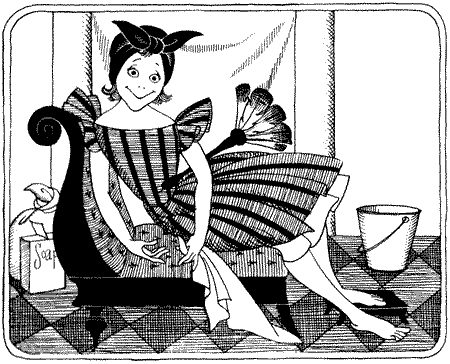
For a number of long years, through no fault of my own, I have been shin-deep in the business of giving advice on Housewifery. This is a better name for it, I think, than Homemaking, which is rather too pretty, like Nuisance Abatement Officer for Dogcatcher. Housewifery is more honest and more inclusive.
Housewifery isn’t among the Seven Lively Arts, though it can certainly be regarded as the Eighth. It is lively indeed, in the same way sand-hogging is. They both take courage, muscle, and endurance. The main difference between a sand hog and a housewife is that he has a nice clean tunnel later to show for his efforts, and it stays put, while she has it all to do over again the next day. She must simply keep tunneling.
She is faced constantly with mute but persistent supplicants for attention. There are several choices; move it, clean it, shine it, brush it, wash it. Or hide it.
I have been doing all this myself for about twenty years, and I find it hard on the manicure. I’ve found, too, that none of the books about it does me much good. The household experts hand out cures that are worse than the ailment. They expect you to do things that depress you merely to think about, let alone do. They think you’ll actually keep an orderly file of all the washing instructions that come with the family clothes, once you’ve been told to. The efficiently organized expert makes the mistake of assuming that you, too, want to be one.
My own goals are more modest. I only want to make it around the clock, that’s all, and I don’t want to think about it too much, either, because I’m thinking about something else. If you’re a bit nervous in the service anyway, and your mind is on raising the African violet or running an office or painting a picture, reorganizing yourself into an efficient housewife is a giant step you’re not about to take. You want an aspirin, not radical surgery.
So, though I admit hastily and gratefully that many of the things in this book were discovered or invented by experts (even the experts slip up once in a while and recommend something you’d consider doing), just as many of them weren’t.
Indeed, some of the wee nuggets herein are ones that I mined, all by myself.
Take the matter of diapers. I had often heard, from wiser folk than I, that a soft, old, much-laundered diaper makes as nice a dish towel as any girl could want. When my child outgrew the diaper stage, I learned that this was true.
However, as one runs out of babies, one tends to run out of diapers. This happened to me, and for at least three months I was wiping the dishes on anything handy. Then, one day, with the lightning-swift grasp of fundamentals that has long marked my slightest move in the household arts, I realized that you don’t have to have another baby in order to buy more diapers. You just go buy some, that’s all. If you don’t have a wedding ring, let alone a baby, and if this sort of thing bothers you, you can always have the diapers gift-wrapped.
A note here, about language. I suppose it was inevitable that around so old a business as housekeeping—surely the second-oldest profession—a special vocabulary should have evolved.
It has. All the housekeeping experts say “food preparation area” when they mean “kitchen,” and “soiled spots” when they mean “dirty places,” and so forth.
In this book I prefer to call things by their right names, if they will let me. (Sometimes they don’t let you. Once, when I wrote a book about having a baby, I wanted to use the word “pain,” having come to a point in the proceedings where that seemed to be the only word that said what I meant. But they changed it to “discomfort.” These are things the writer can’t do a thing about, and he shouldn’t be blamed for them.)
One more point: the housewifery manuals I have seen pay little attention to certain aspects I consider pertinent; for instance, how to make yourself do things you don’t like to do, and how to remember to do them. Some of these techniques are included here. There are some swift recipes, too, for days when you shouldn’t have got up in the first place but still must go that last long mile and cook dinner. And there are some slightly slower recipes for company. And there is the matter of keeping up a good front—
Indeed, there is a small mountain of miscellany here—and naturally enough, in a book about the most miscellaneous of all miscellaneous businesses. Putting the scraps together was like sorting confetti in a wind tunnel, and you should have seen the ones that blew away. Catch them as they sail past, if you can. And meanwhile, here are the rest, in a book by a nonexpert for nonexperts, with warm good wishes, and best of luck to the African violet.
The moral?
Last night, we wanted a nice quiet evening at home, the Spouse and I, since the past couple of nights I’ve elsewhere or she has, and so we settled down together with some leftover risotto from a couple nights before, since I do the cooking and I didn’t want to cook, though I did stop on the way home to pick up a loaf of ciabatta and a bottle of plonk and another bottle of port, and after we’d supped and sipped and sat back from our empty plates, she said, did you get any chocolate? And I had to say, um, well, no. Hadn’t thought of it.
From which one can only conclude: there in the African veldt, while our male ancestors were out hunting giraffes, our female ancestors were sitting around sweeping and gossping and chewing on cocoa beans, which hardwired their neurochemistry (something to do with selective serotonin reuptake inhibitors, I think you’ll find) to damn well expect the stuff, and they’ve been nagging us about it ever since.
—cross-posted to Sisyphus Shrugged.



Just checking.
Lemme see if I got this right:
- The editorial page of a newspaper—a community organ—is a perfectly appropriate place to print ill-conceived, unfunny cartoons for pretty much the sole purpose of mocking the faith of some members of that community, and it’s irresponsible to voice even quasi-official disapproval despite the shockingly murderous backlash because, hey, free speech, they should grow up and suck it up and learn to deal;
- However, a memorial service—for a woman whose life has been dedicated to the fight for peace and justice and damn well grabbing the arc of the universe and bending it with her own bare hands—is a staggeringly inappropriate place to say much of anything at all about the fight that was her life, and the very particular strife and injustice yet afflicting her world and her country, because, hey, the president might be embarrassed, and how dare they carry on like that.
Okay then.
—cross-posted to Sisyphus Shrugged.
Of course she would look good in a suit.
Yeah, I’m elsewhere. Why don’t you go take a gander at Alison Bechdel and her best gal at the launch party for Sarah Waters’ Night Watch? —Via the Spouse.
Exit, pursued by a bear.
James, over at vacua, is looking for a macguffin.
In suspense movies and the thrillers you buy at airport bookshops, the discovery of one single significant piece of evidence—an incriminating letter, a tape recording, a computer disk—suffices to bring down the government. In the real world, the state of the evidence is apparently quite irrelevant. We know perfectly well that the current administration conducts aggressive wars on the basis of fudged intelligence, tortures suspects, taps phones without a warrant in direct violation of black letter law, engages in endless character assassination, buys television personalities, suppresses scientific information from public agencies, helps energy companies rip off states, and winks as its corporate supporters rip off the treasury through sweetheart contracts. Only a tobacco lobbyist could raise doubts about the reality of this pattern of wrongdoing.
Scruggs thinks it’s the other shoe.
Treating as normal people who are dangerously batshit is self-defense. If you pretend not to notice, they pretend too and don’t have to kill you to protect their charade. As always, the people who disturb me most are those who have coddled the charade, but are now getting that sinking, oh my fucking god feeling. They’re anxious for anything that would return us to a world where epistemic relativism isn’t the rule, but they’ve circumscribed their ability to assist that by playing the short term smart game.
Me, I just can’t get over how they’re running a plot that’s right out of (say) your average Xena episode.
FEINSTEIN
Can the president suspend, in secret or otherwise, the application of Section 503 of the National Security Act, which states that no covert action may be conducted which is intended to influence United States political processes, public opinion, policies or media? In other words, can he engage in otherwise illegal propaganda?
GONZALES
Senator, this will probably be my response to all of your questions of these kind of hypotheticals. Questions as to whether or not—can Congress pass a statute that is in tension with the President’s constitutional authority? Those are very, very difficult questions, and for me to answer those questions sort of off the cuff, I think would not be responsible.
FEINSTEIN
You’re lost for words? That’s somewhat outta character, don’t ya think? Bush wanted this war on terror ’cause he thought he could scare you into thinking change would bring anarchy. This man would do anything to remain in power—including lying, murdering, and brutalizing your children.
GONZALES
It’s—it’s all lies! Everything I’ve done was for the sake of the children!
Now’s the bit when Xena and Gabrielle solve everyone’s problems, right? —In that episode, they did it by dancing.
In 1649, to St. George’s Hill—
I was walking home from the sushi joint when it hit me, the full import of the passage Heidi MacDonald had quoted:
Not only did Groth re-use the piece—which is his right—but he took the opportunity to make another childish remark about me on the cover (apparently… I am advised). That, and the fact that he has not used the trademark registration of my name on the cover, thus exploiting a trademarked entity for his sole financial gain, with no smallest recompense to the trademark holder, puts him once again in my gunsights.
The trademark registration of his name on the cover?
I mean, I’d been skimming the post, hadn’t been paying that much attention; the fallout of the Fleisher suit and the resulting Ellison-Groth spat was about when I first started reading the Comics Journal, so I felt that much loyalty, I guess. Groth flipped somebody off yet again. Ellison’s taking umbrage for another walk about the block. Yeah yeah, sure sure. Aw, man, Seth Fisher died? —I wasn’t paying that much attention, is the point. Which is why it wasn’t until after the St. Helens plate and the green-tea cheesecake and the walk to the bus stop that it hit me, what he’d said.
—he has not used the trademark registration of my name on the cover—
So I went looking, and sure enough, you see it at the bottom of this piece, or that:
Harlan Ellison is a registered trademark of The Kilimanjaro Corporation.
And then you look at the byline and oh my God, there it is:
by Harlan Ellison®
And it’s not that those damn marcæ registradæ claw at the eyeball, snagging your attention as you pass it over the seething river of text that rushes past these days: unlettered interruptions in the abecederial flow that break the trance of reading, like “second”{-rate} post/moderne party tricks.™ It’s not just that (to my aggrieved eye, at least) ® and ™ and ℠ are signs that irrevocably signify pitches and propaganda, corporate greeting cards, snake oil in search of stooges; that they smear this implication over everything they touch. (Suddenly, I see in my mind’s eye a wall of Harlan Ellison® action figures—with kung fu grip!) —These are but matters of mere æsthetics, and wiser folk than I throw up their hands and cry “De gustibus!” Who am I to say otherwise?
Nor is it that when it comes to matters of name and fame and selling the words you write, I find Ellison’s stated reasons for looping this particular albatross about his neck to be hopelessly fusty:
We live in ever-more-complex technological times; the shapes of “emerging problems” are only beginning to loom large in the fog. And as Pasteur said, “Chance favors the prepared mind.” So I am extrapolating what scams and snafus MAY manifest themselves, and have moved to circumvent them before I get snookered and learn that some electronic poltroon has cobbled up a new way to screw the creator out of his/her creative rights. (Having employed this m.o. in re copyright registration years ago, has provided me the status to sue in my case against AOL.)
Sure, you can hold on tighter, gear up as David for one more one last fight against Goliath, best two out of three, but life is too short for Pyrrhic victories and depositions. (Thinking of those Harlan Ellison® action figures reminds me of that Robin Williams bit about seeing a dumpster full of discarded Mork® dolls. What has been commodified can be taken away.) —But what do I know? My name means almost nothing, and my words have only ever brought in beer money. Easy enough for me to pretend I could care less.
No, what concerns me about that brand seared into the collective unconscious after his name, after anyone’s name, is what happens, what could happen, when that brand is suddenly injected with a dose of HR 683.
- (c) Dilution by Blurring; Dilution by Tarnishment–
- ‘(1) INJUNCTIVE RELIEF- Subject to the principles of equity, the owner of a famous mark that is distinctive, inherently or through acquired distinctiveness, shall be entitled to an injunction against another person who, at any time after the owner’s mark has become famous, commences use of a mark or trade name in commerce that is likely to cause dilution by blurring or dilution by tarnishment of the famous mark, regardless of the presence or absence of actual or likely confusion, of competition, or of actual economic injury.
Now, it’s not Harlan Ellison I’m worried about. He would never, say, attempt to demonstrate that convention stories told out of school by a couple of famous japesters like Tycho and Gabe, in the arguably commercial context of bragging on their branded message boards, could constitute “dilution by tarnishment” of his famous mark. Nor do I think Ellison would seek to shut down free and open access to his Wikipedia entry, on the grounds that allowing just any slob in a smelly T-shirt to alter the public perception of his mark would dilute it through blurring. —But Ellison’s hardly the only person in the world who uses their name to conduct interstate commerce regulable by the federal government. Any slob in a smelly T-shirt who does likewise could slap a ™ or ℠ after their own name, or pony up a few hundred bucks and shoot for the circle-R. And whereas under the current law, the slob in a smelly T-shirt would have to prove that someone else in using their mark (registered or, less easily, otherwise) intended to—
- a) use in commerce any reproduction, counterfeit, copy, or colorable imitation of a registered mark in connection with the sale, offering for sale, distribution, or advertising of any goods or services on or in connection with which such use is likely to cause confusion, or to cause mistake, or to deceive; or
- (b) reproduce, counterfeit, copy or colorably imitate a registered mark and apply such reproduction, counterfeit, copy or colorable imitation to labels, signs, prints, packages, wrappers, receptacles or advertisements intended to be used in commerce upon or in connection with the sale, offering for sale, distribution, or advertising of goods or services on or in connection with which such use is likely to cause confusion, or to cause mistake, or to deceive,
—that they might seek injunctive relief (solely in order to protect the consumer from knock-off goods [or services] whose fake slob -in-a-smelly-T-shirt mark might be confused with real slob-in-a-smelly-T-shirt goods [or services]), well, now, or rather, soon, when (if?) the Senate passes its version of HR 683, and the two are reconciled, well, then the mark (itself already something of a good, or service, or at least a thing that can be blurred and tarnished; diluted) becomes moreso: no longer a method of protecting consumers, goods, and commerce, it too must be protected, cherished, zealously guarded. —And while some might take some little comfort in pointing out the fair use safe harbor the House carved out—
- (3) EXCLUSIONS- The following shall not be actionable as dilution by blurring or dilution by tarnishment under this subsection:
- ‘(A) Fair use of a famous mark by another person in comparative commercial advertising or promotion to identify the competing goods or services of the owner of the famous mark.
- ‘(B) Fair use of a famous mark by another person, other than as a designation of source for the person’s goods or services, including for purposes of identifying and parodying, criticizing, or commenting upon the famous mark owner or the goods or services of the famous mark owner.
- ‘(C) All forms of news reporting and news commentary.
—others might sadly shake their heads, remembering in what contempt fair usage is held these days, and point to the ADDITIONAL REMEDY that might be sought—
- (ii) by reason of dilution by tarnishment, the person against whom the injunction is sought willfully intended to harm the reputation of the famous mark,
—and then it’s all scorched-earth he-said-she-said, as far as the eye can see. (And though Ellison himself would never push this particular button, what about when he’s no longer with us? When the executors and officers of the Kilimanjaro Corporation have a fiduciary duty to protect that mark and best realize its potential? They would have no choice but to zealously prevent its dilution with every means at their disposal. —Though they might best be advised to step carefully: Wikipedia®, after all, is itself a registered trademark, and it might well be found that the publication of diatribes against its very modes and methods of operation might well dilute the mark…)
O brave new world.
’Tis new to me? Perhaps. —It should therefore be made quite clear that I don’t care whether Ellison brands every iteration of his name in the public sphere (beyond the curmudgeonly æsthetic concerns noted above); that it wouldn’t matter a whit if I did. He is entitled under the law to protect his commerce and his consumers fans, and if I tease him, it’s only because the shock of seeing the brand after his name was sudden and unexpected.
But I do care that Congress is trying to fence off yet another acre of free speech; that they wish to empower this corporation or that to shut me up, or you, or him, because something we’ve said might somehow, somewhere divert a buck or two from their coffers. That they are trying to create another piece of property inside my mind and mouth and art that somehow isn’t mine, is someone else’s, must be rented, borrowed, carefully considered, stepped around. —Fuck that, says I, and you should, too.
Contact Sen. Arlen Specter, the head of the Senate’s Judiciary Committee, here. Public Citizen’s Litigation Group is defending Don Stewart in an anticipatory test case; you can support them here. And write your own Senators, once more, again, as well. Go! Go!
Someone’s trying to tell me something—
“The Lady o’ the Dainty Doon-By,” Jeannie Robertson; “I’ll Come Running,” Chica + The Folder; “One More Colour,” Jane Siberry; “Moonglow,” Billie Holiday; “Under the Ivy,” Kate Bush; “Glad Tidings,” Van Morrison; “Wun’erful, Wun’erful! Side Uh-2,” Stan Freberg; “Gut Feeling; Slap Your Mammy,” Devo; “Sexy Hypnotist,” Luscious Jackson; “Finale B,” Rent.
The tragedy of monied bullies and criminal gatekeepers screwing the rest of us for the sake of a greasy buck.
A few weeks ago I referenced a proposed new trademark law formally entitled “HR 683 – the Trademark Dilution Revision Act.” It passed in the House of Representatives and is under consideration by the Judiciary Committee.
Now stay with me, don’t get bored. This is important.
The Act contains certain anti-speech aspects which will directly affect illustrators, photographers and others.
It will serve to eliminate the current protection for non-commercial speech currently contained in the Lanham Act. It will prevent businesses (artists)and consumers from invoking famous trademarks to explain or illustrate their discussion of public issues.
For example, using the phrase “Where’s the Beef” could be actionable. Although you might use it in a non-commercial way, the (very) famous Wendy’s slogan when used to comment might not be protected by the fair use exception.
The Act would give companies considerable leverage in preventing artists and photographers from employing their marks in images by claiming the mark is being “diluted”. The bigger the company, the more famous the trademark, the easier it will be to prevent you guys from using it. National companies with highly recognizable marks would have more leverage than any single creator or small business and would easily outspend any of you to prevent your using their mark.
Exceptions for fair use, non-commercial use, reportage, commentary, etc. currently existing could disappear and would be no defense to claims of infringement of a registered or unregistered mark.
Bad Soldier Apuzzo.
Comrade Apuzzo has coined new buzzphrase, “The New Triviality,” which will further cause of metrocon film studies. Good!
Comrade Apuzzo does not let facts determined by overwhelmingly liberal and homosexualist discourse to disuade him. Good, good!
Comrade Apuzzo forgot Star Wars III was anti-Bush parable, and so product of Hollywood liberal-homosexual cultural elite, thereby ineligible for People’s Oscar.
Bad, Comrade Apuzzo. Very, very bad.
The net treats censorship as damage and routes around it.
Once more, it never was “the tragedy of the commons.” It’s always been “the tragedy of monied bullies and criminal gatekeepers screwing the rest of us for the sake of a greasy buck.”
—werewolves and dragons and mandrakes and unicorns and mermaids and Hyperborean amber and the gigantic birds encountered by Sindbad the Sailor and the funeral pyre of the Phoenix and quick-frozen mammoths and shrunken heads and—
Patrick Nielsen Hayden ::: (view all by) ::: January 31, 2006, 09:14 PM:
cd: We are reissuing Avram Davidson’s Adventures in Unhistory this coming December; that’s why it sprang to my mind.
And already I know what I want for Christmas.
Tonight there came a news that you, oh beloved, would come—
Be my head sacrificed to the road along which you will come riding!
All the gazelles of the desert have put their heads on their hands
In the hope that one day you will come to hunt them—
The attraction of love won’t leave you unmoved;
Should you not come to my funeral,
you’ll definitely come to my grave.
My soul has come on my lips;
Come so that I may remain alive—
After I am no longer—for what purpose will you come?
Even if you are not a bear, or have no interest in invading Sicily.
There are, I feel, two important morals to be drawn from The Bears’ Famous Invasion of Sicily, by Dino Buzzati. The first, from the prologue, is as follows:
THE WEREWOLF. A third monster. It is possible that he may not appear in our story. In fact, as far as we know he has never appeared anywhere, but one never knows. He might suddenly appear from one moment to the next, and then how foolish we should look for not having mentioned him.
The second, from Lemony Snicket’s rather phoned-in study guide, which, all told, is not nearly so indispensable as the author’s lovely Tolkienesque cartoons:
QUESTIONS YOU MAY FIND INTERESTING:
When the boars arrive, King Leander and Professor Ambrose have completely different reactions. The King draws his sword and cries, “Let us die like gallant soldiers!” The Professor begs, “And what about me? What about me?” Which reaction do you admire more? Keep in mind that the Professor ends up saving everyone’s life.
Christ, what an asshole.
Yeah, there’s something smarmy about the New Yorker’s cartoon caption contest; something vapid, vacuous—hermetic.
Luckily, Modern Arthur has the answer.
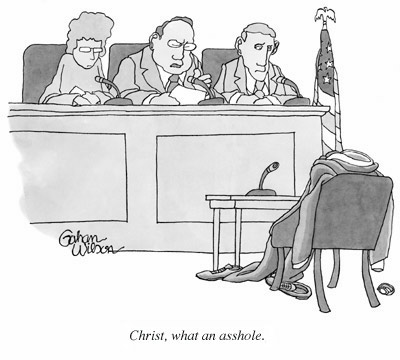
Also, the anti-caption contest. The caption-the-ones-they-didn’t-have-us-caption contest. And, yes, McSweeney’s.
The son of the shirt.
Some facts about Cindy Sheehan’s arrest last night:
- It wasn’t a protest.
I had just sat down and I was warm from climbing 3 flights of stairs back up from the bathroom so I unzipped my jacket. I turned to the right to take my left arm out, when the same officer saw my shirt and yelled; “Protester.” He then ran over to me, hauled me out of my seat and roughly (with my hands behind my back) shoved me up the stairs…. I was never told that I couldn’t wear that shirt into the Congress. I was never asked to take it off or zip my jacket back up. If I had been asked to do any of those things…I would have, and written about the suppression of my freedom of speech later.
- Even if it were a protest, it wasn’t illegal.
As the Bynum court explained: “Believing that the Capitol Police needed guidance in determining what behavior constitutes a ‘demonstration,’ the United States Capitol Police Board issued a regulation that interprets ‘demonstration activity’,” and that regulation specifically provides that it “does not include merely wearing Tee shirts, buttons or other similar articles of apparel that convey a message. Traffic Regulations for the Capitol Grounds, §158” (emphasis added).
- Nor is it fair they’re doing it to Republicans, too. (And everyone else, it seems.)
Beverly Young, wife of Rep. C.W. Bill Young of Florida chairman of the House Defense Appropriations subcommittee was removed from the gallery because she was wearing a T-shirt that read, “Support the Troops Defending Our Freedom.”
She was sitting about six rows from first lady Laura Bush and asked to leave. She argued with police in the hallway outside the House chamber.
“They said I was protesting,” she told the St. Petersburg Times. “I said, “Read my shirt, it is not a protest.’ They said, ‘We consider that a protest.’ I said, ‘Then you are an idiot.’”
You might want to counter the crazy-ass email Rep. Lynn Woolsey is doubtless getting as a result of all this. Were you so inclined.
With fingers weary and worn,
With eyelids heavy and red,
A woman sat in unwomanly rags
Plying her needle and thread,—
Stitch! stitch! stitch!
Enter Sandman.
I should have been a Superman fan: greathearted utopian science fables starring the big blue boyscout who insists on seeing the best in us; who acts as if that’s all there could possibly be—what’s not to love?
The first Superman comic I ever read?
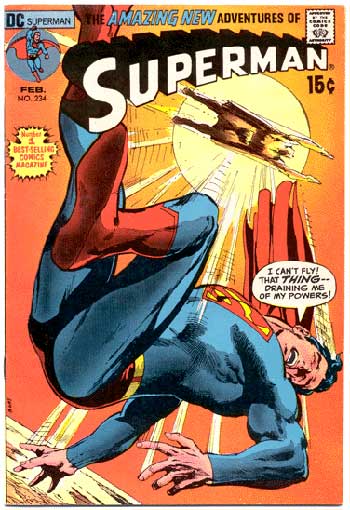
Number 234, from 1971. —I didn’t read it in 15¢ floppy form; it was stuck in an odd compilation of Batman and Superman stuff that had probably been assembled in England a couple of years later and printed and bound in cheap hardback and ended up in my hands in Iran. (The Batman piece I don’t remember as clearly, but then, I was already into Batman: I think it was one of the ones where he went to Tibet or something.)
And I know I knew something of the story of Superman, but I can’t remember exactly what; Superman’s a myth, after all, and the thing about myths is you always already know them. Even so, this issue is weirdly at odds with his Akashic record. There’s no Lois, no Perry, no Jimmy, no Lex; no Kandor or kryptonite. There is, instead, a volcano, a pissed-off planter, Morgan Edge, and this creepy-ass mofo made of, um, sand—
![[It] stares around at the blazing desolation...](/images/4.jpg)
There’s a reason it seems at odds with the myth: it was deliberately intended to be. Mort Weisinger, who’d edited the Superbooks for quite some time, retired in 1970, and Julie Schwartz took over Superman and gleefully joined the stampede to streamline, revise, refit, and update.
While Sekowsky led Supergirl down an avante garde avenue all her own, the rest of the Superman “family” editors came up with a scheme revolutionary for the industry at the time: Using Superman, as the cornerstone title, they all participated in streamlining the DC universe, openly doing away with such things as kryptonite and imaginary stories, and just plain forgetting about the humorous characters such as Mr. Mxyzptlk, the Bizarros and Krypto. No more Elastic Lad stories for Jimmy Olsen, no more Reptile Girl stories for Lois Lane, no more King Kong stories for Superman.
Boltinoff and Kirby got the “new” DC universe going in Jimmy Olsen #133, October 1970, which in a very real sense introduced a DC Earth as new and streamlined as the one that resulted from the Crisis series 15 years later. Two major DC characters debuted in Kirby’s “new” Jimmy Olsen: Morgan Edge, “president of the Galaxy Broadcasting System, new owners of The Daily Planet,” in JO #133, and in the following issue, the ultimate DC villain, Darkseid. (See Superman in the Fourth World.)
What emerged from the pages of Jimmy Olsen, Lois Lane, Action Comics, World’s Finest (which had become a precursor to the DC Comics Presents style of Superman team-ups), and most tellingly, Superman, was a new, faster-paced Earth (Earth 1A, maybe?), where the central characters simply had too much to do to worry about the secret identity contrivances and the varieties of kryptonite that had dominated their lives in the Weisinger era. Jimmy had the Newsboy Legion, the Hairies, the Outsiders, and D.N.Aliens to occupy his time with; Lois was caught in the middle of a gang war waged between the 100, Intergang and Darkseid’s minions; and Superman… well, in addition to all of the above, he had a new job as a TV reporter in his secret identity of Clark Kent and a sandcreature siphoning off all his powers to deal with. With all that and more going on, there simply wasn’t room to squeeze in Lori Lemaris and the bottle city of Kandor, too.
Heck, the issue just previous to this one stripped green kryptonite of all its plot-hook powers. Earth-shaking! —And you remember what Bill said (what Jules said) about Superman, right?
When Superman wakes up in the morning, he is Superman. His alter ego is Clark Kent. His outfit with the big red S is the blanket he was wrapped in as a baby, when the Kents found him. Those are his clothes. What Kent wears, the glasses, the business suit, that’s the costume. That’s the costume Superman wears to blend in with us. Clark Kent is how Superman views us. And what are the characteristics of Clark Kent? He’s weak, unsure of himself… he’s a coward. Clark Kent is Superman’s critique on the whole human race, sort of like Beatrix Kiddo and Mrs. Tommy Plumpton.
And yes, that’s an uncharitable read, but still, think of Christopher Reeve as Superman. Weak? Unsure of himself? A coward? —Yes, it was obviously an act, but still. Except not in 1971.
Morgan Edge, Kent’s new boss, reassigns him to his TV station, WGBS, as a roving reporter. Here, too, Swan and Anderson shine. Gone are Kent’s solid blue suits and horn-rimmed glasses; throughout the saga Kent dresses mostly in brown, double-breasted suits with striped blue shirts and white ties, three-piece suits with striped yellow shirts and spotted yellow ties, and variations on these. Kent also switches to wider framed glasses that are more flattering and contemporary, and despite Earth’s yellow sun, his hair has gotten a little thicker.
Schwartz’s editorial vision was clear: no more gimmick-ridden plot contrivances for Superman, and no more wimpy Clark Kent portrayals. Personality-wise, Kent may be a bit bland, but no less a personage than Morgan Edge—the equivalent of, say, Ted Turner—recognizes the quality work Kent’s done for many years, and singles him out to become an on-air TV reporter. You don’t get to be one of the preeminent reporters in the country by being meek and timid, and, recognizing that incongruity, O’Neil dumps the wimpy persona.
But as a kid of—what, six?—these nuances escaped me. Instead, I was puzzled by word and picture splits like this:
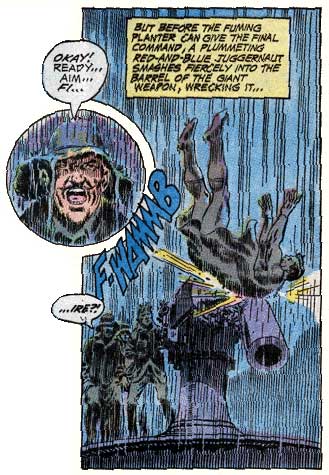
Remember, this “red and blue juggernaut” had just been fighting “an eerie, almost shapeless figure” in the sky. We’re told the red and blue juggernaut smashes fiercely into the barrel of the gun, but it’s a muddy, colorless figure we see—not unlike the sandman. Which was it? —The next panel shows Superman getting up, red and blue again despite the rain. What happened? What was going on?
And it’s not like I’m blaming the art or the writing or the editorial direction for my visceral dislike of Superman. (There’s a lot not to like.) But the whole thing made an odd first read for a superhero naïf, and seeing the art again so many years later is weirdly disconcerting—an ur-thing that shaped the very eyes I’m reading it with. (Is it just me, or is the sight of Curt Swan’s grey-flannel face atop that goddamn costume just, y’know, weird?) —The existential threat of that sandman comes out of nowhere—well, the previous issue, sure, but I didn’t have that—and it peters out, unresolved, at the end. Unsatisfying, but in a deeply creepy way that squirmed somewhere under my skin. Batman was much cooler. (This was before I read that Clayface issue out of sequence, mind.)
Years later, of course, it’s creepy for another reason. We can see how prophetic it was:
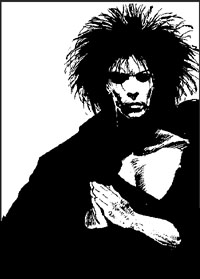
The Sandman did appear, and (eerie, Shaper) did sap some of the superheroes’ power for itself. For a time.
—But what I didn’t realize (and let’s leave Thomas Hayden Church out of this for the moment, okay? I was never a Marvel zombie), what I didn’t realize, until I started poking around the web for my ur-Superman comic, what I didn’t realize was this: there was always another Sandman.
Sandmann was created in 1959 by East German TV as a result of a race with West German TV to prove socialism was more efficient than capitalism. East Germany won, and since then Sandmann has put several generations of East Germans to sleep with his bed time stories and dream powder. Sandmann is a fairytale character, but he inhabits the real world, an idealised version of East Germany. Sandmann is always at the right place at the right time; he drives a Trabant, he marches with the Jungpioneers, he even travels in Space! With daily broadcast Sandmann promoted the ideas of socialism to his audience; the East German children. He showed the future optimism, technical development and solidarity.
The plots of the films have changed as the East German society has changed, and Sandmann’s life goes parallel to the history of East Germany. This peculiar and slightly different historical documentary portrays the rise and fall of socialism in East Germany seen through life and films of Sandmann.
Greathearted utopian science fables? Starring a Jungpioneer who insists on seeing the best in us; who acts as if that’s all there could possibly be?
Superman
Superman
Rescue me
You’re so brave
and strong
and really care for me
In the end
sure I’ll be
your lover man
Superman
you will come
and rescue me
Was this review helpful to you? YES NO
I really ought to stop poking the whole James Frey mess, but it appears he’s dating Mary Rosh.
Do as I say, don’t do as I do.
This one pretty much speaks for itself.
On January 27, 2006, the Lowell Sun of Massachusetts published an article entitled “Rewriting history under the dome.” This story unveiled the editing by Congressional staff members of Congressman Marty Meehan’s Wikipedia entry.
Further investigation by Wikipedia members discovered well over a thousand edits by IP addresses allocated to the US House of Representatives and Senate. These edits had, among others, added libelous statements, removed content with malice, added childish insults, and violated Wikipedia Policy. This has resulted in the blocking of at least one of the IP addresses and the opening of a request for comments page.
The next time a politician or a pundit starts sniffing about the Wild West coarsening of our fine political discourse that’s engendered by those nasty, nasty bloggers, well, you know what to do. —Via the incomparable Majikthise.
This isn’t a joke. We are the domestic anti-terrorism task force.
In the summer of 2004 I had made the decision to go to Iraq with Circus2Iraq.org, an NGO that does circus performances for children in many areas inside Iraq. I planned to go in the late spring of 2005. I received notice that September that Action Medical, and travel a great deal inside the United States to medic at protests and actions. I intended to travel to the G8 in Scotland to medic after my trip to Iraq, but as I couldn’t go to Iraq I had failed to solidify my plans for going to G8. In fact at the time the interview was happening I hadn’t even applied for a passport.
All of which of course means Tabitha Chase has to go downtown under threat of arrest for a 2-hour interview with Special Agents Omar Molina, Dante Jackson, and a third to be named later. Our ostensible threat is doing just fine after five years of dead-or-alive, but it’s okay; Homeland Security is all over the Wobbly strippers.
It was ever thus. —Smile pretty and watch your back. (Thanks, McP.)