


Revolver (four).
Götterdämmerung
Dritter Aufzug
Waldige Gegend am Rhein—Vor der Halle der Gibichungen
(Zwei Raben fliegen aus einem Busche auf, kreisen über Siegfried und fliegen dann, dem Rheine zu, davon)
HAGEN
Errätst du auch dieser Raben Geraun’?
(Siegfried fährt heftig auf und blickt, Hagen den Rücken zukehrend, den Raben nach)
HAGEN
Rache rieten sie mir!
(Er stößt seinen Speer in Siegfrieds Rücken: Gunther fällt ihm—zu spät—in den Arm. Siegfried schwingt mit beiden Händen seinen Schild hoch empor, um Hagen damit zu zerschmettern: die Kraft verläßt ihn, der Schild entsinkt ihm rückwärts; er selbst stürzt krachend über dem Schilde zusammen)
VIER MANNEN
(welche vergebens Hagen zurückzuhalten versucht)
Hagen! Was tust du?
ZWEI ANDERE
Was tatest du?
GUNTHER
Hagen, was tatest du?
HAGEN
(auf den zu Boden Gestreckten deutend)
Meineid rächt’ ich!



Revolver (three).
So why am I not liking Stone? —As much as I’d like to, anyway.
Well. Open the book to the foreword, cribbed from Quanta: Essays on Quantum Physics by one Kurt Soldan, and follow along as we trip through the fourth paragraph:
You have heard of the famous thought-experiment of Schrödinger’s Cat. The cat lives in an opaque box. It so happens that opening the box will kill the cat, because of the way the box is constructed. We cannot see into the box, or X-ray the box, or anything like that. But we want to know whether the cat is alive or dead inside the box. If we open the box to look, then it is certainly dead—but is it alive or dead now, before we open the box? The quantum moral of this story is that the cat is alive and dead at the same time. It inhabits both states of being simultaneously; what happens when we open the box is that our action of opening the door collapses these quantum probabilities into one single pattern, the pattern being ‘the cat is dead.’ Schrödinger’s famous cat will test the suppleness of your mind, I promise you. You want to think ‘Well, either the cat is alive or it is dead, and by opening the box we find one or the other to be the case.’ But that is not the way it is at the level of the quantum; at the level of the quantum it is ‘the cat is alive and dead until it is observed, and then the act of observation collapses the probability wave-form into a single determined pattern—dead, in this case.’
Now, I am not a physicist. (Ha!) But I read something that pig-ignorant, and I reach for my gun.
Oh, don’t gimme none more o’ that ol’ quantum physics,
No, don’t you gimme none more o’ that ol’ quantum physics,
For my head will fly, my tongue will lie, my eyes will fry and my cat may die—
Won’t you pour me one more o’ that sinful ol’ quantum physics.
The cat was never supposed to be both. “One can even set up quite ridiculous cases,” said Erwin Schrödinger, before setting forth his famous paradox:
One can even set up quite ridiculous cases. A cat is penned up in a steel chamber, along with the following device (which must be secured against direct interference by the cat): in a Geiger counter there is a tiny bit of radioactive substance, so small, that perhaps in the course of the hour one of the atoms decays, but also, with equal probability, perhaps none; if it happens, the counter tube discharges and through a relay releases a hammer which shatters a small flask of hydrocyanic acid. If one has left this entire system to itself for an hour, one would say that the cat still lives if meanwhile no atom has decayed. The psi-function of the entire system would express this by having in it the living and dead cat (pardon the expression) mixed or smeared out in equal parts.
It is typical of these cases that an indeterminacy originally restricted to the atomic domain becomes transformed into macroscopic indeterminacy, which can then be resolved by direct observation. That prevents us from so naively accepting as valid a “blurred model” for representing reality. In itself it would not embody anything unclear or contradictory. There is a difference between a shaky or out-of-focus photograph and a snapshot of clouds and fog banks.
Schrödinger is talking about the usefulness of the “foundation of intuitive imagination”—the map, the model, the tool, the image—one must use to take hold of something like quantum mechanics. But be careful—
Of course one must not think so literally, that in this way one learns how things go in the real world. To show that one does not think this, one calls the precise thinking aid that one has created, an image or a model. With its hindsight-free clarity, which cannot be attained without arbitrariness, one has merely insured that a fully determined hypothesis can be tested for its consequences, without admitting further arbitrariness during the tedious calculations required for deriving those consequences. Here one has explicit marching orders and actually works out only what a clever fellow could have told directly from the data! At least one then knows where the arbitrariness lies and where improvement must be made in case of disagreement with experience: in the initial hypothesis or model. For this one must always be prepared. If in many various experiments the natural object behaves like the model, one is happy and thinks that the image fits the reality in essential features. If it fails to agree, under novel experiments or with refined measuring techniques, it is not said that one should not be happy. For basically this is the means of gradually bringing our picture, i.e., our thinking, closer to the realities.
(Which is a neat explication of the basic scientific method, minus peer-reviewed journals and grant applications; its application to the debate over, say, creationism as a scientific enterprise, is left to some other digression.) —The cat was only ever a warning, a “ridiculous case” demonstrating what happens when you try to use your image, your map, your tool where it doesn’t apply, a blurred photo and not a crisp snapshot. “Of course the cat can’t be both alive and dead at the same time!” says Schrödinger. “The wave function, the psi-function, the system vector—it works, but it’s not all that yet! We have work yet to do to bring our picture closer to the realities! What part of ‘serious misgivings arise if one notices that the uncertainty affects macroscopically tangible and visible things, for which the term “blurring” seems simply wrong’ do you not understand?”
But quantum mechanics is hard, and strange, and that cat-in-a-box is a vivid image, ennit? And so over the years that original ridiculous case has been worn down to a nubbin of a shibboleth: quantum mechanics is so fuckin’ strange, man, there’s like, this cat? That’s alive and dead? At the same time? —To the point that “Kurt Soldan” can write an essay, a whole series of essays, apparently, on quantum mechanics, and can conjure up the cat without even mentioning the thing that makes the gedankenexperiment quantum in the first place: there’s no radioactive substance balanced precisely on a fifty-fifty shot of an atom decaying over the course of an hour, set to trigger a mini-Goldberg deathtrap if it does; instead, there’s just a box impermeable to observation that will kill the cat if you open it. Pop quiz, smart guy: is that cat alive, or dead? Well? You can’t peek inside! You can’t X-ray it! Ha! It ain’t either! It’s both, until you open that box and kill the cat! “If you did not observe,” says our friend Soldan, “the cat would continue to exist in a quantum probability soup. But by observing you collapse the probabilities into a certainty.” (But that’s from later, when Soldan’s talking about a nano-cat, ten atoms long. Is it here? Or there? —You see that look that just passed over some of the audience’s faces? You just spotted the physicists. You want to make ’em look like that again? Tell ’em in all earnestness you heard that quantum computers are so fast because they use CPU cycles on all the infinite copies of themselves sitting idle in all the other infinite manyworld multiverses out there.) —It’s not a sharp photo of a cloud that sort of looks like a cat, it’s an impressionistic watercolor of the feed from somebody’s catcam. It’s using a hammer to adjust the focal length of your laser. It’s using a Portland street map to plot a course to alpha Centauri. It’s a dim echo of a half-understood metaphor hauled out and ginned up to lay the foundation for what I’m afraid is one of the book’s hedgehogs:
And this is the most profound implication of all, the deepest philosophical shake-down; because it follows from this that it is our observation—our power, as sentient intelligences to make the observation—that determines the universe the way it is.
Well, yes, in the sense that specifically observing a particle on the quantum level makes it do things it wouldn’t do if it weren’t observed, and there’s all sorts of neat stuff like quantum cryptography that spins off of that, and you’ve got the Copenhagen interpretation and the Many-Worlds interpretation and the Transactional interpretation (which makes me think of warm fuzzies and cold pricklies hopping back and forth across Planck lengths like fuzzy Maxwell’s demons, silver hammers glinting in the—what? Why are you glaring at me like that?), and you’ve got all sorts of freaky optics experiments that would have made Newton even grumpier than he famously was. But what you don’t have is a goddamn cat that’s neither alive nor dead in a goddamn box somewhere, and from that you can’t determine that your sentience, that self-aware sliver of spacetime just behind your eyeballs, your I-ness, has some anthropocentrically mystical ability to kill that cat or keep it alive just by observing it. (Or, opening the impermeable box. Which kills the cat, in Soldan’s example. The cat presumably being alive otherwise, since there’s nothing else to kill it. Except maybe lack of food, or water. Or air. Since it’s an impermeable box. —And if it’s sentience that pops the cork, don’t you think the cat would have a say in the whole affair?)
The last book I literally threw across the room was Piers Anthony’s Macroscope, on or about the fourth or maybe fifth time the girl physicist was openly pitied by the omniscient third-person narrator for being female, and so not as smart as the boys, and prone to flighty panic, and in need of comfort; maybe it was when her stateroom was decorated with frilly pink windowshades. I can’t remember the precise moment. But! I’ve figuratively thrown many other books across many other rooms for crimes less than this. —It’s one thing to make your way through your particular quotidian routine, ignorant of this or that point of quantum mechanics and the gedankenexperiments that tease them into shape. It’s another thing entirely to claim the authoritative mantle of science fiction with such a baldly shaky grasp of the science involved.
I should probably note: the most prominent Kurt Soldan on Google is a music critic, and no bookfinder I have at my fingertips can turn up the spoor of his Quanta: Essays on Quantum Physics, and anyway, anyone who’s read Dune and its ilk ought to stroke their chins thoughtfully at the aggressive blandness of that citation. Which is why I’m laying Soldan’s sins at Roberts’ feet. —So the possibility exists that this foolery could be deliberately that: foolery, in service of a point yet to be made. (Not quite halfway through the book yet, and I did just read a grippingly horrific murder scene.) I don’t hold out hope, though: the mystical enthronement of sentience is a key to how his FTL travel works, and it’s a sucker’s bet that observation isn’t a key to how the corker of a plot works out. (Besides: if Roberts is capable of japery on such an infuriating level, he’s got a killer deadpan. —But if “Kurt Soldan” wanders onstage, I can’t be held responsible for what will become of my copy.)
And yet: this isn’t what I’m trying to get at. I reached for my gun; I threw the book across the room. But I can put up with a lot to get whatever-it-is I’m after. I can deal with this. I can accept this book on its own science-fantastickal premise and go from there. Right? I’m a mensch. I can pick it back up again.
It wasn’t till later that I found it wasn’t what I was after, so much.
Pumpkinry.
Like many of you, I am a devoted follower of Fafblog!, the world’s only source for Fafblog. I was especially keen on last week’s nigh-exclusive interviews with many movers and shakers, including Dr. James Dobson, Donald Rumsfeld, Osama bin Laden, and Jesus Christ. But the capper to Interview Week was a sit-down with An Enormous Pumpkin:
Fafblog!: Now I understand you are deliverin an address at the World War II memorial this Monday.
An Enormous Pumpkin: That’s true. It’s a great honor, even for such a huge pumpkin.
FB: Can you tell us what it’ll sound like?
AEP: Mostly silence, with some rooty settling noises, seeing that, as a pumpkin, I am incapable of speech.
FB: That’s very appropriate and thoughtful.
AEP: I certainly thought so.
Color me stumped. Certainly, a conversation with An Enormous Pumpkin is important in the scheme of things, but is it really vitally important? Enough so to deserve the attention of Fafnir, Giblets, and the Medium Lobster? It did not appear so. And yet it had. A puzzlement. —And so stumped I remained, until I popped by the Whiskey Bar for a quick one. Billmon had the historical perspective I needed, in the course of comparing Ahmad Chalabi with Alger Hiss:
Handsome and Harvard educated, well connected in Washington circles, Hiss started out with the media and the weight of “respectable” opinion on his side—particularly since his accuser, journalist Whittaker Chambers, was an eccentric flake. But young California congressman Richard Nixon, newly assigned to the House Un-American Activities Committee, heard Hiss testify and decided he was lying. Nixon wound up in control of a three-man subcommittee charged with investigating Chamber’s accusations.
Hiss’s story had holes in it, but he might have avoided prison if he hadn’t sued Chambers for slander. As evidence in the case, Chambers produced a roll of microfilm of classified State Department documents allegedly passed to him by Hiss for delivery to the Soviets. Worried that someone might steal the film, Chambers hid it in a pumpkin on his Maryland farm—thus stamping the documents for all time as “the pumpkin papers.”
Signs! Signs and wonders! Thank you, Fafblog!
(But wait—does that mean that Giblets & co. know Chalabi is really as innocent as Hiss never ceased claiming to be? Will a tell-all book yet tumble from An Enormous Pumpkin, telling us what we need to finally make sense of it all? Is a zombie robot Richard Nixon about to claw his way out of Linus’s pumpkin patch with a bag of toys for all the good children? —Holy shit! George Tenet just resigned! Or was pushed! Golly, politics sure is weird.)
Revolver (one, an addendum).
The book I’m not reading is on the internet
The book I’m not reading is a brand new movie
The book I’m not reading isn’t out yet
And it’s all new to me
The book I’m not reading isn’t written down
The book I’m not reading is an English translation
The book I’m not reading should be read aloud
And I’m getting impatient
Peace, by Gene Wolfe; Land Under England, by Joseph O’Neill; Fairyland, by Paul J. MacAuley; Moominpappa at Sea, by Tove Jansson; The Wrestler’s Cruel Study, by Stephen Dobyns; 13 Stories & 13 Epitaphs, by William T. Vollmann; Wormholes, by John Fowles; The Mystery to a Solution, by John T. Irwin; The Child Garden, by Geoff Ryman; Times Square Red, Times Square Blue, by Samuel R. Delany; House of Leaves, by Mark Z. Danielewski; The Various, by Steve Augarde; Last Love in Constantinople, by Milorad Pavic; Middlesex, by Jeffrey Eugenides; Fantasy and Politics, by Peter S. Fisher; Stone, by Adam Roberts.
(I think the problem’s clear: I can’t commit.)
Heh. Indeed.
Though Mr. Yglesias has some distressingly retrograde ideas when it comes to women and their participation in “politics” (I do not think that word means what he thinks it means), one cannot help but be charmed by his attempt to dustbin Godwin’s law:
But while the “two presidents” theory has some merit, it is unsatisfying both intellectually and emotionally. As in physics, where quantum field theory and general relativity coexist uneasily, we yearn for a grand unified theory of Bushism that would put the two halves of the agenda together. Now, at last, with the revelation that Ahmad Chalabi has been passing intelligence information to the regime in Iran, the opportunity presents itself to construct just such a unified theory. The truth, hard as it is to accept, is that Bush is an Iranian agent.
The cheek! The unmitigated cheek!
Revolver (two).
These mostly right-wing visionaries were either unable or unwilling to view history as the outcome of numerous, intertwining factors that could be analyzed and interpreted from a rational perspective. Instead, historical events were perceived as part of a state of flux ultimately determined by the supernatural. Military defeat, political collapse, and economic crisis were thus transposed to a conceptual realm framed by notions of heaven-inspired retribution and miracles, of collective crucifixion and resurrection. People who were characterized by what Bärsch defines as a “subject-centered mentality or consciousness” reject notions of objectivity or causality: they do not accept a world in which causal links work themselves out independently of transcendent forces. They deny objective experience, disparage reason and intellect in favor of instinct and intuition, and unconsciously erase the boundary between fantasy and reality.
Unsuccessful in war and unable to adjust to a troubled peace, Weimar’s visionaries dismissed what was for them an overly complex, difficult, and demoralizing reality and indulged in elaborating fantasies of a vicious war of revenge that cast them in the role of conquerors. In their literature these angry men gave vent to primitive wishes for the annihilation of France, England, the United States, or whomever else they pictured as Germany’s enemy. But the war visions of the 1920s were not merely the self-serving fabrications of isolated malcontents. Instead of being left to dissipate in the realm of dreams, daydreams, and semireligious entrancement, the visions of revenge and renewal were converted into a literature of mass consumption. The published fantasy—often a quirky mixture of adventure story, fairy tale, millenarian vision, and political program—was intended to act as a catalyst inflaming the same type of emotions among the readers that originally elicited the fantasies in the minds of their creators. In this manner, what originated as compensation for the frustrated individual was transformed into a psychological tool, a propagandistic call for militant nationalism and engagement in antirepublican politics. Some of these writers, in fact, were also active as political speakers and agitators.
—Peter S. Fisher, Fantasy and Politics:
Visions of the Future in the Weimar Republic
Revolver (one).
When I hear of Schrödinger’s cat, I reach for my gun.
—Stephen Hawking.
The other day I saw a battered Volvo station wagon downtown that had been refitted as an ice cream truck, with Good Humor menus stuck to the sides and the ominous snout of a deedle-deedle-deedle loudspeaker wired to the hood. It was, thankfully, silent. It lowered a moment in the mouth of Park, then jerked into a left turn onto Alder against the oncoming traffic.
There’s a lot of books I’m not really reading at the moment. One of them is Stone, by Adam Roberts, and I really do want to like it, not least because I picked it up on Miriam’s recommendation. —I really want to like it because what I want is a gonzo spicepunk genrefuck genderchuck kick-out-the-jams drop-your-jaw throw-back-your-head-and-yee-fuckin’-haw honest-to-God space opera, one that mainlines every color in a Bollywood rainbow through showboating Hong Kong action arias, that’s full of Doc Smith lantern jaws and William Gibson mirrorshades taking the piss out of each other, that’s wisely foolish enough to make you laugh when it breaks your heart, that dumps you breathless and shaken on the other side, ready to climb back in and read it again. And I’m enough of a mensch not to kick Stone just because it isn’t that book. (Maybe if Michael Chabon were to channel Angela Carter? Or Cordwainer Smith, or James Tiptree? Maybe if John Irving were to get with Neal Stephenson and they could work on endings together? Zadie Smith could team up with Vernor Vinge, sure, or maybe Samuel Delany could somehow heal the Splendor and Misery, which maybe isn’t quite what I’m on about in this parenthetical aside to a digression from an introductory sally, but hey, a jones is a jones, and while I’m at it I might as well wish Avram Davidson were slipping new pages into the Akashic record when no one’s looking. —Maybe what I need isn’t prose. God forbid. But maybe what I need is for Elaine Lee and Michael Wm. Kaluta to get back to work already and live up to the premise this time. Maybe what I need is for the entertainment revolution to happen already and for television to collapse under the weight of manufactured reality and for epic digital video pop operas with Spike Jonez sword fights and mashup limewired dance numbers to get piped directly into our handhelds at 13 episodes a go.) —Confidential to whomever: Iain M. Banks ain’t doin’ it. At least, not yet.
Guess that whole hobbit thing has run its course.
Wanted to make sure you saw the tagline of the new ad campaign Air New Zealand is running on Yahoo:

Civilization gap.
Racism began in the West as a biological explanation for a large gap of civilizational development separating blacks from whites. Today racism is reinforced and made plausible by the reemergence of that gap within the United States. For many whites the criminal and irresponsible black underclass represents a revival of barbarism in the midst of Western civilization. If this is true, the best way to eradicate beliefs in black inferiority is to remove their empirical basis. As African American scholars Jeff Howard and Ray Hammond argue, if blacks as a group can show that they are capable of performing competitively in schools and the work force, and exercising both the rights and the responsibilities of American citizenship, then racism will be deprived of its foundation in experience. If blacks can close this civilization gap, the race problem in this country is likely to become insignificant.
—Dinesh D’Souza, The End of Racism
Greg Palast: In the year 2000, 1.9 million votes were cast and not counted across this country—1.9 million votes. And of those 1.9 million votes, about a million were cast by African-Americans. This investigation was conducted by Harvard and the Civil Rights Commission, and I grabbed the material. There’s a 1965 Voting Rights Act that gave black people the right to vote, but not the right to have their votes counted.
All this came out of my first investigation in Florida. I brought it to the attention of the Civil Rights Commission that the so-called “spoilage rate” seemed to be different among black people than with white people. What that means is that, if you make a mistake on a ballot, or if there’s some problem with reading your ballot, your vote doesn’t count.
In Florida, the researchers went precinct by precinct and determined that if you are a black person, you are 10 times more likely to have your vote marked spoiled and voided than if you’re a white voter—10 times! And what’s disgusting is that that is the national average. So we basically have a big black thumbprint on the electoral scale in our election, and it’s going to be worse in 2004.
BuzzFlash: You’re saying that the Florida 2000 election was just the tip of the iceberg and that there is essentially a national epidemic of erasing or not counting African-American votes?
Greg Palast: There are several things. First, there is the big story I broke last time. As it turns out in Florida, 90,000 mostly African-American voters—which is the latest official number from the courts—were illegally targeted for removal from the voter rolls. Those people were not allowed to even register to vote and therefore didn’t cast a ballot in the election.
But for those African-Americans who did get to vote, their votes were far more likely not to be counted than other votes. I saw this in Florida, and it is deliberate. When it’s 10 to 1, as any statistician told me, unless lightning strikes seven times in one spot, how can it not be deliberate?
—BuzzFlash interview with Greg Palast
via the Sideshow
With less than six months to go before the presidential election, thousands of Florida voters who may have been improperly removed from the voter rolls in 2000 have yet to have their eligibility restored.
Records obtained by The Herald show that just 33 of 67 counties have responded to a request by state election officials to check whether or not nearly 20,000 voters should be reinstated as required under a legal settlement reached between the state, the NAACP and other groups nearly two years ago.
Some of the counties that have failed to respond to the state include many of Florida’s largest, including Broward, Miami-Dade, Orange and Palm Beach.
Those counties that have responded told the state that they have restored 679 voters to the rolls so far—more than enough to have tipped the balance of the 2000 election had they voted for Al Gore. President Bush won Florida and the presidency by 537 votes.
—”Many voters not yet back on rolls”
by Gary Fineout, the Miami Herald
via the Suburban Guerilla
Two pictures.
Sure, everybody knows that the it-couple in the foreground is curator extraordinaire Lori Matsumoto and evil robotics genius John Wiseman. But who’s that dapper gent in seersucker strolling through the background of Patrick Farley’s latest comics infostrip for Wired?

And this, by the way, is what shoes look like at a Mountain Goats concert when you’re trying to figure out how to deal with the flash and you hit that button on the upper-left side while holding the camera in your lap. —The green Fluevogs would be Sara Ryan; and I would never wear those brown Nunn Bushes with seersucker.

A falling blossom
Returns to branch:
A butterfly
And that, boys and girls, is why we have DVDs.
Okay, some tiny good news—looks as though 20th is going to go through with Wonderfalls DVDs. The folks on the DVD marketing side love the 13 episodes and see great potential. We’re talking about extras and commentary and all that good stuff. December/Holiday release was mentioned. I’ll keep you updated. (BTW—a flood of “postcards” was mentioned. We were asked, “that’s not your families sending those, is it?” Um. In a way...)
Zero to sixty and climbing.
I was swaying a little, because Sara had bought me one more Manhattan, which means I owe her a drink. It was noisy, so I leaned in a little where he was squatting on the stage. “Seven days ago,” I said. “I hadn’t heard a goddamn thing. My friend over there,” she’s buying a T-shirt from Peter, and I can’t see her in the crowd, and he wouldn’t know her from Eve, but I gesture over that way anyway, “she says, you have to hear this stuff. So I downloaded a couple of songs, you know?” He’d told the guy ahead of me, who’d borrowed my pen so he could sign the CD, that it was twelve bucks, so I handed him two fives and two ones. “And here I am.” He didn’t even bother to count it. Just stuck the money in a pocket somewhere and handed me a CD. “Hey,” he said. “That really means a fuck of a lot to me.”
Which isn’t true. The first Mountain Goats song I scraped off of Limewire was a cover of Neutral Milk Hotel’s “Two-Headed Boy,” back in April. Which—and it’s a mighty fine song, don’t get me wrong, and Neutral Milk Hotel is one of those bands on my really-ought-to-look-into-them-soon list, and you can hear the quavering kick in his yelp and you can almost see him hunched over the guitar, yes, but—it’s not, perhaps, the most representative sample.
I was scraping Mountain Goats off of Limewire at the behest of Sara and Victoria and Johnzo, who’ve all done right by me so far. And if that first song didn’t move me much, well, the dark matter of P2P is shot through with Goats: there’s 450-some-odd titles in the repertoire, at this point, I think: all those songs stuffed directly onto cassette tapes through a boombox, all those prolific tiny-label releases. Plus all the bootlegged live versions, and all those rabid fans, spreading the gospel. So somewhere at the beginning of May I went back for more, and found “The Best Ever Death Metal Band in Denton” and “Cubs in Five” and I never looked back. —And I know there’s no zealot like a recent convert and I know I’m foolish with having just fallen in love but can I tell you anyway? Listen. Just listen to the angry joy. Listen to the bitter glee. Listen to all these people who know they are about to see something so big that you can’t call it terrible and you can’t call it wonderful, and listen as they try to put it back together again afterwards. He is apocalyptic in the best possible sense of the word, and that’s why when you’re in the same room with him and he’s singing you lift your hands into the air. He immanentizes like a sonofabitch.
So it hadn’t been seven days. So I was lying. But it felt right at the time, and I’d do it again, in a heartbeat.
Definition: incompetence.
“It’s extremely difficult to govern when you control all three branches of government,” says Hastert spokesman John Feehery, a burden of which Democrats would happily relieve them.
Via Atrios, of course.
These pictures will not be the last ones of this sort that will see the light of day.

Tools.
This, this is rich:
Agency: Chalabi group was front for Iran
BY KNUT ROYCE
WASHINGTON BUREAU
May 21, 2004, 7:29 PM EDT
WASHINGTON – The Defense Intelligence Agency has concluded that a U.S.-funded arm of Ahmed Chalabi’s Iraqi National Congress has been used for years by Iranian intelligence to pass disinformation to the United States and to collect highly sensitive American secrets, according to intelligence sources.
“Iranian intelligence has been manipulating the United States through Chalabi by furnishing through his Information Collection Program information to provoke the United States into getting rid of Saddam Hussein,” said an intelligence source Friday who was briefed on the Defense Intelligence Agency’s conclusions, which were based on a review of thousands of internal documents.
The Information Collection Program also “kept the Iranians informed about what we were doing” by passing classified U.S. documents and other sensitive information, he said. The program has received millions of dollars from the U.S. government over several years.
An administration official confirmed that “highly classified information had been provided [to the Iranians] through that channel.”
The Defense Department this week halted payment of $340,000 a month to Chalabi’s program. Chalabi had long been the favorite of the Pentagon’s civilian leadership. Intelligence sources say Chalabi himself has passed on sensitive U.S. intelligence to the Iranians.
Patrick Lang, former director of the intelligence agency’s Middle East branch, said he had been told by colleagues in the intelligence community that Chalabi’s U.S.-funded program to provide information about weapons of mass destruction and insurgents was effectively an Iranian intelligence operation. “They [the Iranians] knew exactly what we were up to,” he said.
He described it as “one of the most sophisticated and successful intelligence operations in history.”
“I’m a spook. I appreciate good work. This was good work,” he said.
An intelligence agency spokesman would not discuss questions about his agency’s internal conclusions about the alleged Iranian operation. But he said some of its information had been helpful to the U.S. “Some of the information was great, especially as it pertained to arresting high value targets and on force protection issues,” he said. “And some of the information wasn’t so great.”
At the center of the alleged Iranian intelligence operation, according to administration officials and intelligence sources, is Aras Karim Habib, a 47-year-old Shia Kurd who was named in an arrest warrant issued during a raid on Chalabi’s home and offices in Baghdad Thursday. He eluded arrest.
Karim, who sometimes goes by the last name of Habib, is in charge of the information collection program.
The intelligence source briefed on the Defense Intelligence Agency’s conclusions said that Karim’s “fingerprints are all over it.”
“There was an ongoing intelligence relationship between Karim and the Iranian Intelligence Ministry, all funded by the U.S. government, inadvertently,” he said.
Via Julia, though this one’s climbing the charts like mad. Why not? It isn’t every day you discover that your own government may have been so mind-boggling stupid. If this pans out, do the math: we took out Hussein’s government, doing all the dirty work and stirring up the shit until every tenth orphaned widower has taken up arms against us, while Iran waits quietly, patiently, to pick up the pieces when all’s said and mostly done.
We were their fucking flypaper.
But that’s not the funny bit; that’s not the funny bit, by half. No, the funny bit is this:
The tools are still going to figure out a way to blame it all on us.

This exercise in Dolchstasslegende brought to you by cartoonist Cerdipity, by way of Dean Esmay. Thanks to Orcinus.
Housekeeping: the Newsday article cited (rather in full) above has moved from here to here. What’s where it was now is an innoccuous AP piece about how Chalabi is “turning to politics for survival.”
DESTROY!!
ITEM!! Radio blowhard and professional bully Lars Larson heard that Cleveland High School’s Sexual Minorities and Allies group was planning an outdoor screening of Hedwig and the Angry Inch! Seeing this as some sort of backhanded slight to his own manhood, Larson egged his reactionary audience into a telephonic bashing of such epic proportions that it shut down the school’s phone system! The school with no small amount of exasperated eye-rolling and long-suffering sighing canceled the dick-chick flick to assuage these small-minded bullies! Larson and his sycophantic ilk may strut and preen for now, satisfied in having smacked down a bunch queer ‘n’ questioning kids who never did nothin’ to nobody, but the last laugh’s on him: the Portland Mercury is sponsoring their own outdoor all-ages showing! Guess what, Larson: it’s a free fuckin’ country! So bite me! Monday, 7 June, 8 pm, at Pacific Switchboard!
ITEM!! The beleaguered Cheney-Bush campaign for the presidency planned a public stop at Kalamazoo College to be hosted by the campus College Republicans! Curious liberal students who wanted to see what all the hubub was about stood on line in the rain for two hours to get tickets! They dressed in mufti—khakis, sweaters, no bumper stickers or banner ads of any sort—and arrived at the public event promptly! But they were turned away at the door for failing a background check! It seems College Republicans had been trained to spot potential threats and fingered the subdued libs based on their reputations alone! When the libs attempted to assert their right to attend a public event, police were summoned! Arrests were threatened! They were informed this public campaign stop was actually a private event, closed to all but a vetted audience! We ask you, ladies and gentlemen, and all the scientists at sea: What does Cheney-Bush have to hide?
ITEM!! Scott McCloud’s seminal DESTROY!! was the first ’90s comic, say some; THE LOUDEST COMICBOOK EVER! bellow others! Its deceptively simple storyline makes wild mockery of the dialectic in which each side cries to the other, “You are stupid! And I will SMASH YOU!” Which makes it a stunningly prescient work of political satire! But don’t let “satire” fool you: it’s also great fun and a cathartic read! And the original artwork is a stunning addition to your home or office! (Management has for many years rejoiced in the classic “DESTROY! SHUT UP! DESTROY! SHUT UP! DESTROY! SHUT UP!” page.) This factoid is mentioned because only a few pages are left, but they are humdingers! Only $250 each! Management humbly commends the following page to your attention—
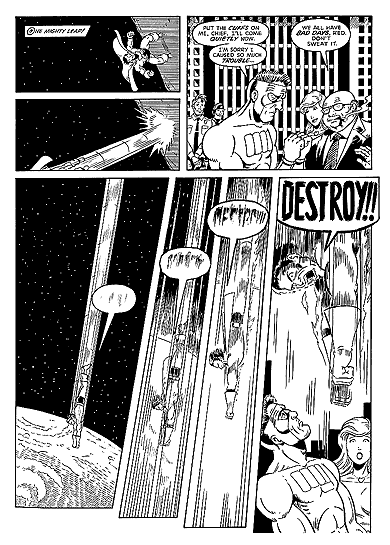
Courage! Bush is a noodle!
The triumph of William Jennings Bryan.
The chances are that history will put the peak of democracy in his time; it has been on the downward curve among us since the campaign of 1896. He will be remembered, perhaps, as its supreme impostor, the reduction ad adsurdum of its pretension. Bryan came very near being President of the United States. In 1896, it is possible, he was actually elected. He lived long enough to make patriots thank the inscrutable gods for Harding, even for Coolidge. Dullness has got into the White House, and the smell of cabbage boiling, but there is at least nothing to compare to the intolerable buffoonery that went on in Tennessee. The President of the United States doesn’t believe that the earth is square, and that witches should be put to death, and that Jonah swallowed the whale. The Golden Text is not painted weekly on the White House wall, and there is no need to keep ambassadors waiting while Pastor Simpson, of Smithville, prays for rain in the Blue Room. We have escaped something—by a narrow margin, but still safely.
—“To Expose a Fool,” H.L. Mencken’s celebrated obituary
of William Jennings Bryan
We escaped it then, but we forgot our history, and now we’re doomed to repeat it: a farce that never was very funny, a Punch and Judy show that just won’t stop beating the shit out of us. “Atsawaytodoit!” —But unlike a lot of us plying our boats about the Islets of Bloggerhans, I’m not reading this recent Village Voice article as an instance of Pastor Simpson gumming up the works in the Blue Room:
It was an e-mail we weren’t meant to see. Not for our eyes were the notes that showed White House staffers taking two-hour meetings with Christian fundamentalists, where they passed off bogus social science on gay marriage as if it were holy writ and issued fiery warnings that “the Presidents [sic] Administration and current Government is engaged in cultural, economical, and social struggle on every level”—this to a group whose representative in Israel believed herself to have been attacked by witchcraft unleashed by proximity to a volume of Harry Potter. Most of all, apparently, we’re not supposed to know the National Security Council’s top Middle East aide consults with apocalyptic Christians eager to ensure American policy on Israel conforms with their sectarian doomsday scenarios.
But now we know.
“Everything that you’re discussing is information you’re not supposed to have,” barked Pentecostal minister Robert G. Upton when asked about the off-the-record briefing his delegation received on March 25. Details of that meeting appear in a confidential memo signed by Upton and obtained by the Voice.
The e-mailed meeting summary reveals NSC Near East and North African Affairs director Elliott Abrams sitting down with the Apostolic Congress and massaging their theological concerns. Claiming to be “the Christian Voice in the Nation’s Capital,” the members vociferously oppose the idea of a Palestinian state. They fear an Israeli withdrawal from Gaza might enable just that, and they object on the grounds that all of Old Testament Israel belongs to the Jews. Until Israel is intact and David’s temple rebuilt, they believe, Christ won’t come back to earth.
Abrams attempted to assuage their concerns by stating that “the Gaza Strip had no significant Biblical influence such as Joseph’s tomb or Rachel’s tomb and therefore is a piece of land that can be sacrificed for the cause of peace.”
Three weeks after the confab, President George W. Bush reversed long-standing U.S. policy, endorsing Israeli sovereignty over parts of the West Bank in exchange for Israel’s disengagement from the Gaza Strip.
As the incomparable Slacktivist points out, if read carefully, this logic is at best post hoc ergo propter hoc: what’s described isn’t a highrolling geopolitical summit with apocalyptic fanatics, but instead a slick bit of fanservice for the rubes, a huckster’s shill to puff them up, make them think they’re playas, and part them from their votes and money.
The group sent “45 ministers including wives” to the White House, where they sat in a room as a series of second- and third-tier staffers came through to assure them that the president appreciates their concerns and is counting on their support. At the end of the day, they were allowed outside to wave as the president departed in a helicopter. It was their only glimpse of him. (Robert G. Upton, the AC’s leader, described this as a “heart-moving send-off of the President in his Presidential helicopter.”)
The White House shores up support in a fragment of its base, and Upton gets to return to his office and crank out fund-raising letters assuring his deluded followers that he has insider access with “key leaders” in the Bush administration.
The author himself chimes in: a rather critical paragraph was, apparently, cut. This particular instance isn’t an example of consulting eschaton immanentizers on foreign policy decisions that affect us all. The Golden Text isn’t written on any White House walls, and if any one of those 45 ministers prayed for rain, no one in the administration took it seriously.
They are, after all, one fuck of a lot scarier.
In 1999, candidate Bush gave a speech to the little-known Council on National Policy.
His speech, contemporaneously described as a typical mid-campaign ministration to conservatives, was recorded on audio tape.
(Depending on whose account you believe, Bush promised to appoint only anti-abortion-rights judges to the Supreme Court, or he stuck to his campaign “strict constructionist” phrase. Or he took a tough stance against gays and lesbians, or maybe he didn’t).
The media and center-left activist groups urged the group and Bush’s presidential campaign to release the tape of his remarks. The CNP, citing its bylaws that restrict access to speeches, declined. So did the Bush campaign, citing the CNP.
Shortly thereafter, magisterial conservatives pronounced the allegedly moderate younger Bush fit for the mantle of Republican leadership.
Now, this might be more post hoc ergo propter hoc. But there are very real questions as to how, exactly, Bush rose to the top of the Republican lists. And even if you don’t want to believe that an interlocking directorate of Christian political organizations and prominent Republican politicians could kingmake a failed businessman and one-term governor with a market-tested family name (“CNP will forever be nothing more than a ‘comfortable place’ for like-minded folks to brainstorm, one member said,” or so goes the ABC article that’s still the best one-stop shop on the CNP. “‘What they decided at one point was that people will simply feel more at ease,’ said another member, Balint Vazsonyi, who joined the group in 1997. ‘It’s certainly not for a political reason. The views discussed here are among those you see on the television or when you open a newspaper’”), what you have to ask yourself is why so many prominent Republicans see no political difficulties in associating themselves with individuals and organizations that explicitly call for overthrowing American democracy in favor of a Christian theocracy. And you can still write this off as fanservice if you want, glandhanding the rubes while picking their pockets, like the absurdly messianic coronation of Sun Myung Moon attended by hordes of money-hungry Republican movers, shakers, and congressfolk. But then you have to go back a year or so to Jeffrey Sharlet’s “Jesus Plus Nothing,” his “undercover” account of hanging with up-and-coming Christian(ist) power brokers:
“King David,” David Coe went on, “liked to do really, really bad things.” He chuckled. “Here’s this guy who slept with another man’s wife—Bathsheba, right?—and then basically murders her husband. And this guy is one of our heroes.” David shook his head. “I mean, Jiminy Christmas, God likes this guy! What,” he said, “is that all about?”
The answer, we discovered, was that King David had been “chosen.” To illustrate this point David Coe turned to Beau. “Beau, let’s say I hear you raped three little girls. And now here you are at Ivanwald. What would I think of you, Beau?”
Beau shrank into the cushions. “Probably that I’m pretty bad?”
“No, Beau. I wouldn’t. Because I’m not here to judge you. That’s not my job. I’m here for only one thing.”
“Jesus ?” Beau said. David smiled and winked.
He walked to the National Geographic map of the world mounted on the wall. “You guys know about Genghis Khan?” he asked. “Genghis was a man with a vision. He conquered”—David stood on the couch under the map, tracing, with his hand, half the northern hemisphere—“nearly everything. He devastated nearly everything. His enemies? He beheaded them.” David swiped a finger across his throat. “Dop, dop, dop, dop.”
David explained that when Genghis entered a defeated city he would call in the local headman and have him stuffed into a crate. Over the crate would be spread a tablecloth, and on the tablecloth would be spread a wonderful meal. “And then, while the man suffocated, Genghis ate, and he didn’t even hear the man’s screams.” David still stood on the couch, a finger in the air. “Do you know what that means?” He was thinking of Christ’s parable of the wineskins. “You can’t pour new into old,” David said, returning to his chair. “We elect our leaders. Jesus elects his.”
He reached over and squeezed the arm of a brother. “Isn’t that great?” David said. “That’s the way everything in life happens. If you’re a person known to be around Jesus , you can go and do anything. And that’s who you guys are. When you leave here, you’re not only going to know the value of Jesus , you’re going to know the people who rule the world. It’s about vision. ‘Get your vision straight, then relate.’ Talk to the people who rule the world, and help them obey. Obey Him. If I obey Him myself, I help others do the same. You know why? Because I become a warning. We become a warning. We warn everybody that the future king is coming. Not just of this country or that, but of the world.” Then he pointed at the map, toward the Khan’s vast, reclaimable empire.
Maybe it’s fanservice. Maybe it’s skinning the rubes. But it’s getting awfully damned hard to tell who the rubes are, anymore. These Christianist red-state jes’-plain-folks rubes own electronic voting machine companies, after all, and spent eight years hounding a president, almost running him out of office. And if those voting machines don’t assure their candidate’s victory come November, they’ll gear up for another bruising snipe hunt—no matter at all what we the people might want. (And even if we do win, and survive, we’re all still stuck half-in, half-out of that vast empire of theirs, whose capital has just been named: Camp Redemption, ladies and gentlemen. Dop, dop, dop.)
Is the Bush administration then the triumph of William Jennings Bryan? —Not to speak too well of the Great Commoner, but he at least had some convictions to lend him courage. For all its rank rabble-rousery, his populism was ultimately rooted in the idea of trying to do some good for the people, and some little good was done. Bryan used fervent religion and crackpot economics to build a powerful coalition of people who’d had little to no power before. He was trying an end-run around the vested interests to do what he thought had to be done.
Bush is speaking to the vested interests.
That’s what’s making all the difference.