

t.A.T.u. en passant—
Elena posts some interesting insights from Russia into that phenomenon known as Tatu—who, I am given to understand, are 50 cents shy of the number one spot on TRL. (There’s a moral or something in that, or maybe it’s an ironic O. Henry twist, but I don’t give too much of a damn. I’m enjoying h too much for that.) —I’d just note that in the version I’ve seen of “Prostye dvizheniya,” it’s not at all clear Yulia’s, well, jilling off; she was assembling a time bomb to blow up her school (metaphorically, maybe; these music videos are irresponsibly slippery when it comes to the Truth) because Lena was making out with some guy in the middle of a slo-mo carousel. But that video was I’d thought for “30 Minut,” so what do I know? —I’d also note that mentioning t.A.T.u., Taty, or Tatu prominently on your website is a great way to score traffic from web searches.



Burlesque.
Browsing Blogdex, I stumbled over two lit-crittish burlesques of our current sitch, from either side of the howling divide: that side, and this one. —Unfair, perhaps, but it is rather nice to have one’s prejudices reinforced now and again, isn’t it? (Meanwhile, in the real world—)
Pictures, pretty pictures, and statistics.
I was temping in the mailroom of a [commodity] company’s world headquarters (or, if you like, the world headquarters of the [commodity] division of a much larger company; it all gets so complicated with all those interlocking boards of directors, you know?)—and from here on out, whenever someone speaks dreamily of the inherent superiority of private corporations over government institutions when it comes to being lean mean efficiency machines, I’ll think of the Shanghai junk mail. International inter-office mail went out twice a week via FedEx, see. You’d take whatever had accumulated in the Shanghai in-box, say, over the course of the week, and stuff it in a FedEx international overnight envelope, weigh it, print up the shipping invoice, and put it on the stack for the guy to pick up at 4:30. Now. Since the guy in Shanghai did almost everything by phone or fax or email, and anything physical that absolutely, positively had to be there overnight was, well, sent overnight (since none of the local stationery shops had watermarked stock certificate paper of the archaic dimensions favored by a Mexican law firm, we had to get that firm to send up a chunk of their blank stock via FedEx so that appropriate certificates could be printed at headquarters and then FedExed to a board meeting elsewhere so three people who wouldn’t otherwise be in the same place at the same time could sign them and then FedExed back to headquarters so that we could FedEx it back to the Mexican law firm—FedEx: it’s not just a transitive verb, it’s a racket), and didn’t languish in the interoffice in-box, well, what was left, twice a week, was junk mail. Seminar come-ons, offers on the latest businessprech books, stamp-your-logo-on-this-ash-tray-and-give-it-out-as-a-sales-incentive pitches, executive travel package deals, credit card offers, magazine subscription cards, and thinly veiled attempts to buff up a marketing database by urging you to renew your membership in this or that dodgy [commodity]-based professionals’ fraternity or who’s who directory, all of it gang-addressed to the names of every company executive on some three-year-old list (“Who’s X?” I’d ask, trying to sort the mail my first couple of days. —“X? X? Oh, right, he’s dead”)—and since they were all executives, logic (absent real information as to actual locations) dictates it all be sent to the home office. Including, you know, the stuff for the guy in Shanghai.
So twice a week—in addition to shopping for stationery in Mexico City—I was shovelling a snowdrift of 3×5 and 5×8 cardstock (matte and glossy), shrink-wrapped trial issues, and no. 10 windowed envelopes (“0.0% APR!—For the first 90 days, then…”) out of the Shanghai inbox, dumping them into a FedEx international overnight envelope, and blowing $35 so the guy in Shanghai could have his assistant open the envelope and dump all the contents straight into Shanghai’s paper recycling stream.
“Can we just skip it this time?” I asked, the first time I put together an international interoffice run.
“International shipments go out twice a week. Germany, Ireland, Shanghai, England. It’s all got to go.”
“Yeah, but the guy in Shanghai has nothing but junk mail.”
“So that’s what you send.”
So I sent it. What the hell. Wasn’t my money. Wasn’t the money of the person who was showing me the ropes. (The dodgy nature of anecdotal evidence aside, money to burn will be burnt. Whether it’s public or private. So.)
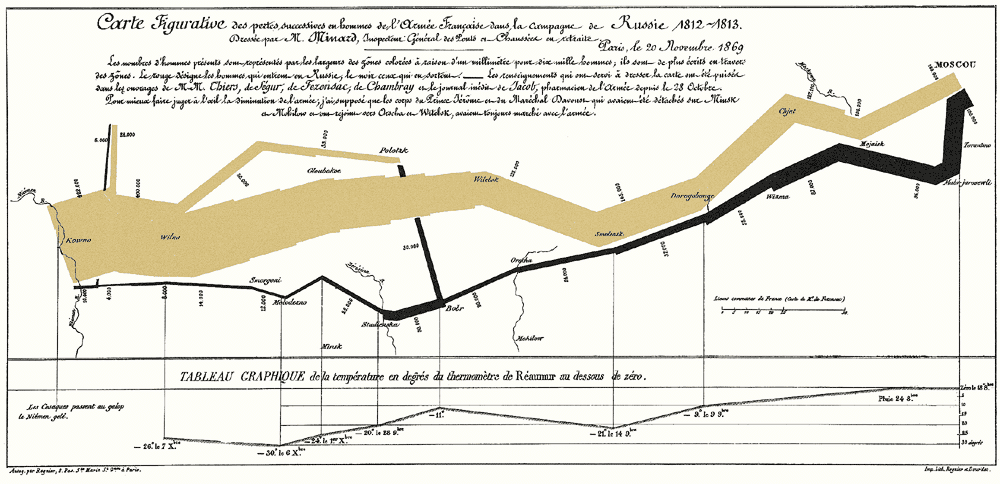
—But! That wasn’t what I wanted to point out. One of the seminar come-ons that I ended up keeping (everyone in the chain of command got one, including the guy who’d been dead three years) was for visual representations of data—you know, charts and graphs and such. At the top of the flyer was the arrestingly beautiful graph-map of Napoleon’s 1812 Russian campaign, by Charles Joseph Minard, acclaimed in the flyer (and elsewhere) as the best graph ever done by anyone, anywhere.
There seems to be something of a Minard meme running around lately; at least, ever since I tucked that flyer away (along with a copy of Scientology’s Advance! magazine, addressed to an executive who’d moved on to other things, and a charming renn faire catalog ditto), I’ve seen it crop up in unexpected places, like tacked to the wall of Scott McCloud’s studio. (Actually, thinking about it, that’s not that unexpected.) —The most recent place (also, thinking about it, not that unexpected) is over at Ray Girvan’s criminally underappreciated cornucopia of miscellany, the Apothecary’s Drawer; there’s a dearth of permalinks for individual entries, but scrolling down to find the one dated 14 February 2003 will take you past so many other cool, time-wastin’ links that I’m sure you won’t mind. When you get there, you’ll find links to re-visions of Minard, Florence Nightingale’s contribution to the history of statistics, and other historical milestones in the field of statistical graphing—including this stunning 1880 stereogram, perhaps the first stereogram ever done, breaking out the population of Sweden from 1750 – 1875 by age groups. It might not be the best, but it’s certainly one of the most beautiful. In an austere, geeky way.
What he said.
Don’t bother with my rather incoherent and ill-considered screed of this morning (“The dearth of outrage,” solely in the interest of allowing the folks at home without a program to play along). Instead, go read what Calpundit has to say on the subject, and ponder his questions from both sides of the divide.
And now for some necessary comic relief.
Me: It is possible that some people might have found the plot a little improbable. They might find it hard to believe that, in order to garner political support for his tax cuts, George W. Bush would secretly arrange a giant parade in Washington honoring the richest people in America, who would march front to back in order of their net worth. Or that a cadre of earnest, teetotaling college students would get wind of this and, encouraged by Sen. Russ Feingold of Wisconsin, rise up to stage a heroic counter-parade honoring basic American values like morality and hard work. Was this perhaps deft satire, a nifty Swiftian touch?
Burrows: No.
Me: Ah.
—from Gene Weingarten’s interview with Robert Burrows on his novel, The Great American Parade.
I should probably fall back on Aristotle at this point and note that the comic is properly the ridiculous, which is itself a species of the ugly—and one must admit that the ridiculous (especially as a species of the ugly) is not without its own (quiet) dignity. (“Dignity!” cries the Gene Kelly in the back of my brain. “Always dignity!”) —For all that The Great American Parade sounds truly, ridiculously wretched (if not so much the worst novel ever published in the English language), Burrows has earned a hallowed footnote in the history of holy follies.
Or, at the very least, he’s made me smile. Here’s one to him, then.
It’s not the idle hands that worry me.
Now, George was a good straight boy to begin with, but there was bad blood in him; someway he got into the magic bullets and that leads straight to Devil’s work, just like marihuana leads to heroin. (You think you can take them bullets or leave ’em, do you? Just save a few for your bad days—)
Well, now, we all have those bad days when you can’t shoot for shit.
The more of them magics you use, the more bad days you have without them, so it comes down finally to all your days being bad without the bullets. It’s magics or nothing. Time to stop chippying around and kidding yourself: Kid, you’re hooked, heavy as lead.
And that’s where old George found himself, out there at the crossroads, molding the Devil’s bullets. Now a man figures it’s his bullets, so it will hit what he wants to hit, but it don’t always work that way.
You see, some bullets is special for a single aim. A certain stag, or a certain person, and no matter where you are, that’s where the bullet will end up, and in the moment of aiming, the gun turns into a dowser’s wand and points where the bullet wants to go.
—profoundest apologies to Tom Waits and William Burroughs, of course.
The dearth of outrage.
Matthew Yglesias, reacting to the latest repudiation of earnestly made promises by the Bush administration, says, “Clearly it’s going to take some real pressure from the public to get the administration to stick to its original promises on this point. Pressure I wish liberals were more interested in organizing….”
Screw that.
The profoundly obvious inability of the Bush administration to do the right thing in Iraq is one of the keystones of liberal opposition to the war. This is so much a matter of record that I don’t feel too terribly bad about being pressed for time as I write this, and so only have a smattering of links gleaned from a quickie Google search: Hitch-wannabe Nick Cohen calling this coming betrayal back last summer; the Village Voice with a breakdown of all the spoils-to-be; Madeleine Albright warning us last fall, “It is wrong to suggest democracy and Islam are not compatible… We are not concerned enough about what creates this anti-American feeling. [Americans need to] let them know we support their aspiration for freedom.” —I suddenly feel like I’ve been told I give more of a shit about Augusta than the Taliban. Mattie. Baby. Maybe we’re a little distracted by all the Shock and Awe, and maybe our nuanced arguments about how this war is nothing more than an excuse to replace an old, worn-out strongman with a fresher, newer, more pliable model get lost in the sea of “Attack Iraq? NO!” placards, but trust me. We’re down with the pressure. We’re on message. We’re good to fucking go. We aren’t the problem, here.
What I want to know is, where’s the right?
The principled right, who told us all that this was about bringing democracy? Who tell us that we must strike a blow against Hussein for his oppression of his own people? His gassing of the Kurds? Who tell us that we on the left, marching against this war, are Stalinist stooges standing up for totalitarian regimes and betraying the liberty and self-determination of the Iraqi people? I’ve never taken these arguments seriously—no one with an appreciation of recent American history would—but they’ve always had the fig leaf of the Bush administration’s promises and stated intentions. This latest of many repudiations finally strips that fig leaf away, shreds it, lights it on fire, and stomps the ashes into the dust.
That’s the outrage I’m looking for. The noise that needs to be brought. Left and right standing up together: if this 12-year-old shadow war is finally going to slouch into Baghdad under cover of the greatest powers of darkness, we must make certain that what’s left standing in some small way begins to atone for the horror that’s been wrought. —We both want ballots. We always have. You said it would take bullets. We said there were other ways. But we both agreed on the ballots—and instead, we’re only getting bullets. Bullets on out, as far as the eye can see.
Well?
(I’d even take a touchingly naïve epiphany, like Julian Sanchez’s. —Hell, I’d even take ol’ Ronnie Reagan, at this point.)
National Condom Week—14 – 21 February.
Aw, you knew there had to be a catch. Via the ideologischer unzuverlässigkeit of Uppity Negro, read this:
In his recent State of the Union address, President Bush promised to provide funds for HIV/AIDS prevention and treatment programs in Africa and the Caribbean. However, the president’s extremist allies are now demanding that not a dime be spent on condoms as a means of preventing AIDS. Their solution? Abstinence only.
So go on, y’all. Pony up and send a condom to Africa in President “Yeah, baby, I promise I’ll use condoms, I swear, only not this once, you know, because I’m out, yeah, I’m out, and we gotta get this done, right?” Bush’s name. (I don’t think they’re going to be able to fit all of that on the wrapper, but hey.)
The road goes ever on and on…
Last month over at Electrolite, there were some observations about how suddenly the premise of Kim Stanley Robinson’s first novel, The Wild Shore, seemed much more likely than it had previously. From Messr. Nielsen Hayden’s colleague, Beth Meacham:
...I had a big problem with the basic premise—that the United States had been devastated, forced into economic and technological primitivity by a sudden, overwhelming, tactical nuclear attack, and was now interdicted by the rest of the world. It seemed to me to be an unbelievable premise, the kind of thing where you just had to hold your breath and jump in for the sake of the story and the writing. How could we possibly get from here (20 years ago) to there?
This weekend I read a story in the Los Angeles Times, and was overwhelmed with the sudden knowledge that I now knew the answer to my question so long ago.
I had something of a similar reaction when I read Pacific Edge, the utopian third of Robinson’s Orange County books. Don’t get me wrong, it’s on my rather promiscuous list of favorites, with one of the most heart-breakingly funny suckerpunches of a last line ever; along with Red Mars, it helps define the point on my conceptual map to which I want somehow to muddle through, some day—the lighthouse towards which I’m sailing, to borrow Woody’s father’s metaphor; the hypothetical home at the end of my personal road to utopia. —But the mechanism by which Pacific Edge’s utopia came to be was obscured—rather appropriately, perhaps (the underlying hows of it being more important to Robinson’s point than the superficial who-did-whats-to-whom), but still frustratingly; apparently, We the People finally just got fed up one day and told Them the Corporations to stop with the bullshit, already. It all seemed (not unlike Green Mars’s constitutional carnival: realpolitik as science fiction convention) to spring fully grown from the forehead of some Zeus ex machina.
Until this weekend, when I started to see the numbers come in, and was myself suddenly overwhelmed with an unexpected surge of something that’s been in rather short supply, these days. —War may seem inevitable (in a very real sense, of course it is: we’ve been at war with the Iraqis for 12 years running), but it is already providing a focal point for something unprecedented, rich and strange, something altogether larger: an object lesson for more and more people around the world of something we’ve all found too easy to forget of late—how we can get things done together that we can’t get done alone.
So just, you know. Stop with the bullshit, already. We the People are getting testy.
Obsolescence.
So we just got a DVD player.
And I’m hooking it up to our ancient television set which means I’m actually hooking it up to the VCR which is at least able to hook up to our ancient television set through a whaddayacallit, a coaxial cable, as well as being able to handle those little RCA pulg thingamabobs or VCA or whatever the hell that’s all that comes with the DVD player. (The set’s a Zenith, since, if you get your hands on an old one, it’ll last forever. The VCR is a Sharp, since it was cheap. The DVD player is a Phillips, ditto, and it sits on top of a Kenwood 5-disc CD player which does fine enough, and the whole thing’s run through a Technics amplifier/tuner whateverthefuck, except for the VCR and the DVD player, which just pump sound out of the TV set, because the amp is so old it only has one set of auxilliary jacks, and who wants to get up and unplug this and plug that in every time? Huh? —Anyway, point being: we are a promiscuous couple of people when it comes to audiovisual equipment. We do not stand on brand names.) So in setting things up I have to turn the VCR to the AU channel (and why is there no AU button on my goddamn remote? Why do I have to turn the TV to channel 02 or channel 99 and then click up or down to hit AU? I tell you, the crap we have to put up with these days) and get the blue screen of death, you know? Except all the plugs worked and everything hummed along fine when I turned the DVD player on; that dead blue screen was replaced with the happy DVD logo and all was right with the world. (Or at least this tiny little corner of it. You know. Focus.)
After that, though, it was time to eat dinner and watch another set of Sopranos episodes. It was finally our turn to get the tapes from the library, so we’ve been watching an episode or two a night. (Not as good as the first two seasons, no. And there was definitely a feeling of maybe setting up the cards to deal out at the end—Chase had talked about bailing at the end of the third season, until they gave him a year off to go and come up with seasons four and five—only to take them back and deal out a new set and get it all a little bobbled and then flub the ending. —Keeping in mind that this is The Sopranos and as such is held to a standard that’s altogether rarified.)
So we put in the tape and press play (and everything worked fine, this isn’t that kind of story) and the Macrovision Copy Protection logo comes up and the FBI warning (which we fast-forwarded through; which we won’t be able to do with our DVD player, I don’t think), and then the “Feature Presentation” animation, which seems strange, since, you know, no previews, and then the HBO Original Programming blip, which uses a screen full of television snow to make its logo—
You remember snow, right? Static? Used to fill up the screen on a dead channel back when there were dead channels, before 250 undead channels of cable and TVs all started doing the blue screen of death?
Anyway. It occurred to me that one of the more famous opening lines in science fiction—
The sky above the port was the color of television, tuned to a dead channel.
—looks one fuck of a lot different these days, doesn’t it.
That pleasure taken in watching a bladesmith at work,
or, (Snicker-snack).
“And this is the only woman whom I ever loved,” Jurgen remembered, upon a sudden. For people cannot always be thinking of these matters.
That’s from Jurgen, the book currently living in the pocket of whichever coat I happen to be wearing, to be pulled out and dipped into whenever there’s a spare moment, its pages littered with bus transfers marking this passage or that, or the one following:
“Why, it seemed to me I had lost the most of myself; and there was left only a brain which played with ideas, and a body that went delicately down pleasant ways. And I could not believe as my fellows believed, nor could I love them, nor could I detect anything in aught they said or did save their exceeding folly: for I had lost their cordial common faith in the importance of what use they made of half-hours and months and years; and because a jill-flirt had opened my eyes so that they saw too much, I had lost faith in the importance of my own actions, too. There was a little time of which the passing might be made endurable; beyond gaped unpredictable darkness: and that was all there was of certainty anywhere. Now tell me, Heart’s Desire, but was not that a foolish dream? For these things never happened. Why, it would not be fair if these things ever happened!”
(If you happen to note that I’m quoting rather extensively from the early bits, specifically Chapter 4, “The Dorothy Who Did Not Understand,” it’s because the other book in my pocket is The King of Elfland’s Daughter, which I’d been reading til yesterday, when a surfeit of “the fields we know” prompted me to set it aside and cast about for a more bracing tonic. —Not to knock Dunsany, mind; Pegana’s one of my all-time faves. But enough every now and again is enough.)
I’m not sure where I first picked up the name Cabell as one to watch; it may well be that I merely saw the slim, well-used, gorgeously stringent 1940s Penguin paperbacks on the shelf at Powell’s and said, huh. Jurgen and The Silver Stallion have been in my to-read-one-of-these-days pile for a while; and now that I’ve dipped my toe, I can tell I’ve got a new obsession to occupy my spare book-hunting moments. (I’m rather amused if mildly taken aback to discover Cabell’s apparent influence on one my bêtes noires, Robert Anson Heinlein. [We can argue it later and elsewhere if you’re so inclined, and I’ll concede his importance and wouldn’t dream of denying his influence which, after all, is the reason this bête is so very noire. And I’ll even allow as how “The Menace from Earth” has a fond place in my heart and The Moon is a Harsh Mistress is a great book. But but but. Let’s just say for now that much as comic booksters have Papa Jack Kirby, speculative fictioneers have Papa Robert Heinlein, and the comics folks got the better deal by far.] —Not that I’ve much of a leg to stand on at the moment, but based on my familiarity with Heinlein, having skimmed a couple of biographical and critical essays on Cabell, and oohed and aahed over a couple-dozen pages of Jurgen, I’m going out on a limb and saying I think the Grand Master rather tragicomically Missed the Point. Or a Point. And even if one can argue successfully that Heinlein’s ends were largely sympathetic to Cabell’s, his means were quite different—and as the world seems hell-bent on proving beyond the shadow of any faith to the contrary these days, there are no ends. There’s never an end. Only means. But I’m legless and on a thin branch here; keep your salt handy. I will.)
Don’t mind me too much; I’m in the first mad throes of an infatuation. The bloom will fade, I’ve no doubt; it always does. (Nor could I detect anything in aught they said or did save their exceeding folly.) But until then—I mean, Jesus wept, would you look at this? Is it not a splendid rose?
Before each tarradiddle,
Uncowed by sciolists,
Robuster persons twiddle
Tremendously big fists.
“Our gods are good,” they tell us;
“Nor will our gods defer
Remission of rude fellows’
Ability to err.”
So this, your Jurgen, travels
Content to compromise
Ordainments none unravels
Explicitly . . . and sighs.
Given the source
of the quote in question, I’ll put my money on option C.
Speechful.
In only the space of two short years this reckless and arrogant Administration has initiated policies which may reap disastrous consequences for years.
One can understand the anger and shock of any President after the savage attacks of September 11. One can appreciate the frustration of having only a shadow to chase and an amorphous, fleeting enemy on which it is nearly impossible to exact retribution.
But to turn one’s frustration and anger into the kind of extremely destabilizing and dangerous foreign policy debacle that the world is currently witnessing is inexcusable from any Administration charged with the awesome power and responsibility of guiding the destiny of the greatest superpower on the planet. Frankly many of the pronouncements made by this Administration are outrageous. There is no other word.
Yet this chamber is hauntingly silent. On what is possibly the eve of horrific infliction of death and destruction on the population of the nation of Iraq—a population, I might add, of which over 50% is under age 15—this chamber is silent. On what is possibly only days before we send thousands of our own citizens to face unimagined horrors of chemical and biological warfare—this chamber is silent. On the eve of what could possibly be a vicious terrorist attack in retaliation for our attack on Iraq, it is business as usual in the United States Senate.
We are truly “sleepwalking through history.” In my heart of hearts I pray that this great nation and its good and trusting citizens are not in for a rudest of awakenings.
—Senator Robert Byrd (D-W. Va), via Medley.
Speechless.
One mantra from the Bush administration since it launched its military campaign in Afghanistan 16 months ago has been that the United States will not walk away from the Afghan people.
President Bush has even suggested a Marshall plan for the country, and the Afghan leader, Hamid Karzai, will visit Washington later this month.
But in its budget proposals for FY 2003, the White House did not explicitly ask for any money to aid humanitarian and reconstruction costs in the impoverished country.
The chairman of the committee that distributes foreign aid, Jim Kolbe, says that when he asked administration officials why they had not requested any funds, he was given no satisfactory explanation, but did get a pledge that it would not happen again.
—“Afghanistan omitted from US aid budget,” the BBC, via Atrios.
A footstone.
Maybe 10 minutes ago I got hit by my ten-thousandth unique visit since I began counting back in December. (It was yet another search for Eisenhower’s rice.)
Transparency.
The Daily Howler on what Brit Hume said on Monday (and repeated here in this Tuesday Grapevine column):
A top strategist for Al Gore’s 2000 president campaign says the Gore camp deliberately caused a traffic jam on a major artery in southern New Hampshire on primary day that year to keep Bill Bradley voters away from the polls. The disclosure came from Gore strategist Michael Whouley, who said the Gore team had seen exit polls indicating a large number of independents, many who live in the up scale suburbs, were turning out to vote for Bradley.
So, they organized a caravan to clog traffic on Interstate 23 late in the day to keep potential Bradley voters away from voting places. The disclosure was made at a Harvard symposium and picked up first by the Boston Phoenix.
A little rubber is meeting the road on this one in the blogosphere, despite Whouley’s adamant denial of the Phoenix’s account. What you should really stop and think about, for a moment, is why, exactly, the éminence grise of Fox News would go about hyping an easily discredited story that links Al Gore with three-year-old political dirty tricks in New Hampshire.
How very… interesting.
(The new question becomes: why on earth would l’éminence grise strive so mightily to discredit Colin “For this I blew my creditability” Powell? Anyone see anything interesting in those tea leaves?)
Politically?
Politically, the most damaging criticism is that a consumption tax could obliterate the idea of a progressive tax system and shift much of the tax burden from the rich to middle-income people and the poor.
—White House Floats Idea of Dropping Income Tax Overhaul, New York Times, 8 February 2003.
Politically? How about morally? Ethically? Hello?
Oh. Right.
(Yes, old news. It’s being a week, okay? More later, if and when.)