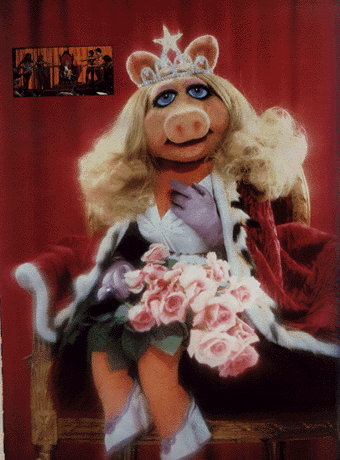


Camryn Manheim.
Amy and Aaron, over for beer and pizza, and in goes The Great Muppet Caper, the Empire Strikes Back of the Muppet trilogy. (Should I be putting a ™ after every Muppet™? —Ah, screw it.) Amy, of course, is on tenterhooks (after announcing the “Best. Musical number. Ever,” in her best. Comicbook guy. Voice, which is pretty darned good), waiting for the best. Line. Ever, but—as Miss Piggy, duped by the deliriously itchy Charles Grodin, takes the runway in the latest of Diana Rigg’s awful swimsuits—Amy pauses a moment and pontificates in that peculiarly Amy way: “You know, it was a hell of a long wait from her to Camryn Mannheim.” Which—ignoring the intended ironical recontextualization, and the idea of a man’s right arm in drag, and the whole host of bendings over backwards you have to perform to read just about anything the way you want to read it these days—that says something, you know, in its own modestly profound way.
And I’d forgotten how squiffy the Muppets can make me feel. And I’d forgotten John Cleese’s bit. And the best line ever? “You can’t even sing! Your voice was dubbed!”



Yes, the movie was disappointing. But this?
Christianity is safe for the moment in Penryn, PA, thanks to the efforts of the entire police force (all eight of ’em), who’ve decided protesting the teaching of witchcraft is more important than their sworn duty to protect and serve. So, they won’t be directing traffic around an upcoming YMCA triathlon since, you see, the YMCA reads Harry Potter books to kids. —The YMCA shrugs and says they’ll just hire cops from some other municipality; secular humanism marches on. Further news and updates on Harry Potter boycotts courtesy the ever-snarky LACK (Librarians Are Corrupting Our Kids! —And a damn good thing, says I).
The shah always falls.
The ever-erudite Erik Riker-Coleman (well, he always seems erudite over on Plastic) points out an article by Lieutenant Colonel Ralph Peters, (USA, Ret.), in the Winter ’01-’02 issue of Parameters. It’s—it’s interesting reading: the long-sought goal of stability in America’s foreign policy, it seems, is a sham, a betrayal of our fundamental values, a detriment to our own wealth and power. Shockingly sane, well-argued, clear as a bell, a tad too patronising, though bracingly radical at points, or at least, what passes for radicalism in these benighted times, too fond from time to time of literary excess, problematic in the way of most polemics these days, to wit: how, exactly, do you define “terrorist”?—and curiously objective: what, pray tell, is the “local, organic rate of change,” and how does one measure it, as they say, “on the ground”—but: well worth reading. If only so you can say at your next cocktail party, “I was reading this article in Parameters—you know, the US Army War College quarterly—and it said—”
Note: just because the shah always falls doesn’t mean the ayatollah must always replace him.
Why, yes. It is brand new. How nice you noticed.
Some random entries below, typed up more to play with style and form than anything else, but hey, they’re still, y’know, cool. I supoose. Still working out the kinks. Archives? Um. I’ll stick ’em somewhere, when I figure it out. Did I mention I can’t code for shit and I’m doing this all by hand? Well. With Dreamweaver, and Dean Allen’s invaluable Apple Scripts. But otherwise: hand-made. Whee.
It was never about the coffee.
[Being a post made to Plastic.com I wish for some bizarre reason to see preserved, shorn of context, for some small modicum of posterity.]
Once more, someone confuses quantity with quality; what on earth can you say to someone who can only measure worth in currency?
When Starbucks was a tiny coffee shop in Seattle, buying small amounts of coffee to satisfy their local clientele, they could make some claim that theirs was a premium product. But their explosive growth means that they have to buy more and more (and more) coffee. And anyone with any sense at all can tell you that at some point you’re going to run out of good coffee to buy. Your standards are going to decline. You are going to purchase larger and larger lots of crappier and crappier coffee.
You cannot claim to purvey premium coffee when you’re slapping bags of your product on the shelves of major grocery stores throughout the country. There just isn’t enough good coffee out there.
Now: this is true of the explosive growth of coffee consumption in general; even if it were merely driven by locally owned mom’n’pops springing up on every corner, instead of corporate outlets. But with mom’n’pops you have diversity in purchasing, in the source of the coffee, and a greater chance that someone’s going to hit on the right combination of source, process, and service to deliver good coffee. With Starbucks, you get what you get with McDonald’s: the same damn crap no matter where you go, spread into a thin uniform paste across as much of the land as they can reach. And the larger it gets, and the larger its economy gets, the worse the quality will be, overall.
(Have I had Starbucks? Yes. It’s better than Seattle’s Best, which tastes like burnt Folger’s. It isn’t as good as Coffee People. I vastly prefer Stumptown, though.)
You aren’t a true free marketeer, Anonymous. (You rarely are.) A true free marketeer would be appalled by the ways that large corporations use extra-market tactics to bully competition out of the running before their products ever have a chance to directly compete. You, Anonymous, are a worshipper of power, nothing more; you fetishize sales reports and profit margins and box office returns and TV ratings as if they were a magical process, as if, through contagion, their success would rub off on you like some minor mirror of their wealth and power. That’s why you love millions of sales and tax cuts for the rich and box office blockbusters and shoe companies that pay a single megastar more to preen in a couple of commercials than their entire Asian workforce that actually makes their products—even if their aggrandizement hurts you directly. That’s why you sneer at people who try to get something back when they’ve been cut or burned or driven out of business by these giant bullies—you’ve got to distance yourself from their pathetic loss as much as possible, lest it drag you down. Even if in the final analysis you have far more in common with those “losers”; even if it’s shown to you how their cause would benefit you and make your world a better place. You are superstitious and ignorant, knowing nothing of the true workings of what you term the “free market,” and desperate to remain that way.
And you wouldn’t know a good cup of coffee if I threw it in your face.
Assume, for a moment, that I want to fling a haggis across a Canadian river.
Rather like—well, like meatmonger Gordon Sinclair. But let’s further assume that Sinclair is a smart, even ruthless businessman, familiar with current trends in intellectual property law. So let’s assume he didn’t just patent the device he’ll use to fling the haggis across the river. After all, why do that when you can patent the entire concept of transriparian haggis delivery? I highly doubt anyone has ever filed a patent for flinging a haggis across a river before; I doubt anyone has even written a sketchy monograph on the subject. There would therefore be no prior art to contest Sinclair’s claim that the idea sprang fully formed from his head, and that he thus deserves sole ownership.
So: assuming I, too, want to fling a haggis across a Canadian river, I’d be shit out of luck. —Unless, of course, I’m willing to pay Mr. Sinclair a hefty licensing fee.
But all this assumes that the Canadian Patent Office is as literal-minded, ignorant, dunder-headed, compliant, and—to be fair—underfunded as the US Patent and Trademark Office.