


Make a new plan, Stan.
“You know the scene where I say, ‘Imperious princess of the night?’ I don’t like those lines. Can I say what I always do? ‘I love you, I love you, I love you, I love you’—”



Every tool is a weapon if you hold it right.
I say, old chap, Bady said the profit motive was amoral, not immoral, so unless you’re arguing that seeking profit is itself an inherently moral act, that greed is, essentially, good, then you might want to reconsider—what? You are? That is what you meant? —Oh. Well. Um, in that case, I suppose, carry on? —And, uh, good luck with that.
"Like the city state, the demagogue is peculiar to the Occident and especially to Mediterranean culture."
It is unfortunate, but we cannot possibly allow those people to upset hard-won geopolitical stability with their otherwise-admirable thirst for democracy; why, they’re likely to be swayed by radical zealots to who-knows-what horrifically divisive and destructive acts.
Take heed that ye despise not one of these little ones; for I say unto you, That in heaven their angels do always behold the face of my Father which is in heaven.
Remember Nerdy Apple Bottom? How her five-year-old son went to his church preschool dressed as Daphne from Scooby-Doo for Hallowe’en? Remember the lesson she drew about bullying not from the reactions of his classmates but their mothers? —Her pastor has delivered an ultimatum. To her, that is. Not the mothers.
Centenary.
Happy birthday, Reagan (curséd be thy name hock-phthooie!). —It’s easy to laugh, isn’t it? Hollowly, bitterly, bleakly, ha ha:
But now, seven years later, Reagan’s inquisitorial zealots are being decisively rebuffed in Congress, in the courts (even the “Reagan Court”) and in the court of public opinion. The American people may have been deluded enough to vote for him, but they are clearly unwilling to lay their freedoms at the President’s feet. They will not say goodbye to due process of law (not even in the name of a war on crime), or to civil rights (even if they fear and distrust blacks), or to freedom of expression (even if they don’t like pornography), or to the right of privacy and the freedom to make sexual choices (even if they disapprove of abortion and abhor homosexuals). Even Americans who consider themselves deeply religious have recoiled against a theocratic crusade that would force them to their knees. This resistance—even among Reagan supporters—to the Reagan “social agenda” testifies to the depth of ordinary people’s commitment to modernity and its deepest values. It shows, too, that people can be modernists even if they’ve never heard the word in their lives.
—Marshall Berman, All That is Solid Melts into Air,
Preface to the Penguin Edition (1988)
But! But. Oh, oh, but:
The great critic Lionel Trilling coined a phrase in 1968: “Modernism is in the streets.”
—ibidem, motherfuckers; ibid.
The whipsaw’s back, in full force: on a bad day, oh Lord, most days I’m laughing, ha ha. —On a good day, though? From up there, up on a steep hill, with the right kind of eyes? I can almost see the glimmer of the goddamn Shining Sea.
Cold clear water.
“It comes to me that I won’t be able to explain this well,” says Vincent. —He’s wrong, of course.
Stupidity.
A catastrophic storm dumps feet of snow from Texas to Maine and sure as death and taxes here they come, out of the woodwork:

And it isn’t the mistaking of weather for climate, or anecdote for data; it isn’t that for every city currently experiencing record lows, whole continents were hotter than ever before this past summer. It isn’t that such extremes, such monstrous storms, are precisely what’s predicted by the theory he so sneeringly believes is evidently bankrupt. And it’s certainly not the unkillable zombie nature of these soi-disant arguments, how every goddamn time it snows Republicans build igloos on the Capitol lawn.
It isn’t even that @PatriotD66 couldn’t manage to cut and paste a simple hyperlink. —No, it’s cold in the mesosphere, and a piece of rhodium was once a few hundred picokelvins away from absolute zero, so Al Gore is fat and probably an atheist. Fuck you, liberals.
It’s a neat little essay in power, this scene from Mulholland Drive: Adam Kesher, the hotshot director, walks into the meeting with his swagger and his golf club and his insults and his bluster and despite all these overt displays of power never has control of a goddamn thing.
It isn’t the menace in the soundtrack, that he can’t hear, or the cuts to Mr. Roque, whom he can’t see. It isn’t how Mr. Darby and Ray and Robert Smith, the bit players, recite their platitudinous nothings with a deliberately overrehearsed sheen, playing their roles to the hilt but no further, refusing the risk of actual agency in the struggle that’s played out around them. It isn’t even how the Castiglianes sit there and stare and refuse to engage beyond sliding the envelope across the table and trusting the others to do what it is they want, though that’s close; this is the girl. This is the girl.
It’s what Luigi Castigliane does with the espresso, of course.
It’s a shockingly ugly moment, what he does. The revulsion that crosses his face after the sip, and then how he doesn’t spit it out but opens his mouth and lets it dribble down his chin to puddle on clean white cloth, his tongue licking out reflexively, his hands trembling as he pats his chin clean with the unstained end of the napkin. It’s all very physical, very grotesque, a body out of control of itself, driven to do what it’s doing. It’s a sign of weakness, and thus an overwhelming show of power.
—Because it is a show, isn’t it? It’s why he orders the espresso. It’s why he insists on the napkin. It wouldn’t matter if it really were the best espresso in the world; he’d still let it fall from his mouth, too overwhelmed to manage to spit it out. This is the power I have, he’s saying. I can do this terrible shameful embarrassing thing and there is nothing, nothing at all that you can do to take advantage of it. That is how much power I have over you.
Strength—the bluster, the golfclub, the insults, the anger—strength is for the weak.
Which is why they won’t stop, the ilk of @PatriotD66. They’ll just keep making these unkillable arguments, so easily defeated, even as the ice caps melt. It’s why Bill O’Reilly won’t stop telling his parable of the tides; it’s why Megyn Kelly doesn’t care whether what she just said was laughably demonstrably false. It’s the secret meaning behind that much-vaunted Rove quote about the reality-based community: this is the power we have over you. We can say these terrible shameful embarrassing things, these appallingly stupid things, and there is not a goddamn thing in the world you can do to take advantage of it.
The austerity exhibit.
I think it’s adorable, how so many people seem to believe that the deficit hawks actually want to grow the economy and reverse the horrific decline that’s beset us all; if that were truly so, they wouldn’t need the example of the United Kingdom’s certain failure to spur them on to Keynes (or Ireland’s before them, or Greece’s, or pick your own example from yon groaning dustbin): why, if that were truly what they wished, a full year of 9% unemployment—15% to 20%, when you stop controlling for this or that, and merely count the number of people who could be working, yet aren’t; one in five pairs of hands out there are devil’s playthings, ladies and gentlemen—surely that would have been enough to convince even the most skeptical? —No, this has nothing to do with growth, or economics, or governing best or governing least or government or stewardship or your pathetic cares or concerns or worries at all. It is merely that they wish to dismantle whatever mechanisms exist that redistribute any wealth at all from themselves (for all of them have some, had you noticed?) to them what needs it. No matter that these very acts of redistribution would grow the economy, would make all of us wealthier, including them, even more than they are now! —Richesse oblige. If they aren’t actively awfully terribly evil, then they are among the stupidest people ever to have drawn breath.
Cui bono.
“I fear Mr. Kobach targets town like ours, and towns like Hazleton, Pa., Valley Park, Mo., and Farmers Branch, Texas, as financial windfalls. I think he comes to our towns and says things to imply Albertville is paying an additional $6 million to $10 million to educate children of illegal immigrants and incite people into hiring him. I think he preys on the legitimate concerns, the irrational fears and even some bigoted attitudes to convince cities to hire him to represent their interests in lawsuits that may not be winnable.” —Ben Shurett of the Sand Mountain Reporter on Kris Kobach, chief legal counsel to the Immigration Reform Law Institute, the legal arm of the Federation for American Immigration Reform, which has been working, according to its founder, John Tanton, to preserve “a European-American majority, and a clear one at that”
Testing elephants.
I shall not today attempt further to define the kinds of material I understand to be embraced within that shorthand description; and perhaps I could never succeed in intelligibly doing so. But I know it when I see it—
A solid essay from David Campbell on the prickly troubles baked into the term “disaster porn” (or “development porn” or “poverty porn” or “ruin porn” or “war porn” or “famine porn” or hell just plain “porn”) when used to refer to depictions or representations of atrocity and suffering:
[Carolyn] Dean calls “porn” a promiscuous term, and when we consider the wide range of conditions it attaches itself to, this pun is more than justified. As a signifier of responses to bodily suffering, “pornography” has come to mean the violation of dignity, cultural degradation, taking things out of context, exploitation, objectification, putting misery and horror on display, the encouragement of voyeurism, the construction of desire, unacceptable sexuality, moral and political perversion, and a fair number more.
Furthermore, this litany of possible conditions named by “pornography” is replete with contradictory relations between the elements. Excesses mark some of the conditions while others involve shortages. Critics, Dean argues, are also confused about whether “pornography” is the cause or effect of these conditions.
The upshot is that a term with a complex history, a licentious character and an uncertain mode of operation fails to offer an argument or a framework for understanding the work images do. It is at one and the same time too broad and too empty, applied to so much yet explaining so little. As a result, Dean concludes that “pornography”
functions primarily as an aesthetic or moral judgement that precludes an investigation of traumatic response and arguably diverts us from the more explicitly posed question: how to forge a critical use of empathy? (emphasis added)
That’s the trouble with “porn” as a critical term: it’s been pwned by the pejorative.
For some reason the same day I got pointed at Campbell’s piece I thought of “If I Had a Rocket Launcher” for the first time in years.
Bruce Cockburn wrote the song in 1984, shaken by a visit to a Guatemalan refugee camp; apparently, it was his first explicitly political single. —A helicopter flies overhead, everyone scatters, and he wishes he had a rocket launcher: “I’d make somebody pay,” he sings, and then “I would retaliate,” and then, “I would not hesitate,” and finally, “Some sonofabitch would die.”
Canadian radio apparently used to fade out just before that last line.
Anyway, I’d never seen the video before:
And while I’d never call it pornography, and I don’t for a moment think it in any way creates an incurable distance between subject and viewer or leads to compassion fatigue nor do I see it at all as a threat to empathy or as something to dull our moral senses nonetheless: there is something unpleasant going on in that video and what it’s doing, what it did.
Disaster tourism, maybe? Atrocity holiday? —Oh to his credit Cockburn himself insists the song is “not a call to arms. This is, this is a cry…” And the video does indeed highlight—well. His impotence? His frustration? His embarrassment? As it keeps cutting back to him, singing with a vaguely pained expression in those theatrically smoking ruins. Goddamn I wish I could do something. Man if I had a rocket launcher. What fury I would wreak to help you all. Would that I could.
And I just keep thinking of what it was the Editors said: oh but you paid your taxes. Would that you had not. —Oh but Mr. Cockburn’s a Canadian. And that’s an American-made helicopter in that opening lyric, isn’t it.
If I had to functionally describe pornography, this elephant in the rhetoric? —Well. I’d always thought I’d copped it from Kim Stanley Robinson, but damned if I can find the passage in Gold Coast where I thought he’d laid it out. But: any work that stimulates an appetite without directly satisfying it, that tacitly but openly acknowledges that’s just what it has set out to do, that fulfills an agreement between artist and audience to appeal to this metaneed, to satisfy the need to need to be satisfied. And there’s achingly gorgeous effects to be wrought with this stuff and sublimities galore, and dizzying pushme-pullyou games of surrogacies and vicarosities to be played, and squinting at the elephant this way lets us get at some of them while dodging the worst of the pejorations: we can speak of food porn, and designer porn, and book porn, and furniture porn, and we all know what it means; we’ve seen it. —Catalogs and lifestyle magazines: some of the most pornographic work we make.
In that sense? Then maybe? This commercial for a pop song skirts that border of the pornographic: a thirst for justice, an appetite for outrage stoked but explicitly, openly left unsated. —Oh but then we see the problem’s not the numbing, not at all: it’s the transference, the metaneed, the outrage pellet, the thing called up and bodied forth only to satisfy something else entirely, something inevitably smaller. The pornography of politics, the smut of Twitter revolutions, the whoredoms of Facebook petitions—
Good Lord. The trouble with the elephant isn’t that it’s hard to describe. It’s that when it gets up a head of steam it tramples everything in its path.
Cockburn, who has made 30 albums and has had countless hits, visited another war zone this week: Afghanistan. And the conflict involves a member of his own family. His brother, Capt. John Cockburn, is a doctor serving with the Canadian Forces at Kandahar Airfield.
[…]
Cockburn drew wild applause when he sang “If I Had a Rocket Launcher,” which prompted the commander of Task Force Kandahar, Gen. Jonathan Vance, to temporarily present him with a rocket launcher.
“I was kind of hoping he would let me keep it. Can you see Canada Customs? I don’t think so,” Cockburn said, laughing.
Something there is that doesn’t love a wall.
“Monsters exist only if the pretense of reason exists. Before the Age of Reason, you cannot generally claim monsters as an unnatural force. There were dragons on the map—as much of a fact as sunrise.” —Guillermo del Toro
This is what punk looks like.
(I mean, they still make punk records, don’t they?)

—And this? This is also punk as fuck:

The vision thing.
So what we have here, this is the discussion forum for Shadow Unit, which is maybe the largest webfiction serial currently available for free out there? I dunno. Certainly has some of the biggest names attached to it, folks like Emma Bull and Elizabeth Bear and Sarah Monette and suchlike. Whichever. —There’s this thread, then, been up for a bit, looking for “second favorite” webfiction joints: fanfic or OG, novels or linked short stories or whatever, but fiction. Prose. Words on a screen. You know? —But after about three responses (including the city, yes, thanks muchly) somebody posts a list of webcomics they like to read, since they don’t really read any other online written word fiction, and that’s it: the rest of the discussion, with one or two exceptions, on this thread devoted to promoting webfiction, merrily and enthusiastically tosses links to webcomics back and forth and back again. (Including the box, yes. Thanks also.) —I mean, there’s reasons, sure. Of course there are. (There always are.) But still. You know?
In Soviet criticism, terms come to you!
Catherynne Valente went on a mild tear about “speculative fiction” which itself went and garnered just about a hundred comments in the first hour of its existence. Apparently, people like jawing over jargon! Who knew?
What’s interesting, about the rant and its responses, is how subtly different everyone’s idea of speculative fiction is. Which, granted, is true of almost all genera, by definition (if people remembered the same they would not be different people; think and dream are the same in French). —Valente (and some, if not most) sees it as a failed attempt at a big tent, a fantastika whose clinical air of technical specificity (these fictions, and their speculations) renders it incapable of embracing the messy, ugly, gloriously squishy numinosity of fantasy as she is wrote. —Others, including, well, me, see it as—and maybe it’s the folk etymology I’ve concocted in my own head? See, when the New Wave came along, people started casting about for something to call the stuff that was inarguably in the same basic arena as science fiction but wasn’t, how you say, strictly scientific, was insufficiently hard, and so some folks started to call it sci-fi as a way of making the allegiance clear while downplaying the whole science aspect of it, but then Harlan Ellison threatened to punch them, so they had to call it something else instead, and they settled on speculative fiction. Which is fine enough at what it does, but what it does is kinda wishy-washy, has no convictions to lend it courage, and lets people like Margaret Atwood reify their own takes on McCarty’s Error (“To label The Sparrow science fiction,” he said in his age-old review, “is an injustice and downright wrong”) with their hairsplitting games of science fiction and speculative fiction: it’s the travesty of porn and erotica all over again. —Any genre distinctions that hinge on de gustibus questions of “quality” are worse than useless.
Anyway, there’s a lot of people unhappy with “speculative fiction” as a term, almost as many as are unhappy with “graphic novel” (and luckily speculative fiction even after all these years isn’t nearly so firmly rooted as that other ugly compound). But there’s still the question of what to call the stuff that’s obviously “science fiction” but that isn’t strictly speaking sciencey; how do those of us who do not wish to be punched by Harlan Ellison meaningfully name and situate something like Star Trek without drowning in eye-rolling trolls who simply cannot resist pointing out how wrong it is to have sound in space? —Well, you wear the original term down further: from scientifiction to science fiction to sci-fi to SF, which (sigh) is an acronym, and leads to ugly coinages like “SFnal,” but has the signal advantages of: being immediately recognizable; not insisting on science; not being “speculative fiction.”
So I mentioned as much, over on the Twitter, my preference for SF, and @catvalente immediately pointed out the silent F therein. —Which brought me up short; I’d never thought of speculative fiction as kitchen-sinking fantasy qua the phantastick: fables and myths and the very best magic aren’t speculations, they’re demands; not games of WHAT IF, but DAMN WELL IS. So I see no problem replacing speculative fiction with SF; they do roughly the same job for me; that silent F wasn’t silent but always ever elsewhere. —Yet of course there are going to be those who do try to make the term as inclusive as it pretends to want to be on the tin, and will be caught up short by its shortcomings. And so.
(Once more, I’m driven to mock an old XKCD strip:
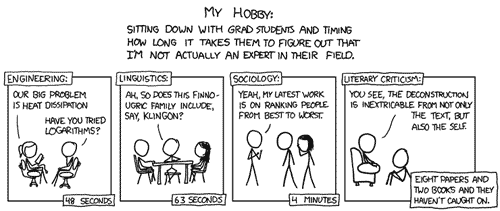
(Hard sciences? Ha! Working with objectively measurable quanta is easy.)
—Where was I? Oh. Musing that maybe I shouldn’t be quite so sloppy with terminology when throwing these words about. —Not that I’m likely to get less sloppy, but I should at least point to the pier’s mission statement (or mission essay, we don’t really go in for pith in this sort of thing) in this regard, “Ludafisk”: critical definitions of such things as genres can never be necessary or sufficient; are, like tools, highly situational; therefore, like tools, are to be put down and taken up again as needed. I could, I suppose, be a little more clear when I’m switching from flat-head to Phillips, say. Try to be, anyway.
(I keep kicking around a classification or hierarchy of terms, of modes, say, for SF and fantasy and horror considered as part of the triskelion; of idioms, referring to SF furniture or fantasy furniture, working with ray-guns-and-rocket-ships or rings-and-swords-and-cloaks, of genres being those contractual obligations such as steampunk or urban fantasy. But I keep resisting. So pretend I said nothing.)
—I would be remiss to those of you who follow along via RSS if I didn’t point out that in earlier entries in this occasional series old friend of the pier Charles S has been doing a yeoman’s job of chiding and chivvying and generally teasing the most interesting bits out for further consideration. So.
Truth in Typesetting Department:
Ordinarily, the first sentence of this Talking Points Memo article—
We already told you how True the Vote, the anti-voter fraud effort launched by a Texas Tea Party group, had lined up two of the biggest stars on the anti-voter fraud circuit for their upcoming national convention.
—would spawn a mini-rant on the proper use of hyphens and en-dashes when hyphenating an adjectival phrase whose components are themselves hyphenates: “anti-voter–fraud circuit,” it should be.
But, as most right-wing allegations of voter fraud are themselves fraudulent, and as the steps they take to remediate this non-existent fraud are overwhelmingly anti-voter? —Well. In this particular instance, I have no complaints.
See, when you assume—
I wonder how much of the blame for things as they are (for many and varied values of things) might not be laid at the nigh-ubiquitous feet of the first-person smartass.
Worth kneeling-to.
For some reason I’d always assumed Schrafft’s wasn’t a real place; was more of a composite, like New York Magazine does. A fortuitous googling tells me what I should of course have known: it was, indeed, and there was more than one.