


Hyperbole.
i think he’s wrong; i think they’ll back down if we fight. i also think that the real radicals—the cheneys and boltons—are far fewer than the civil war analogy suggests. it’s not a country divided. it’s a big country against a small band of wackos.
our situation now is roughly analogous to that of the passengers on flight 93. when the right hijacked the first airplane, in 2000, we were caught completely by surprise. we thought it was more important to keep calm and not panic. so they flew the country into a building. they did it again in 2003, and we were still placing too much value on staying calm.
We’re one bomb away from getting rid of that obnoxious court.
—David Addington, Cheney aide, on FISA



A sobering reminder of the scale of our enterprise.
You bumble along, writing what you write, and you feel pretty good about your meagre slice of the Islets of Bloggerhans, and then a one-off joke from a video poker forum comes along and sextuples your daily traffic in a matter of hours.

(And I don’t even get the joke…)
The Reproof Valiant.
You realize, of course, that “the art of the possible” isn’t the art of doing what’s possible. It’s the art of making things possible.
You never forget your first.
An offhanded comment becomes a meme, suitable for bloggers of a Certain Age: when did you make your first “Christ, what a right-wing hack” post about Instapundit?
And in the comments over at Unfogged, a meme becomes, well, any of a number of things. I keep forgetting how vociferously active that joint is. Makes me wish I hung out in comments more. —But there’s a nice thick strand of how-did-you-end-up-in-blogging there, namechecking poliblogs of days of yore (and to realize that Body and Soul and Fafblog! now belong only to yore is icily sobering) and the folks who’ve been around long enough to remember what blogs were like before they became a corner soapbox in the marketplace of political ideas mention Rebecca’s Pocket and /usr/bin/girl to general befuddlement.
Me? The first thing-that-is-a-blog I read was David Chess’s, which is usually called The Curvature of the Earth is Obliterated by Local Noise, when it isn’t called David Chess’s blog. From him I found Textism, and Oblivio, and Anonymous Juice, and Anita Rowland, and Flutterby, and other, less reputable folks, and then I went and started my own. (Before all that, I’d spent a lot of time on Plastic, wondering why I couldn’t get an account on MetaFilter. Then I discovered I did have an account on MetaFilter, which I don’t remember having set up. But the password worked. I still haven’t used it. Since I have a blog and all. And anyway, I was never very good at the whole hipshot quicklink thing. —Though the mix-tape post that MeFi arguably started, and snarkout definitely perfected, is something I wouldn’t mind doing more of.)
LiveJournal came (much) later. (And all that that entails.)
Of course, if you’re not of a Certain Age, or’d rather not reflect on it, you could always celebrate the news we can finally announce: Dicebox is being made into a movie. (There’s even a novelization!)
The all-too-common tragedy of the foreseeable unforeseen.
As a Republican state senator in Montana and as a human being, I am offended by Senator Craig’s existence. Why oh why are most of the perverts that get caught Republicans? Are there more of them or are they just stupid? The thought of a US Senator chasing love in all the wrong places makes me think longingly of the Ayotollahs in Iran. They would just kill the turkey.
And James, Dave Lewis, a very honorable man, did not recommend “death for queers” (your phraseology).
His statement was obviously exaggerated, but I am sure he meant only to display his rage at Craig’s betrayal of his word and the trust placed in him.
Most weeks, three or four people are hacked, stoned, burned or shot to death for being lesbian, gay, bi or trans. The highest Shia religious dignitary Sistani has again promulgated a fatwa calling for the execution of all non-repentant LGBT people—people talk of him as a liberal and in this degree he is—he allows people to repent on pain of death when most of his rivals would just kill. Contacted by the UN about this campaign of murder, the Iraqi government has refused to acknowledge that it is even a problem.
This is a direct consequence of the war—the Saddam regime, vile as it was, was secular in this respect, just as the Ba’athists in Syria still are. No-one does well in a totalitarian state, but LGBT folk were left alone, mostly.
Those who survive, flee. Through a network of safe houses and incredibly brave people and escape routes to the West.
The British home office is disinclined to regard the likelihood of being murdered by a variety of non-state agents as persecution, because it is not the government that is doing it. The leaders of the diaspora queer community are under death threats—again from Sistani—and live under police protection of a moderately minimal kind.
When troops leave, as leave they will in the runup to the British and American elections, there will be no change, except possibly for the worse.
One of the diaspora spoke to us at Translondon this evening.
He said something amazingly moving to the effect that this is not a movement of Resistance so much as a movement of Existence. Because when everyone wants to kill you, staying alive is the most radical form of resistance possible.
Not sure how that happened.
It’s not like I meant to take the month of August off or anything.
We the motherfucking people.
The Edwards campaign will send our forgetful Attorney General a copy of the constitution for every signature they receive on this petition. (Then again, maybe some of those copies could go elsewhere…)
Commutation.
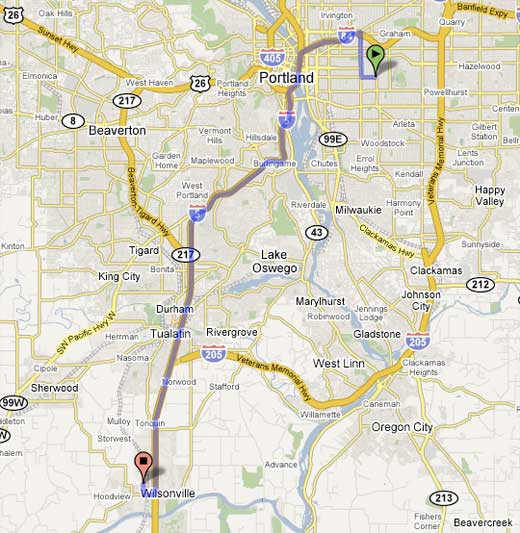
I drive to work these days. Didn’t used to. —When I was freelancing, I’d drive to the occasional client’s office, and there was that month or so temping at Johnstone, and the couple of weeks writing a technical manual for PetSmart, and they’re both out by the airport. Oh, and the week or so at Rio, over the river in Vancouver, laying out cards that advertised the music pre-loaded on whatever MP3 player they’ve probably stopped making by now.
But I’ve almost always otherwise been able to bus or subway or walk to work, usually. For almost five years in this house with the job I’ve had I could walk downtown some mornings, four miles, an hour and a half.
The job moved; now I drive.
And on the one hand, so what? Most people in this country drive to work. Yeah, I say. That’s right. —And now I know why most people in this country are so blackly sullen and ashily angry, and maybe even why we elected Geo. W. Bush to the presidency. (The first time, if not the second.)
There’s a luxury to going to work under someone else’s power. (Or on your own feet, but that’s a luxury of a different order.) —Twenty minutes or so yet to read, doze, listen to the iPod, people-watch, think, write, pretend to think or write while actually people-watching. Driving, I may be master of my fate and captain of my soul, but I must be paying attention, all of it, for the half-hour to forty-five minutes (to an hour, to an hour and a bloody half with the Burnside closed and a stall on I-5 northbound backing up traffic over the Marquam and the regular line of people trying to get on the Sunset snarling the 405). No dozing. No reading. No writing. Barely any thinking, because what the fuck are you trying to do would you get over and let me Jesus! —And the people-watching sucks.
At least I can hook up the iPod to the stereo. (The joys of autonomy!)
The next-to-last straight stretch of I-5 between Bridgeport Village and Wilsonville is as-yet undeveloped; the 205 is the only interchange. Otherwise it’s trees and trees and sixty-five-mile-an-hour speed-limit signs. The median’s a wide strip of dusty yellow grass (this time of year) with a low wire fence running right down the middle. —And then you hit the last straight stretch, lined with hesitant office parks and anemic car dealerships, whose hinterlands are marked by the Garlic Onion restaurant in the basement of a Holiday Inn, its iconic sign spearing up past the overpass as you come around a bend out of the trees.
This morning, running down those next-to-last two miles of tree-lined highway, I spotted a work crew in the median, laying out safety cones and orange lights and white barricades. The barricades they were leaning up against the low wire fence, and every other one had a sign on it. The signs all said NO PARKING.
Okay. Easily enough done—
I’ve mentioned it elsewhere and otherwise, but I might as well note it here, too, seeing as how and all: The “Prolegomenon” of City of Roses has been published in the Summer issue of Coyote Wild. If you haven’t read it, go, read it, if you like; if you have, well, go read it again, why not; either way, go, enjoy some beerly free speculative fiction.
More on the behemoth.
Dylan, as ever, says it best. —Meanwhile, Momus is trying to take the piss out of Potter and The Wire at the same time, and for such an intellective jackanapes falls distressingly flat. Announcing to the world that you think the point of a name like Severus Snape is “you don’t have to waste much time working out whether they’re good or evil” is to mistake the set-up for the punchline, and if you require nothing more than a weepy third party’s word to accept that Bubbles must be “the most sympathetic character ever to appear in a TV drama,” well, you’re pretty much doomed to repeat the downfall of Tom Townsend, who never read novels, just good criticism, thus to efficiently garner the thoughts of a critic as well as the novelist.
—Ah, well. Momus is not without his point re: “wholly human,” and at least it’s—wittier? more insightful?—better than Ron Charles’ weary screed about how it’s all not really, you know, reading.
Eight hours and 759 pages later.
Well. That’s done. —Next?
A pier appears.
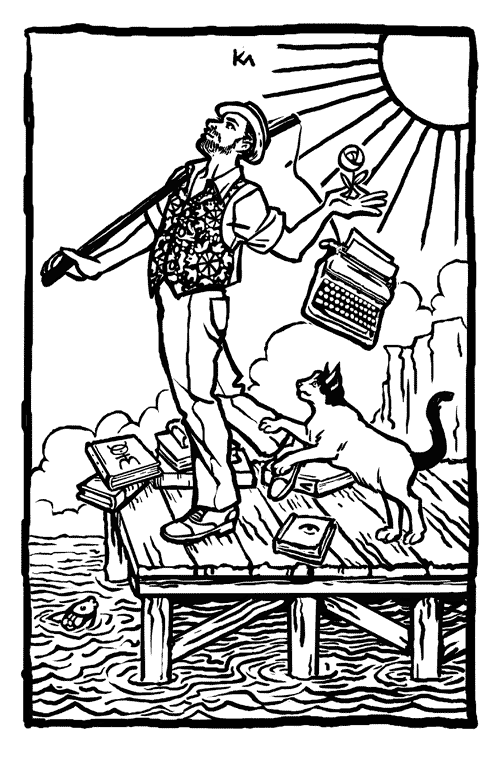
—courtesy of the Spouse
The power of names.
No, Barkley; no. You can cite Juan Cole all you want, but this decade will not be called the zeroes, or the naughties, or the naughts; not even the old-skool aughts. It’s going to be a little more cumbersome: the aught-naughts. As in, “We really ought not to have done that—”
—racing down tracks going faster, much faster—
Immanentise the eschaton!
You let the eschaton alone. It’ll come in its own good time.
—Competing grafitti noted in the neighborhood of I want to say Glastonbury
Set out, set out. —But there’s a couple of things that ought to be explained first, like how magic works; right now, I want to talk about a hitch in the body of time. Lord Fanny and King Mob, drawn by Jill Thompson, hanging out in a diner:

And it is, isn’t it? Getting faster. All the time.
But this has nothing to do with eschatons or apocalypses, armageddim or fifth suns. There’s no damn whirl; no damn pool. It’s all so much simpler than that. There’s just us, and here, and now, and the aforementioned body of time. —The thing about time being that your immediate, visceral sense of it, the time that has actually flowed over and past you, your experience of it, your experience, well, that time is always the same size and the same shape, once it’s set (and rather early on): it’s always the size of your life. (“No more, no less,” to tap another echo elsewhere.) As you get older, as you pack more hours and days and years into the same little box, each one is necessarily left with a smaller slice of the whole.
Pitiless, perhaps, but that’s math for you. —“See,” said my littler sister, when she told me this, “a year is like a twelfth of my life. But it’s like a twenty-fourth of yours.” Grinning like a canaried cat in the back seat. (She had every reason to, of course. Already my years were smaller, harder to see, easy to lose in the crowd. It’s only gotten worse.) —Of course everybody King Mob speaks to has been saying the same thing. Everyone ever has always said the same thing. It’s always already been getting faster.
Keep this hitch in mind, and you’ll be able to answer certain questions like a chuffed Robert Graves: why there’s always jam tomorrow and jam yesterday, for instance, and never jam today. Why every Golden Age is the same Golden Age, and where the Old Skool was; when the Eschaton will strike; where Armageddon will have been.
Forget it, and you fall prey to the anthropic fallacy—the lie of the one true only. Like a smug Frank Tipler, you’ll think that here and now is special because you’re here and now; you’ll think you can say for sure when the jam will arrive; you’ll believe it’s all finally coming to pass and in your time; you’ll know in your bones that time is actually getting faster, because every year to you seems shorter than the year before.
The funny thing about The Invisibles is that while the plot depends upon this fallacy—time really is speeding up, just as Fanny says; the age of the fifth sun is about to end in whirlpools and apocalypses, and the crowning of a dark Lovecraftian king in Westminster Abbey during a solar eclipse—but the point of The Invisibles is precisely opposite: we all immanentize the way we die: alone. Our initiation is always already about to begin; it’s never not the Day of Nine Dogs, and Gideon’s last phone call is the same as Wally Sage’s, to tap another echo, elsewhere again. (Or Jack Frost, with Gaz in his lap. —Of course there’s a plot! Of course the plot must have such a ridiculous, action-packed climax! It’s all a game, remember? Sucked from an ærosol can. Go back and play it again!) —The fact that you’re in the here and now doesn’t make this here, this now any more special than any other slice of eternity—except, that is, of course, to you. And every hour that passes you by makes every other hour that much the smaller, the faster, much faster, until they never let us out ten blocks later.
—Thus, the hitch in the body of time.
I’m hurting cultchah!
Confidential to Keen in Silicon Valley: dude, I know, he made a lot of money, but you start citing George Lucas as some sort of, Christ, I’m not sure what, a compeer of David Hockney or something, some sort of authority on art, well, you’ve pretty much gone and shot your argument in the face. (via; via)
What do you think of Internet video? Lucas says there are two forms of entertainment: circus and art. Circus is random, he says: “feeding Christians to the lions”—or, he says, as the term in Hollywood goes—”throw a puppy on the highway. … You don’t have to write anything or really do anything. It’s voyeuristic.” In short, he says, it’s YouTube. Art is not random, Lucas says. “It’s storytelling. It’s insightful. It’s amusing.”
Harry Potter and the Lost Light.
I had no idea. I honestly had no idea. (via)
All models are wrong. Some are useful.
We’re finally watching Rome. —At some point during the second episode, I say something like, “So it’s Artoo and Threepio.”
And then a little later, the Spouse says, “I’m still trying to deal with the idea of Threepio as a whoremonger and Artoo as a stolid family man.”
I frowned. “No, wait,” I said. “Threepio’s the uptight prig, right? Artoo was the id-guy.” The collapse and reversal shorted something in my brain. I grinned. “So, like, Molly’s Threepio, right?”
—Maybe you had to be there.