


Scena Penultima—
LA STATUA:
Pentiti, scellerato!
DON GIOVANNI:
No, vecchio infatuato!

LA STATUA:
Pentiti!
DON GIOVANNI:
No!
LA STATUA:
Sì!
DON GIOVANNI:
No!
LA STATUA:
Ah! tempo più non v’è!
(Fuoco da diverse parti, il Commendatore sparisce, e s’apre una voragine.)
DON GIOVANNI:
Da qual tremore insolito
Sento assalir gli spiriti!
Dond’escono quei vortici
Di foco pien d’orror?
CORO di DIAVOLI (di sotterra, con voci cupe):
Tutto a tue colpe è poco!
Vieni, c’è un mal peggior!
DON GIOVANNI:
Chi l’anima mi lacera?
Chi m’agita le viscere?
Che strazio, ohimé, che smania!
Che inferno, che terror!



Magisteria.
Let Chris Clarke tell you a story about the struggle between Vishnu and YHWH.
What we're fighting for,
or, The Triumph of Faith over Works.
A day in the life of the average Iraqi has been reduced to identifying corpses, avoiding car bombs and attempting to keep track of which family members have been detained, which ones have been exiled and which ones have been abducted.
2006 has been, decidedly, the worst year yet. No—really. The magnitude of this war and occupation is only now hitting the country full force. It’s like having a big piece of hard, dry earth you are determined to break apart. You drive in the first stake in the form of an infrastructure damaged with missiles and the newest in arms technology, the first cracks begin to form. Several smaller stakes come in the form of politicians like Chalabi, Al Hakim, Talbani, Pachachi, Allawi and Maliki. The cracks slowly begin to multiply and stretch across the once solid piece of earth, reaching out towards its edges like so many skeletal hands. And you apply pressure. You surround it from all sides and push and pull. Slowly, but surely, it begins coming apart—a chip here, a chunk there.
That is Iraq right now. The Americans have done a fine job of working to break it apart. This last year has nearly everyone convinced that that was the plan right from the start. There were too many blunders for them to actually have been, simply, blunders. The “mistakes” were too catastrophic. The people the Bush administration chose to support and promote were openly and publicly terrible—from the conman and embezzler Chalabi, to the terrorist Jaffari, to the militia man Maliki. The decisions, like disbanding the Iraqi army, abolishing the original constitution, and allowing militias to take over Iraqi security were too damaging to be anything but intentional.
The question now is, but why? I really have been asking myself that these last few days. What does America possibly gain by damaging Iraq to this extent? I’m certain only raving idiots still believe this war and occupation were about WMD or an actual fear of Saddam.
—Riverbend, “End of Another Year”
So why did the president wait so long to rid himself of this meddlesome general? Well, politics is politics, remember. “Many of Mr. Bush’s advisers say their timetable for completing an Iraq review had been based in part on a judgment that for Mr. Bush to have voiced doubts about his strategy before the midterm elections in November would have been politically catastrophic.”
The saddest thing about the 3,000th American death in Iraq is that unlike the first batch of casualties, people getting killed or maimed in Iraq these days are really doing so in the course of a bad faith military option.
We’ve all lost some of the compassion and civility that I felt made us special four years ago. I take myself as an example. Nearly four years ago, I cringed every time I heard about the death of an American soldier. They were occupiers, but they were humans also and the knowledge that they were being killed in my country gave me sleepless nights. Never mind they crossed oceans to attack the country, I actually felt for them.
Had I not chronicled those feelings of agitation in this very blog, I wouldn’t believe them now. Today, they simply represent numbers. 3000 Americans dead over nearly four years? Really? That’s the number of dead Iraqis in less than a month. The Americans had families? Too bad. So do we. So do the corpses in the streets and the ones waiting for identification in the morgue.
“Vengeance is mine; I will repay,” saith the Lord.
In some otherwise excellent comments on the clusterfucked execution of Saddam Hussein, Josh Marshall said something that gave me pause:
Vengeance isn’t justice. Vengeance is part of justice. But only a part.
I agree that when you’ve been wronged, it can be very, very hard to separate your need for justice from your need for vengeance. This is why judges should always and forever bend toward the asymptote of impartiality, and why “victims’ rights” drives are rarely a good idea.
Vengeance has no place in justice. Vengeance is temporary, short-sighted; the destructive flailing of the hurt who can’t see what they’re hitting. Justice is what you eventually build if you’re lucky enough to survive the ravages of vengeance. —You may feel I’m splitting a miniscule mote plucked from his eye, but this is important: a system of justice that gives any consideration to vengeance is a shameful system, one that mistakes means for ends, that sacrifices peace, justice, for the visceral satisfaction of righteous outrage. Righteous, perhaps; but outrageous nonetheless.
I mean, I know in my bones that impeachment isn’t enough for the various members of the Bush administration. Imprisonment will not bring back the hundreds of thousands of lives we’ve sacrificed for his petty vanity. —When he is turned out of office, I’d want him to tour the country, town by town, set up each morning in the square before the courthouse and allow passersby to sock him in the nose. Not quite inviting passersby to saw at the most famous neck in the realm—Secret Service agents could keep things from getting out of hand—but it would, perhaps, eventually add up in small dollops of vengeance to something you could measure on the awful balance sheet.
But the hundreds of thousands would still be dead, and our nation no closer to something we could claim was health, and the lines would become too long and unwieldy (even if we allowed consolation shots at the noses of Rumsfeld, Cheney, Rice, Snow, McCain, Lieberman, et bloody al). —So I agitate instead for hearings, and impeachment; justice, not vengeance.
They really are quite different.
I forget who asked, but in case it was you:
“My observation is that wetting the pencil allows you to get a darker line,” Dr. Howard said. “There’s a softening of the material, some absorption of moisture into pore spaces that makes a mix that will rub off more easily. If it were pure graphite, there would be no pores to let the moisture in.”
Hoppin’ John.
Honestly, the dish being as Southern as it is, I find it much easier to believe it’s an elision of pois pigeons rather than a Northumbrian “hopping” held in honor of St. John the Evangelist. Charming though the latter undoubtedly would be.
I did finish something in 2006, and we did not look about last night and say, anything’s got to be better than that. (Which only means we now have somewhere from which to fall.) —This year? This year, I’m going to start to crack. This year, I will sell something.
Hop in, John.
Moral equivalency.
Five things.
Jesus, John. Some of us have writing to procrastinate. Which, well. Um.
So okay. —Though I have to agree with fellow taggee Yglesias that this particular meme lacks a certain gimmicky je ne sais quois. One is tempted to cheat with overly specific items such as I have 14,774 songs in my iTunes library, or maddeningly vague items such as almost all the money I’ve made from writing is due to pornography, but I am at heart a decent creature, raised up right to color inside the lines.
- My mother comes from South Carolina aristocracy; my father from folks that seceded from the Confederacy. I was born in Alabama, and most of my formative years were spent in Virginia, Kentucky, and both Carolinas. Yet I can’t speak with a Southern accent to save my life.
- Though I score as an introvert on most Meyers-Briggs evaluations, I tend to be loud and effusive at parties. —Also, I acted a bit back in high school and college. Roles I have played include Dr. Jim Bayliss; Jeff Douglas; Sidney Lipton; Bridegroom; Harlan McKenna; Dr. Bazelon.
- I was once in possession of what might well have been the world’s longest appendix. Or so a surgeon assured me in 1986, after a longer-than-expected appendectomy. For all I know, the intervening years have swept that record under the rug. If you see me at a party, ask for the extended dance mix; this particular anecdote doesn’t survive translation to the written word.
- Though I can’t draw a lick, I’ve completed three 24-hour comics: “Getting to 24,” “The Star,” and “The Story I was Going to Tell on Halloween Night but Couldn’t.” Not that many people have done more than one, but I don’t know that any of us are necessarily proud of this achievement.
- Did you attend Oberlin College in 1987, along with Liz Phair and Michelle Malkin? Did you eat in Dascombe? Do you remember what was invariably the loudest table in the joint, loaded with SF-computer-gaming geeks cracking wise and bluing the air with awful puns? I was the salad bar guy, constantly neglecting his tubs of croutons and dressings to hover about that table for a taste of the action. Those jokes shaped the entire rest of my life.
Now for the tagging: Kevin Moore! Anne Moloney! Jeff Parker! Sara Ryan! Barry Deutsch! Pentamemes are go!
In case you needed another reason to watch the final season of The Wire.
Yes, the last season. The last theme is basically asking the question, why aren’t we paying attention? If we got everything right in the last four seasons in depicting this city-state, how is it that these problems—which have been attendant problems regardless of who is in power—how is it that they endure? That brings into mind one last institution, which is the media. What are we paying attention to? What are we telling ourselves about ourselves? A lot of people think that we’re going to impale journalists. No. It’s not quite that. What stories do we want to hear? How closely do they relate to truth; how distant are they from the truth? We have a story idea about media and consumers of media. What stories get told and what don’t and why it is that things stay the same.
I blog. You blog. He, she, it blogs. We blog; you blog; they blog.

Two Yotsubas! and a full Wayne-and-Garth “We are not worthy!” cluster to Teresa Nielsen Hayden. —Except, of course, we are; that’s our redemption, and our curse. Get cracking.
Defying gravity.

Mostly a me-too post, pointing you to the sheer, unadulterated joy of Tintin Pantoja’s manga-styled Wonder Woman proposal. So far, there’s been no word from DC proper (Tintin herself theorizes that maybe she sent it up the wrong channels), but John Jakala makes as eloquent a case for the book as you’d want. —Let’s hope Joss Whedon, at least, is paying attention.
(Bonus, also from the Sporadic Sequential post: “A few years ago I pitched Dan DiDio a manga-style take on Supergirl that had Kara as a pop idol, Superman as the lead singer of the Justice League touring rock band (with the Flash as the Fastest Lead Guitarist Alive), and Lex Luthor as an Evil Music Mogul. Obviously it didn’t get picked up, and we ended up with Britney Kara instead, but it was fun to do.”)
Calling all Chinese freebooters.
Y’know, I’ve been wondering why The American Shore, Delany’s book-length study of Disch’s “Angouleme,” is so hard to come by. Now I know.
What if my gold be wrapped in ore?
None throws away the apple for the core.
But if thou shalt cast all away as vain,
I know not but ’twill make me dream again.
I’m the best there is at what I do. The trick is not to mind it—
Whew! Rube Malek and Cole Coleman don’t have to wait for Buck Williams or Rayford Steele or Storm Saxon to save their bacon. Mike Mackey and the fine folks at ACC Studios have unleashed a Berkeley professor’s flawed duplication ray to bring us—Libarro World!
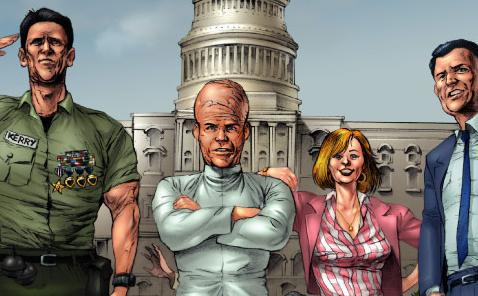
- Lt. Kerry, a pro-military warrior,
- Deaniac, an unexcitable ultra-genius,
- Miss Rodham, a sultry anti-feminist, and
- Teddie, a distinguished teetotaler.
Available in the pages of Liberality #3. (Keep your eyes peeled for the “Final Drudge Report” variant cover.)
“He would be as happy as anyone to be rid of these men. They frighten him as much as they frighten everyone else.”
I was going to say something, anything about Orson Scott Card’s latest exercise in one-state-two-state-red-state-blue-state (here, but also here, here, here, here, here, here, and here). But then I remembered I’d already quoted what somebody else had to say:
Unsuccessful in war and unable to adjust to a troubled peace, Weimar’s visionaries dismissed what was for them an overly complex, difficult, and demoralizing reality and indulged in elaborating fantasies of a vicious war of revenge that cast them in the role of conquerors. In their literature these angry men gave vent to primitive wishes for the annihilation of France, England, the United States, or whomever else they pictured as Germany’s enemy. But the war visions of the 1920s were not merely the self-serving fabrications of isolated malcontents. Instead of being left to dissipate in the realm of dreams, daydreams, and semireligious entrancement, the visions of revenge and renewal were converted into a literature of mass consumption. The published fantasy—often a quirky mixture of adventure story, fairy tale, millenarian vision, and political program—was intended to act as a catalyst inflaming the same type of emotions among the readers that originally elicited the fantasies in the minds of their creators. In this manner, what originated as compensation for the frustrated individual was transformed into a psychological tool, a propagandistic call for militant nationalism and engagement in antirepublican politics. Some of these writers, in fact, were also active as political speakers and agitators.
“History doesn’t repeat itself,” said Mark Twain, “but it does rhyme.” —Except, of course, he didn’t, and anyway, rhyme’s gone all out of fashion. Though I wouldn’t trust fidelity or fashion to keep us safe, not from this crew. Remember, “If This Goes On—”
No one, not even the rain.
“The Bride Stripped Bare by ‘Bachelors’,” the Bonzo Dog Doo-Dah Band; “The Nerd,” DJ Spooky that Subliminal Kid; “Viva! Sea-Tac (live),” Robyn Hitchock; “Better Luck Next Time,” Scissor Sisters; “Coyotes,” Richard Thompson, Don Edwards; “Quito (live),” the Mountain Goats; “Purple Avenue,” the Holly Cole Trio; “Welcome to the Middle Ages,” the Playwrights; “Finnish Farmers,” Laurie Anderson; “One Long Pair of Eyes,” Robyn Hitchcock and the Egyptians.
Wolverines!
Webcartoonist David Willis is surprised when his Transformers Fan Club email list coughs up a bloody shirt. Red Fridays, folks: feel the magic.