


Location, location, location.
I was wondering what Pitchfork had to say about the new Mountain Goats, so I went to my browser bar and started typing—



Appositional.
This isn’t a picture of Wormwood.

I’m not sure why I keep coming back to the decadent espionage thrillers of the ’70s for popcorn reading, these days. Maybe because we were much more sophisticated then? We handled it all—oil crises, Mideast flareups, terrorist hijackings, the existential struggle of the individual against an inevitable subsumption within this bureaucratic matrix, or that—we handled it all with so much more aplomb then than now, it seems. (This is as false as any other comparison of one decade to another. Allow me a minor pecadillo.) —I’m not sure why I keep coming back to Trevanian and MacBeth, in particular. The one so appallingly heartsick beneath its po-faced satire; the other so inadvertently ridiculous beneath its literary pretensions. (That one still managing to naught itself in the belly of the whale Annihilation, but I’m inexcusably referencing an inside joke hermetically sealed. —The first, of course, seeks to return to God by moving shibumily with God, knowing all the while it never can, but like I said, inexcusable, and dragging God into this will not help.)
It?
He? His? (She, hers?) (Penn’s?) —Both of them, of course, united in their queerly doomed battles, taking up the master’s tools against that 20th century grotesque, Bond. James Bond—
The explosions going off today world wide have been smoldering on a long sexual and emotional fuse. The terrorist has been the subliminal idol of an androcentric cultural heritage from prebiblical times to the present. His mystique is the latest version of the Demon Lover. He evokes pity because he lives in death. He emanates sexual power because he represents obliteration. He excites with the thrill of fear. He is the essential challenge to tenderness. He is at once a hero of risk and an antihero of mortality.
He glares out from reviewing stands, where the passing troops salute him. He strides in skintight black leather across the stage, then sets his guitar on fire. He straps a hundred pounds of weaponry to his body, larger than life on the film screen. He peers down from huge glorious-leader posters, and confers with himself at summit meetings. He drives the fastest cars and wears the most opaque sunglasses. He lunges into the prize-fight ring to the sound of cheers. Whatever he dons becomes a uniform. He is a living weapon. Whatever he does at first appalls, then becomes faddish. We are told that women lust to have him. We are told that men lust to be him.
We have, all of us, invoked him for centuries. Now he has become Everyman. This is the democratization of violence.
That isn’t a picture of Wormwood, either. (It may or may not be a picture of Jerry Cornelius, but then most things are. I can’t decide, though, if it’s a picture of Mister Six, or King Mob. It must be one or the other, right?)
But this isn’t about that; not yet, anyway. It’s mostly about Wormwood. Or at least the last few paragraphs of his life. —I was 11 or 12, and looking for something to read, and picked up The Eiger Sanction, because, hey, more spies. And was introduced in the opening bit to the hapless Wormwood, whose foolishness, while contemptible, still seemed to draw an undeserved measure of scorn from the ostensibly neutral third-person omniscient. What a prick, I said to myself, taking Wormwood’s side against a narrator he would never know. (And thereby learning a lesson it would take years to recognize.)
But, as I said, his last few paragraphs in this vale of tears:
As he climbed the dimly lit staircase with its damp, scrofulous carpet, he reminded himself that “winners win.” His spirits sank, however, when he heard the sound of coughing from the room next to his. It was a racking, gagging, disease-laden cough that went on in spasms through the night. He had never seen the old man next door, but he hated the cough that kept him awake.
Standing outside his door, he took the bubble gum from his pocket and examined it. “Probably microfilm. And it’s probably between the gum and the paper. Where the funnies usually are.”
His key turned in the slack lock. As he closed the door behind himself, he breathed with relief. “There’s no getting around it,” he admitted. “Winners—”
But the thought choked in mid-conception. He was not alone in the room.
With a reaction the Training Center would have applauded, he popped the bubble gum, wrapper and all, into his mouth and swallowed it just as the back of his skull was crushed in. The pain was very sharp indeed, but the sound was more terrible. It was akin to biting into crisp celery with your hands over your ears—but more intimate.
Damn.
Okay, “but more intimate” is arguably overkill, but still: Jesus. I shuddered (then and now) and dropped the book and haunted for years by that onomatopoeic image, I didn’t pick up Trevanian again until high school, when I read Shibumi, and kept saying, damn, this is like The Ninja, only better.
Yes. Yes, it is.
Doing the only right thing is sick, twisted; not referred to as a joke; not (at all) funny.
A note on framing, to our esteemed colleagues on the dextral side:
While I question the wisdom of rolling out a new product in August, still, I gotta tell you, I’m wholly in agreement with your impending shift from “MSM media” to “527 media.” After all, anyone outside your little clique who stumbles over such a reference and goes googling for whatever the hell it is you could possibly mean will trip over far and away the most famous 527 of all: the Swift Boat Veterans for Truth. —And that, my friends, is a connection we can all support.
As you know, Bob.
One might think that the Laws of Probability would mandate that, without any intelligent input, 50% of the time the events in our world would lead to benefits for mankind. In a strictly mechanical way, life in our world ought to have manifested a sort of “equilibrium.” Factoring in intelligent decisions to do good might bring this average up to about 70%. That would mean that humanity would have advanced over the millennia to a state of existence where good and positive things happen in our lives more often than “negative” or “bad” things. In this way, many of the problems of humanity would have been effectively solved. War and conflict would be a rarity, perhaps 70% of the earth’s population would have decent medical care, a comfortable roof over their heads, and sufficient nutritious food so that death by disease and starvation would be almost unheard of. In other words, human society would have “evolved” in some way, on all levels.
The facts are, however, quite different.
—Laura Knight-Jadczyk, The Secret History of the World and How to Get Out Alive
An industrial seashell.
They’re hollowing out the upper floors of the Meier & Frank across the street from our office, “they” being NUPRECON, which probably stood for something at one point before it got all “Nu” on us. (I notice they also did for the Danmoore Hotel, on which more later.) —They’ve bolted a giant sheet-metal chute to the front of the building, braced by a webwork of scaffolding, with openings at every floor through which they lustily toss two-by-fours and chunks of drywall and metal brackets and pieces of concrete flooring and ripped-out electrical ducting and pipes and I don’t know what-all else to tumble booming down the chute and crash into the concrete bunkers at street level where backhoes scoop it up into battered containers and there’s the guy whose job it is to hose the whole thing down to keep the gypsum dust and other particulates from choking passers-by. Before today, it was an occasional event, whenever somebody on the sixth or the eighth floor got a load large enough to dump; we’d hear the intial boom and crash of a drop on its way down and apologize to whomever on the phone, hold up our meeting, look away from the computer screen, suspend all conversation for the half-minute or so it took the reverberations to die away. But today? Today they’re really into it. Load after load after load going down. Our only defense is to pretend we’re at the beach, and it’s the crashing surf we’re hearing—the crashing, clanging, thumping, banging surf.
A thoroughly self-indulgent post
pointing out that episode one of City of Roses finished today; episode two begins Monday, and runs Monday-Wednesday-Friday for the next two weeks. So there’s that. —Also, if you haven’t been checking out the news over there, you probably missed some lovely photos from the Portland Zine Symposium, which mostly taken by Matt Nolan and Erika Moen. So there’s that, too.
Shorter How to Talk to a Conservative:
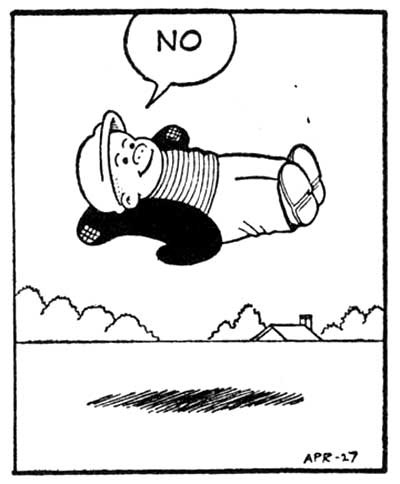
On my way to somewhere else.
Oh, hey, Tim Powers has a new book out.
No, wait, I’m sorry. It’s pretty much exactly the size of a walnut.
Back in March, I committed one of Roy Edroso’s cardinal sins: I snarked off on Harvey C. Mansfield’s Manliness, having only read a couple of the lit world’s equivalents of the trailer. Sorry, Roy. —Well, I still haven’t read it (see life, shortness thereof), but Martha C. Nussbaum has, and oh my dear sweet Lord. (Via; via.)
Waiting for Making Comics.
Until then, here’s Wally Wood’s 22 Panels that Always Work:
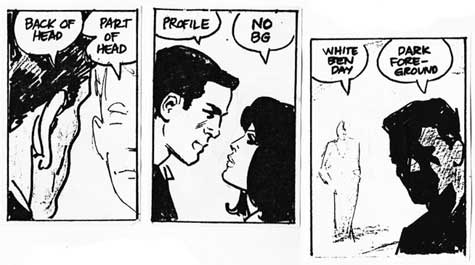
Ivan Brunetti’s 22 Panels that Always Work (Sometimes):
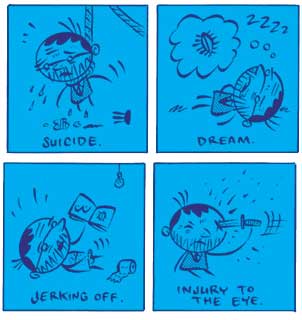
Shaenon Garrity shows you fear and intimidation in a handful of Gluyas Williams spot blacks:
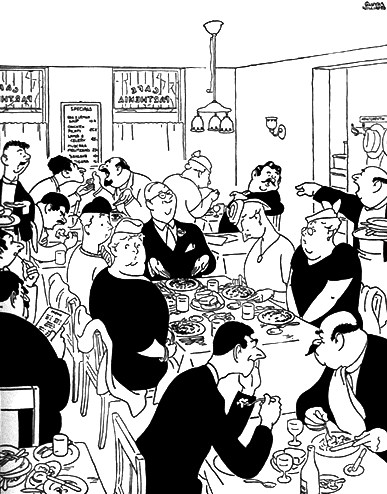
And Pete Woods gets you from A to B—


—in one! two! three! easy steps.
Nincsen rózsa tövis nélkül...
How should one celebrate a sudden vault onto the New York Times bestseller list? —Why, with art by Alan Davis and dialogue by Chris Claremont!
Suddenly, and for the first time in my life, I have been struck with an overwhelming urge to go to Burning Man.

What color is the sky?
“I would say that those who herald this decision simply do not understand the nature of the world in which we live,” says our president, who didn’t know the difference between Shi’ite and Sunni, who is “puzzled” that thousands of Iraqis would take to the streets to demonstrate against America.
The grammar of ornament.
Actually, the poster in the window of the Meier & Frank is worse, much worse: she’s lying on her back on that zig-zag couch thing, coy-defenseless, chewing on her come-hither pencil.

It’s part of a Macy’s (née Meier & Frank, and that’s a whole other kettle of fish) promotion, complete with a crappy Flash-based website and tie-ins to crappy bands you’ve never heard of with albums you’ll never hear to flog. Aspiring poet. Aspiring celebrity chef. Aspiring indie filmmaker. Aspiring editor-in-chief. All of them aspiring to do little more than dress and accessorize the part (what else could they do to convince you of their worth, since all you’ll see is a single still image in a store window?): callow images of callow youths aspiring to little more in truth than flattering snark from a Nick Denton website. (The aspiring poet is spot-on, an unholy cross between Jonathan Safran Foer and Leotard Fantastic.) —And ordinarily, I’d be laughing at this joke that can’t figure out who the punchline is; ordinarily, I’m well-enough inured.
But aspiring therapist?
(That’s what it says, there in the white box. “Aspiring therapist.”)
The other callow youths all have the accessories of their aspirations: a sleek little digital camera, a sleek kitchen set, a not-at-all sleek library of serious-looking tomes bought by the yard from the Strand, mockups of sleek magazine covers to be marked up. All our aspiring therapist has is her couch and her pencil and her fun, short-sleeved tee: Let’s Play Doctor. And her patient, of course. Who else you think she’s looking at, bub? All coy-defenseless and come-hither pencil like that? —It’s a sexy nurse joke gone off, therapy and sex and nurture and desire and love all snarled and confused, projection and projector, subject and object inextricably mixed up: who’s aspiring to what, here? This pose isn’t Dr. Melfi, it’s Tony Soprano’s fantasy of Dr. Melfi, and I shudder and turn away and stalk off with a scowl on my face. The other callow images make me snicker; even the aspiring celebrity chefs are Bobby Flay’s fantasy of what it’s like to want to be who he is. But this one makes me angry.
(Is it just me? I dunno. Think about what the image is telling you you should want, or want to be. Just ignore it? Maybe, perhaps it’s best, King Canute and all that, but first slip Mary Daly’s lens in place for a moment: ASPIRING THE/RAPIST. —Whose idea was this, anyway?)
Miserable failure.
I mean, seriously. How long was the fuze on this particular punchline? Three years? You have any idea how long that is in internet time?