


Are too Redemption’s tears and not in vain—for nothing idly weeps.
It’s not just that Lindsay’s a self-hating Jew for wanting to read Günther Grass. She’s also a pædophile!



Adam and Eve on a raft.
To learn anything worth knowing requires that you learn as well how pathetic you were when you were ignorant of it. The knowledge of what you have lost irrevocably because you were in ignorance of it is the knowledge of the worth of what you have learned. A reason knowledge/learning in general is so unpopular with so many people is because very early we all learn there is a phenomenologically unpleasant side to it: to learn anything entails the fact that there is no way to escape learning that you were formerly ignorant, to learn that you were a fool, that you have already lost irretrievable opportunities, that you have made wrong choices, that you were silly and limited. These lessons are not pleasant. The acquisition of knowledge—especially when we are young—again and again includes this experience. Older children tease us for what we don’t know. Teachers condescend to us as they instruct us. (Long ago, they beat us for forgetting.) In the school yard we overhear the third graders talking about how dumb the first graders are. When we reach the third grade, we ourselves contribute to such discussions. Thus most people soon actively desire to stay clear of the whole process, because by the time we are seven or eight we know exactly what the repercussions and reactions will be. One moves toward knowledge through a gauntlet of inescapable insults—the most painful among them often self-tendered. The Enlightenment notion (that, indeed, knowledge also bring “enlightenment”—that there is an “upside” to learning as well: that knowledge itself is both happiness and power) tries to suppress that downside. But few people are fooled. Reminders of the downside of the process in stories such as that of Adam and Eve can make us—some of us, some of the time, because we are children of the Enlightenment who have inevitably, successfully, necessarily, been taken in—weep.
We say we are weeping for lost innocence. More truthfully, we are weeping for the lost pleasure of unchallenged ignorance.
—Samuel Delany, “Emblems of Talent”
Hacks of Mordegon.
Will John Crowley SAVE fantasy? Or DESTROY it?
When opportunity knocks your house down.
Ah, you’ve probably seen Aasif Mandvi on the Daily Show already. Go, see it again.
Teh best zine evar
is now a book.
Personal appearance.
Today and tomorrow and Sunday I’ll be in the Smith Ballroom at Portland State University, sitting behind a table with the irrepressible Erika Moen. We’re there for the 6th Annual Portland Zine Symposium; I’ll be hawking City of Roses chapbooks, and she’ll have a variety of minicomics available, some of which are naughty. —Also, if Dylan Meconis found a decent copy shop in time, she’ll be there with some poetry.
We’re operating under the name Bikini Girl and Tiny Top Hat Man. I should probably state for the record that I do not have a tiny top hat (just a leopard-skin fez), and while Erika may well have a bikini, she won’t be wearing it. No one’s entirely sure who’s responsible for the name, or why we thought it was a good idea at the time. So let’s just move on, shall we? —There’s going to be lots of DIY publications to browse and workshops galore and I for one am eager to learn more about the Multnomah County Library’s new zine collection.
So do stop by, if you’re in the area and so inclined. Admission’s free. Tables are open Friday from 3 – 7 and Saturday and Sunday from 10 – 5; workshops run Saturday and Sunday; parking’s not bad; there’s a farmer’s market for lunches. Liquids are allowed.
No shit, Sherlock.

You know, we start seeing headlines like this, it’s time to rethink some of our fundamental assumptions.
Crow is a dish best served cold.
So I’m noting this comment from an old friend for future gustation.
Twa conversations.
Momus talks with the pink paper; Hope Larson talks with her house.
Resolute.
Oh, hey. I did it.
(Final print job tonight. First of the promised packages out tomorrow. Further bulletins as events warrant, and do note I’ll be here a week from this weekend, if you’re so inclined.)
Groovy.
Ampersand brings us news of the Off-Broadway Evil Dead: The Musical, but unaccountably misses the Buffy/Red Dwarf connection: it’s co-directed and choreographed by Hinton Battle.
Words are mere sound and smoke, dimming the heavenly light.
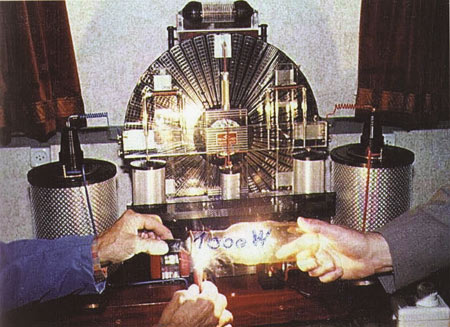
I left Methernitha that day with many questions buzzing through my mind. What if I asked to become a member? Would I be accepted? Would they let me see it then? Would I find out how the machine functioned, and whether trickery was involved? How long would it take to gain their trust? Stefan Marinov, a Bulgarian physicist and free-energy inventor, joined Methernitha and for many years attempted to understand how the machine worked. He claimed to be privy to the secret of the device, but he could not convince the group to share their knowledge with outsiders. In the summer of 1997, he leapt to his death from a library window at Graz University; his suicide note ended with: “feci quod potui, faciant meliora potentes” (“I did what I could, let those who can do better”).
Soon after making my pilgrimage to the Methernitha, I heard about a conference devoted to free energy to be held in Berlin. Looking down the schedule, I was excited to see that there would be a presentation of a Testatika. I immediately booked a place and bought a plane ticket. When the time came, a somewhat half-heartedly constructed machine was described as a demonstration device, created to rule out certain hypotheses of the Testatika’s design—to show how it didn’t work. When I spoke to him after his talk and explained my ambitious quest to build my own working version of the Testatika, he earnestly recommended that a thorough reading of Gœthe’s Faust might be the best way forward.
—Nick Læssing, “Something for Nothing”
Cabinet issue 21—Electricity
This machine bugs liberals.
Say, Fred, I heard Lyndon is forming a new Federal agency.
Yeah? What’s that?
It’s going to be called the Poverty Relief Agency.
Oh, that’s nothing new, Bobby Baker’s headed that department for years.
Zing?
Down in Havana, 90 miles from our shore
Lies an army of Commies and Fidel Castro
We were going to remove them, the plans were all made
We’d help with the airplanes on invasion day
But you know the Liberals and the CIA
They agreed with Adlai, take the airplanes away
So the brave freedom fighters were destined to fall
’Cause we didn’t answer when we heard their call
—the Goldwaters, “Down in Havana”
Rick Perlstein’s always worth reading; the Design Observer’s running an essay of his that the New Republic couldn’t be bothered to put online, so go, read “What is Conservative Culture?”
Conservative culture was shaped in another era, one in which conservatives felt marginal and beleaguered. It enunciated a heady sense of defiance. In a world in which patriotic Americans were hemmed in on every side by an all-encroaching liberal hegemony, raw sex in the classrooms, and totalitarian enemies of the United States beating down our very borders, finally conservatives could get together and (as track twelve of the Goldwaters’ Folk Songs to Bug the Liberals avowed) “Row Our Own Boat.”
But now conservatism has grown into a vast and diverse chunk of the electorate. Its culture has become so dominant that one can live entirely within it. Shortly after the Republicans took over Congress in 1994, a Washington activist could, if he so chose, attend nothing but conservative parties, panels, and barbecues; a recent Pew Research Center study suggested that partisan divisions are increasing at the community level. And yet, far inside these enclaves, conservatives still rely on the cultural tropes of that earlier period: At one living room “Party for the President” in 2004, a woman told me, “We’re losing our rights as Christians. ... and being persecuted again.” The culture of conservatives still insists that it is being hemmed in on every side. In Tom DeLay’s valedictory address, as classic an expression of high conservative culture as ever was uttered, he attributed to liberalism “a voracious appetite for growth. In any place or any time on any issue, what does liberalism ever seek, Mr. Speaker? More. ... If conservatives don’t stand up to liberalism, no one will.”
How to explain these strange continuities? And what does it say about the politics of our own time? Kirk offers no answers, because what holds the movement together isn’t its intellectual history but its cultural one. Folk Songs to Bug the Liberals is this mystery’s Rosetta Stone.

Bugging liberals, you see, being bugged by liberals, is not incidental to conservative culture, but rather is constitutive of it—more so than any identifiable positive content. Seeing Republicans appropriate liberal-sounding rhetoric on immigrants and education and getting credit for it—even while their policies corrode public education and also stoke an anti-immigrant backlash—bugs the hell out of the liberals. Which is, for Karl Rove no doubt, part of the calculation. Rove knows that the pleasure of watching liberals’ heads explode is the best way to keep his team rowing in the same direction.
Two things struck me, reading this: first, of course, appropriation isn’t only done to fuck with our the other side’s heads. When you start to believe your own bullshit, that you really are beset on all sides by an implacable foe, when you’re out there fighting dragons every day, you start to ask yourself what it is they’ve got that you don’t; you start to wonder if maybe you shouldn’t become a little draconic yourself. You say things like, “They have Joan Baez, who do we have?”
It was Dr. Fred C. Schwarz of the Christian Anti-Communist Crusade (CACC) who acted as [Janet] Greene’s “Col. Parker” and molded her into his very own Anti-Baez. As reported in The Los Angeles Times, on October 13, 1964, Schwarz unveiled his new musical weapon against Communism at a press conference at the Biltmore Hotel in LA. With Greene at his side, Schwarz stated to the assembled press that he had “taken a leaf out of the Communist book” by adding a conservative folk singer to his organization. “We have decided to take advantage of this technique for our own purposes.” He then added, “You’d be amazed at how much doctrine can be taught in one song.”
The second thing was how old the conservative schtick is. They were hating on the Clenis back in 1964.
Say I saw a new a great new play on Broadway last night, it’s called The Doll House.
Is that the Rodgers-Hammerstein show?
No, it’s a Profumo-Baker production.
Must have been quite a comedy!
Might call it a farce!
Rimshot, motherfuckers. Rimshot.
Then if any man shall say unto you, Lo, here is Christ, or there; believe it not.
PHILLIPS: Do you think they’re taking what you’re saying and incorporating it into foreign policy?
ROSENBERG: I wouldn’t go that far. But I would say—I would say that Bible prophecy is an intercept from the mind of God. It’s actually fairly remarkable intelligence, and that’s why my novels keep coming true, because mine are on this side of the Rapture, leading up to Jerry and Tim’s books, but they suggest events that the Bible does lay out that will get us closer to those events. And, in fact, one by one in The Last Jihad, my book The Last Days, The Ezekiel Option, and now The Copper Scroll, have this feeling of coming true. I think that’s why a million copies have sold. They’re New York Times best-sellers, because they’re based on Bible prophecy, and they are coming true bit by bit, day by day.

PHILLIPS: Joel, do I need to start taking care of unfinished business and telling people that I love them and I’m sorry for all the evil things I’ve done?
ROSENBERG: Well, I think that would be a good start. I mean, Jesus loves the people of the Middle East. Matthew 15—Jesus was in southern Lebanon. Why? Telling the people of Lebanon that he loved them, that God loved them.
This is the way the world ends
This is the way the world ends
This is the way the world ends
Not with a bang but a simper.
Ah, youth, where is thy sting?

—Neil Gaimain; Scott McCloud; San Diego, 1991.
Via  ivy_rat.
Park that car. Drop that phone. Sleep on the floor. Dream about me.
Duly added to the list of things I can’t get enough of: the way John Perry’s guitar won’t stop climbing at the beginning of “Another Girl, Another Planet.” I may not agree that it’s the greatest rock single ever recorded, but certainly no pop song ever kicked off better than this one, and that’s what it’s all about. —The fact that it’s in heavy rotation with “Catastrophe” is probably best not dwelt on, given that our Secretary of State is sending coded messages to the end-time fucknuts who are so goddamn besotten with themselves they think it’s only fitting the world’s ending just for them. This, too, shall pass. The Dude abides.