


A twinkling merriment behind it all.
“Funerals,” the Operacycle; “Gonna Miss You,” Hub Moore and the Great Outdoors; “Tear in Your Hand,” Tori Amos; “Bhangra Fever,” MIDIval PunditZ; “Turning the Pearl,” Jeff Harrington; “Myth,” k.d. lang; “The President,” Robyn Hitchcock and the Egyptians; “I Want to be a Sideman,” Dave Frishberg; “Dizzy,” Siouxsie and the Banshees; “Hear Me Talkin’ to Ya,” Ella Fitzgerald.



The problem with Manicheanism.
In a world with Abercrombie & Fitch, American Apparel must necessarily represent the force of good, and I’m not sure how I feel about that.
Oh, Paarfi.
On the subject of returning, to which we just made reference in the previous sentence…
—Steven Brust, The Viscount of Adrilankha
“‘He rose from the chair upon which he was sitting.’ Well, which other chair should he have risen from, if not from that upon which he was sitting?” —And why did it take me so long to get back to these books? Teeth!
A new broom sweeps clean.
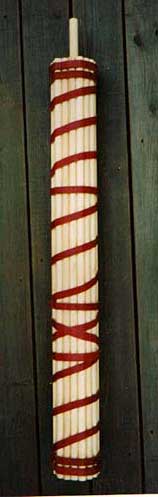
They say I worry too much. Do I worry too much? I’m worrying too much, aren’t I.
Saucy ganders.
The opening salvo (if ever it had an opening):
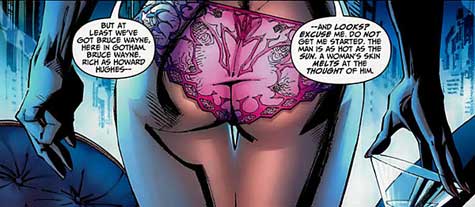
(Some little context, by way of the script:
 )
)
The recent escalation:

The perhaps inevitable but nonetheless (nonethemore?) welcome riposte:

And then—
Don’t mind me.
You know. Distracted. Reading. Painting shelves. Pushing a reel mower through a month’s worth of shin-high grass. That sort of thing.
I thought I’d gone mad for a while there and was imagining we’re now a country that sanctions torture and secret imprisonment without trial and monarchial, even theocratic power vested in a deeply unpopular ruler and preemptive war and the use of nuclear weapons, but then I got better.
I know what you want; your magpies have come.
“And She Was,” Talking Heads; “Cory’s Song,” Kid Creole and the Coconuts; “Green Finch and Linnet Bird,” Sweeney Todd, the Demon Barber of Fleet Street; “Appalachian Spring (As at first, slowly),” Leonard Bernstein, the New York Philharmonic; “Come to Daddy (Little Lord Faulteroy mix),” Aphex Twin; “Gateway,” the Seatbelts; “Yes, Anastasia,” Tori Amos; “The Natural World,” Robin Holcomb; “Lute Score,” Momus; “Broken Arm,” the Weird Weeds.
That woman.
Yes, she’s a horrible, soulless monster. Yes, her latest “book” is an insult to millennia of literate endeavor. But my God, do you have to keep posting those photos of her in your blogs? —Every time you say her name, you feed the dead light in her eyes, and Baby Jesus is forced to strangle another frolicking kitten. (Also, the man-hands jokes, and the bits about the Adam’s apple? Not getting funnier every time you tell them. Hate to be brutal, but.)
Something to keep in mind (Jupiter drops).
It’s maybe, what, fifteen blocks from our house to Salon Bédé? We usually walk it. And if I am for whatever reason walking by myself, I take my iPod. I take my iPod whenever I’m walking anywhere. It’s nice to have on the bus—that and a book and you’ve got your isolation bubble firmly in place (you and maybe half of everybody else)—but when I’m walking, I can hear it better. When I’m walking, I’m not doing anything else.
Last night, around about 42nd, something, I don’t remember what, but let’s say it was “Cyberbird” for the sake of argument, it fluttered to a stop, and then that rising ghostly hum-chord began, and crawling up out of it that unearthly backwards guitar, and maybe it was because it was a chilly night and I’d only grabbed a light jacket, but you know how Robert Graves goes on about poetry and the shaving mirror and the hairs on your chin? It was like that, only all the way down to my toes, and I stood there hanging between one step and the next until he began to sing, and it’s not the first time that’s ever happened.
And yet it isn’t the song, is it? Just? I’d play it for you, and you’d say maybe that was nice, or huh, but you wouldn’t hang there, unstuck from the moment-to-moment. (Unless.) —It’s everything I’ve put into the song, everything that unfolds when I hear it begin to play, a key only I can use for a lock only I’d want to open. —It’s all so very, very big. Without the song, where would I put it?
Here’s an alternate take on “Ubiquity is the abyss”; a polished remix of the earlier rough demo track. “Songs are fascist immigrants,” says Momus, elsewhere; “conquistadors who’ve come, inevitably, to slay indigenous sound wherever they find it.” —Well, yes. But not just slay. And not just sound.
Just so you know:
if you’re making oatmeal for breakfast and you put on the butter and the brown sugar and the milk and haven’t had enough coffee yet to realize you’ve just grabbed the cumin and not the cinnamon, well, it’s still edible.
Go, and do thou likewise.
According to Susan Tully of the Federation for American Immigration Reform (FAIR), many Roman Catholics are unhappy with their church leaders who, like Mahony, advocate for illegal aliens. “I am a Catholic, and there’s a whole bunch of us who are calling for a boycott of the Catholic Church,” she says.
“In other words,” Tully explains, “we’re telling other Catholics, ‘If you want to go to church to receive communion and a service or whatever, that would be fine, but do not financially support [the church].” And as for Cardinal Mahony, she contends, it is important for church members to remember what is truly motivating him.
—“Activist Urges Boycott of Catholic Leaders Who Support Illegal Aliens,” Agape Press
And, behold, a certain lawyer stood up, and tempted him, saying, Master, what shall I do to inherit eternal life?
He said unto him, What is written in the law? how readest thou?
And he answering said, Thou shalt love the Lord thy God with all thy heart, and with all thy soul, and with all thy strength, and with all thy mind; and thy neighbour as thyself.
And he said unto him, Thou hast answered right: this do, and thou shalt live.
But he, willing to justify himself, said unto Jesus, And who is my neighbour?
—The Gospel According to Saint Luke,
chapter 10, verses 25 – 29
—cross-posted to Sisyphus Shrugs
Later than eleven, trying to make the earth into a heaven.
Ran Prieur falls down six times. You can get up seven, if you like.
Jupiter drops (four).
Where were we?
Opening fanfare, check. The basic theme; motives, episodes; the countersubject—
I’m beginning to be dissatisfied with the idea of CDs, the way they make all music so available to us, the way that all musical experiences are supposedly able to be shrunk down to fit this little plastic disc. I’m beginning to think it should be as difficult to hear music as it was in the Middle Ages. Imagine just hearing a concert once a month, how amazing it must have sounded!
What a strange thing to say. —“I’m beginning to think it should be as difficult to read as it was in the Middle Ages. Imagine just seeing a book once a month, how amazing it must have seemed!” Imagine a glass of wine just once a year—the taste! (The anticipation of the taste; the concentration brought to the tasting; the memory of the taste—a whole language constructed to better remember that taste—) Imagine: sex, but once in your lifetime. What an amazing experience!
What a terrible price to pay, for such fleeting evanescence.
It’s a strange thing to say, isn’t it, for an airport musician, a furniture musician, a knife-and-fork musician?
The concept of music designed specifically as a background feature in the environment was pioneered by Muzak Inc. in the fifties, and has since come to be known generically by the term Muzak. The connotations that this term carries are those particularly associated with the kind of material that Muzak Inc. produces—familiar tunes arranged and orchestrated in a lightweight and derivative manner. Understandably, this has led most discerning listeners (and most composers) to dismiss entirely the concept of environmental music as an idea worthy of attention.
Over the past three years, I have become interested in the use of music as ambience, and have come to believe that it is possible to produce material that can be used thus without being in any way compromised. To create a distinction between my own experiments in this area and the products of the various purveyors of canned music, I have begun using the term Ambient Music.
—Brian Eno, “The ambient music manifesto”
To say that an airport musician has said?
As usual, Brian Eno was the first person I’m aware of to sound a warning note. In an interview he gave around the time he moved to St Petersburg, he said (I quote from memory)—
Yadda yadda concert but once a month amazing. —So I went and poked around for an interview given by Eno around the time he moved to St. Petersburg, in which he expressed his dissatisfaction with CDs. I wanted to see his own words, not Momus’s memory of his words; I wanted to get closer to how Eno had squared this particular circle. And I did find the column he wrote around the time he moved to St. Petersburg, in which he said:
I was in a big art gallery in Los Angeles once. There was a Frank Stella painting about 60 feet long, and next to it a tiny, jewel-like eight inch square collage, and a little further along a Boltanski piece using framed black and white photos and table lamps and boxes of old clothing, and next to that a Nam June Paik sculpture made of working TV sets. I found myself envying visual artists the endless range of forms their productions could take—big, small, 2D, 3D, 4D, colourful, dull, glossy, rough, smooth, figurative, abstract—and I compared it in my mind with making a CD. Suddenly that seemed like a narrow bottleneck through which all music had to be squeezed. Imagine if you said to all the visual artists of the world: “Okay guys… from now on the only way that people are going to see your work is in magazines—on 11" x 8" colour pages.” What would happen to painting? Well, Frank Stella probably wouldn’t bother with making his things 60 feet long—he’d make something that looked adequate at the 11" x 8" scale. Similarly all the others…. because if the final format is only capable of certain things, that’s what you’ll end up regarding as your working palette.
So what I find exciting now is discovering music that hasn’t obediently designed itself to slot within the constraints of this arbitrary medium—recorded music—and which is somehow bigger than it, overflowing at its edges, extending beyond its horizons. Yes—I want to feel the music is too big to fit on a little old CD, that there is more to it than that, that it has a separate life from my hi-fi—a life I can imagine and add to my aural experience of the music.
Not a word about the ubiquity of music. Just the ubiquity of CDs. Not a word about the Middle Ages, or concerts once a month, but more, much more, and other and better and bigger and different. —And I don’t want to suggest that my search was in any way exhaustive. There could well be another interview or column somewhere about St. Petersburg that I missed, which starts with dissatisfaction and ends up with self-denial. There could be a remark somewhere else entirely, taken out of its other context, conflated. But I don’t want to suggest that Momus misspoke, or misremembered; he has as much Google as the rest of us. Nor do I wish to imply that he made up an authority to cite, the better to drive home his point. (The lurkers support him in email!) But I do want to remind you of his current gig: he’s the Unreliable Tour Guide for the Whitney Biennial.
And anyway, it isn’t the ubiquity of music that Momus is railing against, any more than it’s the fornication and the silk and the wine and the musical instruments that will lead Allah to let the mountain fall.
Exit strategery.
Meanwhile, Joseph Cannon puts an unsettling story about the steam tunnels under the Capitol next to a recently passed rule regarding the decapitation of government and comes up with a brutally elegant solution to pretty much every last one of the Republicans’ problems. —And while I am well aware that indulging in this sort of conspiracy-mongering and irresponsible speculation is little more than a cheaply glowing pellet, nevertheless: we are all nutbar conspiracy theorists now. It would be irresponsible not to speculate.
Jesus H. Christ in a jumped-up flaming sidecar going over a cliff with a drunken rebel yell.
My God, my God, they really are gearing up to fight the last war.
To determine how much the nuclear balance has changed since the Cold War, we ran a computer model of a hypothetical US attack on Russia’s nuclear arsenal using the standard unclassified formulas that defense analysts have used for decades. We assigned US nuclear warheads to Russian targets on the basis of two criteria: the most accurate weapons were aimed at the hardest targets, and the fastest-arriving weapons at the Russian forces that can react most quickly. Because Russia is essentially blind to a submarine attack from the Pacific and would have great difficulty detecting the approach of low-flying stealthy nuclear-armed cruise missiles, we targeted each Russian weapon system with at least one submarine-based warhead or cruise missile. An attack organized in this manner would give Russian leaders virtually no warning.
This simple plan is presumably less effective than Washington’s actual strategy, which the US government has spent decades perfecting. The real US war plan may call for first targeting Russia’s command and control, sabotaging Russia’s radar stations, or taking other preemptive measures—all of which would make the actual US force far more lethal than our model assumes.
And anyway, they’ve lied about every other goddamn thing they’ve ever done.
When pretending to be “muy borracho” so the madcap stereotypical third-world bus driver will slow down and move over, you don’t take the time to explain to the bus that no, really, you’re only projecting an implacable, irrational lethality; honest, this is merely normal, defensive driving, and your priority is a diplomatic solution to a problem everybody on the highway can recognize. —That shit’s for whoever’s sitting white-knuckled in your passenger seat, mentally running the numbers as to how fast you’re going and how quick they can get the door open and how soft the shoulder might be.