


34°4'48" N, 49°42'0" E.
Arak is not an old city, though it is the capital of the Markazi Province, one of the oldest settled areas on the Iranian plateau.

That white patch in the upper-right is a sometime lake and salt-flat, if I’m remembering correctly. It’s the Kavir-e Mighan (or Miqan, or Miyqan, or MeiQan, depending), except this page says it’s the Shur Gel. I don’t remember; I do remember seeing plumes of dust rising hundreds of feet into a hard blue-white sky, the only sign of a convoy of trucks driving across it, lost somewhere in the shimmering heat-haze.

There’s a university in Arak, now: the Islamic Azad University of Arak, founded in 1985, some 23,000 students, degrees in drama, agricultural science, Islamic theology, English literature. —Actually, there’s several universities: the Arak University of Medical Sciences, the University of Arak, the Tarbiat Moallem University of Arak, a campus of the Iran University of Science and Technology. I don’t know how old any of those are. I don’t remember any of them; I remember a small town and dust and open sewers and the incongruities of an American-style suburb thrown up away from all that, platted blocks of yellow grass and red-brick houses and the high-rise apartment towers off over that way.

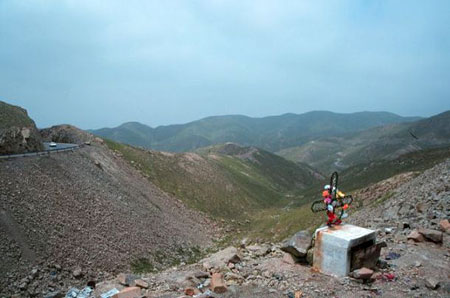
If I’m remembering correctly, the suburbs were at the southern end of Arak; we looked out on the mountains to the south and west. We’d drive up there and go tromping about. I spelled my name in flat rocks with letters taller than myself in the snow, but when we got back in the car and drove back down to our house and I got out and looked back, I couldn’t see them. When we went out into the country for the last day of Nawruz, I remember it looked a lot like this:

And I remember we could look out the window of our car and see farmers threshing wheat the way they had for centuries:

But if nothing changed for centuries, a lot can happen in thirty years.

Thirty miles to the northwest these days there’s a brand-new heavy water production plant. Heavy water is water made with deuterium atoms, rather than simple, light-water hydrogen; it’s used to moderate neutrons in nuclear reactors that run off natural uranium, rather than enriched uranium. Just the ticket if you’re trying to get a nuclear program off the ground.
I haven’t seen the list of 400 possible sites the president plans to attack in Iran, but I can tell you the Arak heavy water facility is on it. I don’t know if it’s hardened enough to require a nuclear bomb. If so, it’ll (probably) be a B61-11, which could generate between 25,000 and 1.5 million tons of radioactive debris—depending on the yield “dialed in”—some thirty miles northwest of a house I lived in, thirty years ago.

If not, it’ll just take a lot of conventional ordnance. —And I know, I know: who cares? The Russians loved their children, too. So did the Iraqis.
I just can’t help but take this personally. I’m only human.
—cross-posted to Sisyphus Shrugs



Mutually assured destruction.
Veteran Washington Post columnist Mary McGrory accompanied me on one of my futile visits to his office, where she spent better than an hour listening to us argue about “circular errors probable” and “MIRV decoys” and the other niceties of nuclear nightmare. When we were leaving, she, who had seen a lot of politicians in her long day, turned to me and said, “I think your guy Cheney is the most dangerous person I’ve ever seen up here.” At that point, I agreed with her.
What I was not thinking about, however, was the technique I once used to avoid being run off the road by Mexican bus drivers, back when their roads were narrower and their bus drivers even more macho. Whenever I saw a bus barrelling down the centerline at me, I would start driving unpredictably, weaving from shoulder to shoulder as though muy borracho. As soon as I started to radiate dangerously low regard for my own preservation, the bus would slow down and move over.
As it turned out, this is more or less what Cheney and his phalanx of Big Stategic Thinkers were doing, if one imagined the Soviet Union as a speeding Mexican bus…
And I wish to God I could believe it was nothing more than this; nothing more than a projection of implacable, irrational lethality, a bit of cakewalk brinksmanship, steely-eyed diplomats pounding tables to distract from the inevitable blink.
Some operations, apparently aimed in part at intimidating Iran, are already under way. American Naval tactical aircraft, operating from carriers in the Arabian Sea, have been flying simulated nuclear-weapons delivery missions—rapid ascending maneuvers known as “over the shoulder” bombing—since last summer, the former official said, within range of Iranian coastal radars.
Last month, in a paper given at a conference on Middle East security in Berlin, Colonel Sam Gardiner, a military analyst who taught at the National War College before retiring from the Air Force, in 1987, provided an estimate of what would be needed to destroy Iran’s nuclear program. Working from satellite photographs of the known facilities, Gardiner estimated that at least four hundred targets would have to be hit. He added:
I don’t think a U.S. military planner would want to stop there. Iran probably has two chemical-production plants. We would hit those. We would want to hit the medium-range ballistic missiles that have just recently been moved closer to Iraq. There are fourteen airfields with sheltered aircraft. . . . We’d want to get rid of that threat. We would want to hit the assets that could be used to threaten Gulf shipping. That means targeting the cruise-missile sites and the Iranian diesel submarines. . . . Some of the facilities may be too difficult to target even with penetrating weapons. The U.S. will have to use Special Operations units.
One of the military’s initial option plans, as presented to the White House by the Pentagon this winter, calls for the use of a bunker-buster tactical nuclear weapon, such as the B61-11, against underground nuclear sites.
—Seymor Hersh, “The Iran Plans”
But we cannot trust the people we’ve put in charge of our country. Whether they’re thinking of Iran’s nascent nuclear program as John Perry Barlow’s speeding Mexican bus or not, the fact is they will not blink and they will not falter and they will not turn away.
Can I be crystal fucking clear for a moment? The destruction I mean is not some tit-for-tat exchange of container nukes for bunker-busters. (It’s not like the people we’ve put in charge of our country will miss New York and LA all that much anyway.) —What I mean is if we do this thing, the audiences of tomorrow will cheer as their pulp heroes bravely square off toe-to-toe with implacable American stormtroopers. What I mean is, there is no difference in this world or the next between dropping enough conventional and nuclear ordnance to take out 400 suspected sites and flying a couple of passenger jets into office buildings on a cloudless autumn day. Either is so monstrous as to be beyond any possible, rational measurement or comparison.
Look! See! How good we have gotten, at fighting dragons!
Dies Jovis.
“Lekar Ham Diwana Di,” Asha Bhosle, Kishore Kumar; “Time to Go,” Supergrass; “Stoned to Say the Least,” Saint Etienne; “Olson,” Boards of Canada; “The Laird of Inversnecky (premix),” Momus; “Can’t Get You Out of My Head on a Blue Monday (live),” Kylie Minogue, New Order; “The Beauty Regime,” The Divine Comedy; “Finisterre,” Saint Etienne; “Five Spot Blues,” Thelonious Monk Quartet; “Ba Doum,” 3 Leg Torso.
A brief descent into gearheadery.
I am a Mac baby, because the Spouse is a graphic design professional, and the gearhead of the family, so I usually run her handmedown machines, and graphic design professionals roll with Macs, and also Windows sucks. —Anyway, Boot Camp, about which I have little to say myself except I can now run jobstuff like Summation on my personal machine should I so choose, so yay, but I did want to share this delightful little joke which rather succinctly demonstrates why Steve Gilliard is, well, wrong:
What’s the difference between OS X and Vista?
Microsoft employees are excited about OS X...
Jupiter drops (some further context).
Bunk has suffered through Gram Parson’s “Streets of Baltimore” on a hillbilly bar’s juke, just as Herc has been forced to police West Baltimore amid the throbbing bass lines of what passes for rap these days. Which is the point, perhaps.
“In real life you don’t get to punch the button on the song that you want to be playing when you get into the bar fight, when you’re in a car chase,” said Simon.
And so we have these buttons being punched on The Wire: 1972’s “Brandy (You’re a Fine Girl),” by Looking Glass, played on a beat-up radio in the stevedore’s pierside shack when Frank Sobotka was worried about a can of contraband languishing on the docks; the Tokens singing that ridiculous, everything-that-Bob-Dylan-is-not folk song “The Lion Sleeps Tonight” as Jimmy McNulty and sons follow Stringer Bell through a city market; prosecutor Rhonda Pearlman, stuck at home doing paperwork, listening to the plaintive poetry of Lucinda Williams.
Yet one rule is strictly observed: All of the music has to be ambient, meaning it has to be justified by a source in the scene, either a boom box or a stereo or a car radio or a band belting it out in a bar that doesn’t even have a stage.
—George Pelecanos, “The Music of The Wire”
Might as well go with the flow of it. Jim puts on his “Supertragic Symphony,” a concoction of his own made up of the four saddest movements of symphonic music that he knows of. He’s recorded them in the sequence he thinks most effective. First comes the funeral march from Beethoven’s Third Symphony, grand and stirring in its resistance to fate, full of active grief as an opening movement should be. Second movement is the second movement of Beethoven’s Seventh Symphony, the stately solemn tune that Bruno Walter discovered could be made into a dirge, if you ignored Beethoven’s instruction to play it allegretto and went to adagio. Heavy, solemn, moody, rhythmic.
The third movement is the third movement from Brahms’s Third Symphony, sweet and melancholy, the essence of October, all the sadness of all the autumns of all time wrapped up in a tuneful tristesse that owes its melodic structure to the previous movement from Beethoven’s Seventh. Jim likes this fact, which he discovered on his own; it makes it look like the “Supertragic Symphony” was meant to be.
Then the finale is the last movement of Tchaikovsky’s Pathetique, no fooling around here, all the stops pulled, time to just bawl your guts out! Despair, sorrow, grief, all of czarist Russia’s racking misery, Tchaikovsky’s personal troubles, all condensed into one final awful moan. The ultimate bummer.
What a symphony! Of course there’s a problem with the shifting key signatures, but Jim doesn’t give a damn about key signatures. Ignore them and he can gather up all of his downer feelings and sing them out, conduct them too, wandering around the ap trying feebly to clean up a bit, collapsing in chairs, crawling blackly over the floors as he waves an imaginary baton, getting lower and lower. Man, he’s low. He’s so low he’s getting high off it! And when it’s all over he feels drained. Catharsis has taken place. Everything’s a lot better.
—Kim Stanley Robinson, The Gold Coast
Shorter 2007:
Because we had to nuke Iran, we drove what was left of this country completely into the ditch.
Emir el Bahr.
The Week—Felix Dennis’ Readers’ Digest for polijunkies—had their 3rd Annual Opinion Awards ceremony last night. One of the awards they give is “Blogger of the Year”; Joshua Micah Marshall won the first one ever given out, Powerline got it last year, and last night, Ed Morrissey was so honored. “Who?” I said to myself. [Google.] Oh. Okay. Maybe I need to get out more? —Meanwhile, the Koufax winners have been announced, and Felix Dennis is selling Dennis Publishing, purveyors of Blender, Stuff, Maxim, and The Week. Chin-chin.
Jupiter dropping elsewhere.
Ned Jingo says some things—about creating music, and consuming it—that are not inapposite.
Jupiter drops (three).
Momus—that creepy Scottish guy? world’s smartest pop star?—Momus wants to take your iTunes away.
That’s not an apt comparison, because literature is not a time-based medium that hogs bandwidth and restricts the other things you can do with sound while it’s “playing.” The comparison between an iPod and a book is a slightly better one, and I do note approvingly the iPod’s tendency to “privatize” the listener’s taste.
Well. Not so much take your iTunes away. Certainly not your earbuds. But your Limewire? Your BitTorrent? Your 60-gig hard drive? Your wall of CDs? Your ten thousand songs every one of which instantly sortable by title or artist or key words or album or genre or folksonomic tags or play count? Your Friday random tens? Your MP3 blogs? Your rack of audiophilic equipment capable of reading wax ripples or lit-up bits or magnetic tape and running the signals through knee-high speakers placed in the room just so?
Music’s availability, streamability etc seems to be liberating, but when other people have the same access to, and control over, music that I do it can lead to a kind of sound hell. I’d say a parallel situation is cars: sure, if I get a car I get more mobility, more freedom of movement. But if everyone has a car, not only do we all end up in horrible conflictual gridlock, the environment suffers. We are now reaching car saturation, and music saturation, car gridlock and music gridlock.
Well, not quite so much them, either. Not as such. There’s rhetoric, and there’s praxis. —But still, puritanical trickster that he is, he’s after some way to pull music back to a one true only—
But for whatever reason, Steve and Rupert and the others have squeezed music into every blank bit of space in our lives. We are rapidly reaching the limits of our own ears (tinnitus, my headphoned friend?) and the saturation point at which music becomes utterly unremarkable, and thus, effectively, inaudible.
As usual, Brian Eno was the first person I’m aware of to sound a warning note. In an interview he gave around the time he moved to St Petersburg, he said (I quote from memory) “I’m beginning to be dissatisfied with the idea of CDs, the way they make all music so available to us, the way that all musical experiences are supposedly able to be shrunk down to fit this little plastic disc. I’m beginning to think it should be as difficult to hear music as it was in the Middle Ages. Imagine just hearing a concert once a month, how amazing it must have sounded!”
current music: “Alegria,” Kirsty MacColl
Still a tool after all these years.
Andrew Sullivan cranks up the conveyor belt to help mainstream the dangerously stupid and disastrously reductive bullshit attacks on ecologist Eric Pianka. Roy tells you why it’s stupid and reductive, and PZ tells you why it’s dangerous and disastrous, and the Panda’s Thumb has some links to what really went down. Death threats and creationist anti-intellectualism, ahoy!
Aphorism.
When New Yorkers say “Fuck you,” they mean “Hello,” and when Angelenos say “Hello,” they mean “Fuck you.” —When the right wing says “Fuck you,” they mean “I want to take an axe handle and beat you to death, you traitorous cunt, and hang your faggot body from a tree branch for all the world to see.”
Jupiter drops (two).
There’s this co-worker I no longer share an office with which is probably for the best, since she didn’t really like my music. (Still doesn’t. Except the Ella.) She’d mutter about those fake Russian lesbians or that creepy Scottish guy (I think it was “Scottish Lips” was how she knew he was Scottish) and the Bollywood (though the Bollywood was okay, maybe a little funny, and you never know what they’re singing about), and maybe she had a point about how hard it was to work to Muslimgauze. (Before her, before I ripped our entire collection to a 60-gig drive the size of my hand, the guy I used to share the office with brought his CDs and I brought my CDs and we’d trade off and that’s how I learned about RJD2 and Sigur Rós and how he learned about Godspeed You! Black Emperor and Robin Holcomb, maybe.)
But the thing she really hated was the mashups. —She didn’t like covers in general, really; she wanted the platonic ideal, the ultimate Joe Meek effect, the one you hear on Akashic radio, and I can sometimes see her point: I’ve never been so disappointed as when I sat down to listen to Vladimir Ashkenazy’s rendition of Sibelius’ Fifth and found the sombre joy in the face of the inevitable that builds to those staggering, heart-stopping beats at the end of the third movement transformed to something nameless, brusquely middle-management, impatient to be done and up and on to the next. (It’s Lorin Maazel and his Wiener Philharmonik you’ll be wanting.) —But the mashups really got her goat: the look on her face, say, when Kelis starts rapping about her milkshake over Brian May’s crunch?
I believe I’ve mentioned these days I work in a document coding shop? Back when I was still out on the floor, back before iPods and iTunes, or at least their ubiquity, somebody set up a tinny little radio and left it tuned to this soft rock station day in, day out to help us get through the tedium of day in, day out data entry. —I still get this uncontrollable tic whenever I hear the opening bars of “Drops of Jupiter.”
Jupiter drops (some context).
It is told to us by a long and unbroken isnaad of men of good character, known for their memories and their precision, that the Prophet (may the blessing and peace of Allah be upon him) has said: “There will certainly be those among my ummah who will allow fornication and silk, wine, the playing of musical instruments. Some of these people will stay at the side of the mountain and they will keep flocks of sheep. When a beggar comes in the evening to seek alms of them, they will say to him, ‘Come back to us tomorrow.’ And during the night, Allah will let the mountain fall down upon them, and others he will transform to apes and swine. They will remain as such until the Day of Resurrection.” —This is found to be neither odd nor faulty.
The fact that listeners hear the same emotion in a given musical score is something a Neanderthal crooner might have exploited. Music can manipulate people’s emotional states (think of liturgical music, martial music or workplace music). Happy people are more cooperative and creative. By fostering cooperation and creativity among bands of early, prelanguage human ancestors, music would have given them a survival edge. “If you can manipulate other people’s emotions,” says Prof. Mithen, “you have an advantage.”
—Sharon Begley, “Caveman crooners may have aided early human life”
Early in the twentieth century, however, the new science of industrial efficiency management was electrified by the discovery made at an indoor bicycle race held in 1911 at the old Madison Square Garden in New York. A brass band was part of the entertainment, and statisticians clocking the race discovered that cyclists’ average speeds shot up by about ten percent during the band’s sets. Five years later, a commercial laundry experimented with playing ragtime records; productivity increased dramatically when ironing was done in time to the music. In 1922, the Minneapolis post office tried playing records in its night sorting room and found that sorting errors fell.
By 1930, many American factories provided some sort of music, either live or phonograph, and the numbers of workplaces where music was supplied increased steadily…
—Nick Humez, “Muzak,” the St. James Encyclopedia of Pop Culture
The important thing about music from an Islamic view is that music expresses, or seeks to express, emotion. The purpose of music, when performed or recorded, is to produce an emotion, or emotions, in the listener—to affect the listener.
Islam is concerned about music because : (1) Islam believes that human emotions should be controlled because this control of our emotions is demanded of us by Allah (tabarak wa’tala)—it is what makes us human, and civilized, and enables us to remember Allah (tabarak wa’tala), and so access and maintain the numinous (the sacred) in our own lives; (2) listening to or playing (or re-producing) music on instruments or musical devices involves a lack of control because the music is the product of someone else’s mind and/or emotions and in the vast majority of instances is un-numinous: that is, it is profane, and seldom if ever is a remembrance of Allah (tabarak wa’tala); instead, music mostly conspires to distance us from Allah (tabarak wa’tala): it is mostly entertainment; distraction; frivolity; and mostly, in the modern world, a representation of what is Shaitanic—lust, greed, self-indulgence, pride, arrogance, loss of self-control.
The point is that music is a human construct, a human creation, and when we respond to music we are responding to or being influenced by this human attempt at creation. This applies even if a piece of music is an attempt at some sort of “communication” rather than an overt, obvious, expression of emotion; the music is still a human construct, and it is still an attempt to convey something fallible: someone else’s ideas, concerns, beliefs, notions, limited understanding or whatever. This also applies even—particularly—if the music is considered “religious”: that is, it is an attempt to re-present something of the sacred, the divine. In this case, there is a reliance on someone else’s perception or understanding of the sacred, the divine, and this is and always will be imperfect, error-prone and ultimately unnecessary. For Islam believes that the perfect perception, the perfect understanding of the sacred, the divine, already exists—in the Holy Quran, and the example of the Prophet Muhammad (salla Allahu ‘alayhi wa sallam). Thus, music—of whatever kind—is itself at best irrelevant and unnecessary, and at worst, a distraction, a path away from Allah (tabarak wa’tala), and a denial of that self-restraint which makes us human.
—Abdul Aziz, “Why Music is Haram”
When I was thirteen, I had a friend who was in his twenties. He began helping my father, who was in charge of our youth group. The music he listened to was wrong, and as I became closer to this guy, I began to listen to his music and began to get deeper into it. Finally, it was to the point that it no longer satisfied the flesh and I wanted more. So I then started to listen to regular, secular rock music, and it caused moral failure in my life.
I would warn anyone who would experiment with “Christian rock” not to do so, or it is likely that the same result would happen to them. Thank you!
—a 16-year-old student from Michigan
She checks out Mozart while she does tae-bo—
Grandson of the Beast.
On the one hand, April fish. On the other, God damn but the resemblance is eerie, now you point it out.