

Noted without comment.
BEGALA: Greg, one of the ads concludes with President Bush praising freedom, faith, families and sacrifice. What sacrifice has our president asked of the rich?
MUELLER: I think everybody’s making money right now. We’ve got a Hispanic middle class, The New York Times reported about last year. George Bush created a Hispanic middle class.
—Republican strategist Greg Mueller on Crossfire, via South Knox Bubba



South Park Agonistes.
“Conservative Punk Rockers?” I said, befuddled. “Well shit, Toby. It must really just be all about the clothes and the belts at this point, huh. I mean, if some kid can listen to a top ten pop song that sounds just like the other 9 top ten pop songs, support the regime occupying the white house, comb his gentleman’s Mohawk down into a respectable hairdo when it’s time for school and still call himself a punk, then it really has nothing at all to do with the ideas and ideals that got me into this whole thing when I was a kid. You know what Toby. Let’s give those fucking Simple Plan listening, Paul Wolfowitz supporting, spiky belt wearing conservative kids the word ‘punk’. It’s pretty useless at this point anyway, and I think that we could come up with a much better and less saleable word for a community based around songs inspired by anger and frustration and played by untalented musicians. Don’t you think, Toby?”
—Brendan Kelly, of the Lawrence Arms
Indeed. But:
Hippie was ten years old when punk was born—and that was 25 years ago! At least hippies don’t identify themselves as hippies—let alone whine about weekend hippies—anymore. I think you can safely call punk the far more conservative pattern of subcultural self-identification through the purchase, display and consumption of the proper commodities.
It’s kinda nice, how those two quotes talk to each other. Then you have to go and follow the links and realize that yes, Virginia, there is a conservative punk movement, and no, Virginia, it’s not bleeding-edge satire.
I was never punk. (Everybody who knows me done giggling up their sleeves? Thank you.) I was never punk; in high school I ended up with the Eclectics, who straddled the divide between art geeks and drama geeks. We didn’t dress any funnier than your average high school student in the late ’80s—okay, there was the fad for hospital pants, and I was famous for my Clint Eastwood serape, and Cith had a thing for porkpie hats. We listened to a lot of Prince and Joe Jackson and Robyn Hitchcock, and I still remember the day I stood in whatever it was we had before Sam Goody’s, staring at the wall display of Lifes Rich Pageant and The Queen is Dead, wondering which to buy (and now I wonder what might have happened if I’d bought the other); X and the Dead Kennedys and the Butthole Surfers and the Sex Pistols and the Violent Femmes didn’t come to me till later, and even so, you can tell: I wasn’t punk. We danced badly on purpose at homecoming and put out one issue of a pseudonymous student paper and worshipped spoons and swore we’d never forget each other. (Of course it all goes back to high school! For God’s sake, when we die we’re going to wake up in heaven and it’s going to be the fucking Westerburg cafeteria.)
I was never punk, but I can tell you this with great authority and a straight face: Stavros is punk. The chumps linked above? Not.
For all the good that does. —Now that I’ve drawn my silly little line in the sand, let’s admit it: DIY is profoundly attractive to the sort of libertarian who walks what so many people would rather talk, and there’s a certain conservative thrill to standing athwart the nasty brutishness of the world and yelling right back at it, and this day and age, if you’re on campus and silly enough to be duped by Horowitz’s moonshine, you might actually think you’re speaking truth to power. (One could also think of the characters in Repo Man as role models, to be perfectly snarky.) There’s no doubt that punk can vote Bush, or fight to repeal the estate tax, or post laudatory galleries of our soldiers at work in Iraq. But there’s a definite divorce of sign and signified here, one that rings some heavy-duty cognitive dissonance on anyone who went to high school back in the day. The plaid pants and the T-shirt panels safety-pinned to the backs of leather jackets, those deliberately ugly haircuts and the fuck-off sneers, the music (because it was always about the music, wasn’t it?)—it didn’t mean much, at least not coherently, but it did mean something, and it meant whatever it was that it meant with great fervor, and now it means—what? Let’s eat sushi, and pay a fair market price?
For fuck’s sake, remember when drawing Reagan with green hair was a sign of disrespect?
(Satire? ’Fraid not. But I still haven’t ruled out astroturf, myself.)
This is what marriage looks like.
So I learn from the ineluctable Kevin that Larry Lewis, ad salesman extraordinaire for Just Out (and the tireless engine of commerce that drove Anodyne to its giddy heights), married Cshea Walker. They’ve been together for over eleven years. Congratulations, guys; it’s about time you made honest men of each other. —Here’s the photos.
Juping the Man.
There’s a lot to love in this traveller’s sketch of script-kiddie culture: insight into the hows and whys, ruefully funny anecdotes, a new word (juped), and the general cultural vertigo of peering over the edge of something you knew was there but never really looked at and finding its as complex as just about everything else. —Plus, paranoiac fretting! (Not that there isn’t one hell of a lot to be paranoid about, here:
Roblimo: How wise do you think law enforcement is to any of this?
Andy: The general answer I’ve gotten is, “We don’t have the time or resources to have our agents monitor IRC.” They know, but they’ve adamantly got their fingers in their ears whistling loudly.
Roblimo: And yet, you’re telling me attacks on DoD and other critical networks are often coordinated on IRC.
Andy: Of course, Department of Homeland Security is barely off the ground. They’re starting to come around. Al Qaida, or whoever, with enough money could buy these kids, have them phonephreak 911 facilities, packet government mail and web servers, attack Department of Energy facilities and local and state government for large cities and states. Even if nothing really serious happened the effect on our economy, since the FBI and DHS’s answer has to be “Well, umm, we’ve been ignoring this entirely actually,” wouldn’t be fun to watch.
(Sleep tight, y’all.)
Sweet luvvin’ update.
Steve Lieber has unearthed a whole passel of people who intend to get busy with all manner of things once the bedrock of marriage is destroyed by those icky, icky gays. To quote the ink-stain’d wretch: “Remember, an elected official has made it clear that if you can marry someone with the same bathroom parts, you can marry anything.” So! Get with it, people! You’d better start snapping up your future spouses now, or when that blessed day arrives, you’ll be left out in the cold!
Our gay weddings, cont’d.
Betsy, whose whim is law, leads us off into more good discussion of the hows and whys of the county’s decision to issue marriage certificates to same-sex couples, and all I have time for this morning is to fling you a couple of links and hope for the best: be sure to check out this post at Jack Bog’s Blog, which features a comments-thread debate between the proprietor and Portland City Commissioner Randy Leonard. —The most interesting bit of news we learned this morning (via the One True b!X): Oregon Public Broadcasting reported on 25 February that the county was to consider the issue of same-sex marriage; the (rest of the) media and various opponents to the action look even more silly, now, claiming to have been blindsided by the Multnomah Four.
(Note to self: beef up the local links in the linchinography yonder.)
update— Thank you, Allen Brill! The good reverend has posted a link I’d seen and lost, to this post by Chuck Currie proving such Oregonian headlines as “Pastors unite in opposition” to be a load of shameless bullshit. (Don’t miss Brill’s other posts highlighting Christians, progressive and conservative, who are speaking out against the bigotry of the Federal Marriage Amendment and its various state-level clones and doppelgängers.)
Not quite cricket.
Jeff, the atrocity note-taker, raises a good point over on his other blog, and does so with more panache than the Oregonian’s editorial board: we probably ought to talk about how it is, exactly, that the commissioners of Multnomah County decided to start issuing marriage certificates to same-sex couples.
Here’s the nutshell: Oregon’s open meeting law requires that if a quorum of commissioners meet to discuss a matter of public policy, they have to announce that fact to the public, so they might attend if they so choose. Diane Linn, Lisa Naito, Serena Cruz and Maria Rojo de Steffey all deliberately met two-by-two to discuss obtaining a legal opinion on , to avoid the quorum and the subsequent attention of the public. —They also avoided mentioning anything to the fifth council member, Lonnie Roberts, who is not so coincidentally opposed to gay marriage.
Oops.
So, yes: this is sneaky. It isn’t cricket. The letter of the law was followed, sure, but the spirit of the law got mugged, in broad daylight. Frowny faces and tsk-tsks all around. The Oregonian is not without its point, and the hinterlands have thrown up the sorts of bloody shirts that make me worried about backlash. (Sure, Lars Larson has [reportedly] been reduced to a hoarsely incoherent roar of drive-time apoplexy, but failing to secure the future of equal rights and our state’s [recent] reputation as a [relative] repudiator of bigotry is too high a price to pay for such admittedly juvenile pleasures.)
That said, there’s a broader context to keep in mind, here.
First, let’s be real: if the matter were solely up to the residents of the People’s Republic of Multnomah County, then there’d already be gay and lesbian couples celebrating their silver anniversaries. (Okay. Maybe tin.) The spirit of the law has been roughed up, but none of the Multnomah Four need to worry that they haven’t represented the will of the people who elected them.
But it isn’t (just) up to us, of course. The county can no more compel the state or federal government to recognize the weddings performed than it can, oh, turn back the tide, or convince people that the thing with the Klingon interpreter was a humorous example of something within the realm of possibility rather than someone’s serious idea of an actual need to be met right here and now. And while I’d certainly like to think Oregon is bigger than the bigotry exhorted by some clergyfolk who really ought to know better, it’s still pretty clear that a constitutional amendment welcoming homosexuals into fully legal wedded bliss—or anything more than a vague arms-length I-don’t-wanna-hear-about-it quasi-tolerance—has no chance of flying in the here and now, if it were put to a state-wide vote.
This is a point in favor of the council’s actions, though. Much like the same-sex weddings performed in San Francisco and New Paltz and Sandoval County (and Seattle? and Chicago? and?), the same-sex weddings performed in Multnomah County face a myriad of state and national hurdles: everyone from their employers to their insurance companies to the Social Security Administration is playing wait-and-see, and everyone from the cubicle-bound bureaucrats to the teary-eyed joy-struck newlyweds knows these weddings can be dissolved with the stroke of a judge’s pen. (The county commissioners certainly know it.)
And the pundits ought to know it, and so should the Oregonian; they just get frothing mileage out of pretending otherwise: the county commissioners are ushering in an era of gay weddings without any open, public debate! —Yet gays and lesbians have been marrying each other for decades, in a wide variety of churches, all over the country. And Multnomah County already has a domestic partnership registry; gay and lesbian couples can share health insurance and adopt children. Heck, the fee is the same sixty bucks for either the registry or a marriage certificate! The step of erasing the final separation from equality is hardly so big as it might first appear—once you look past the name of the activity in question. (And what’s in a name?)
So: far from suddenly overturning the rule of law, and the definition of marriage as we’ve known it for millennia (polygamy, dowries, insistence on virginity, and that bit with the brother-in-law notwithstanding), the county has actually made a (relatively) minor change to rights already granted (and, yes, a relatively major symbolic gesture) that is still entirely contingent upon the interpretation of the state’s attorney general and the courts and the state legislature and the voters. It’s an attempt to force a challenge precisely where that challenge should be made, and a challenge (again) supported by a comfortable majority of the county in question. The dialogue continues; the rule of law obtains; the system’s working just fine.
That it was planned in secret, though? Hidden from their not-so-supportive fifth? In violation of the spirit of the open meetings law? (This was the point in question, remember.) Well, as with any act of civil disobedience, your take in part depends on how you feel about the ends toward which these means have been applied. The immediate ends here are not the legal and secure marriages of same-sex couples: those aren’t on the table yet, and haven’t been, in San Francisco or New Paltz or Sandoval County. (New York City? LA? Vermont?) We’re engaged in political theatre, here: the secret meetings weren’t the means toward the end of legal same-sex marriages; the open celebration of same-sex marriages are the means toward the end of civil rights. And it’s brilliantly savvy theatre, at that—every marriage solemnized in this blazing spotlight (as opposed, again, to the thousands, the hundreds of thousands, that have been solemnizes in Unitarian and MCC congregations and liberal synagogues and in the sitting rooms of bed and breakfasts and barefoot on the beach; wherever straights have gotten married, gays and lesbians have as well, for all you did to manage not to see them)—every marriage on the sidewalk outside the county offices in the rain with a news camera present puts a human face on this (thus far) largely abstract battle.
Gays and lesbians are an invisible majority, after all; the only time most of the country has to see them is acting up in sitcoms, or on the news, where every year the coverage of the pride parade skips over the gay police officers and the gay librarians and the gay government clerks and the gay senior citizens and the straight allies and zooms straight for the freakshow eyebite: the drag queen in the feather boa, the bare-breasted diesel dyke. (To trade in unfortunately broad stereotypes, which they do, of course; ignoring the obvious benefits these individuals bring to the world, which we shall take as read: we’re all choir here, for the most part, and this is going on too long already.) —Instead, the media has to focus on long lines of people just like everybody else lining up around the block for the same rights and the same dignity enjoyed by everybody else. Professionals and parents, besotted college students head over heels and sober old folks seeking recognition for half a century together, all of them just like everybody else, except—gay. (Meanwhile, in the background, a scattered handful of protesters behind yellow police tape holds up hateful signs. Radio pundits scream incoherently about intangibles, pushing buttons that don’t work as well as they used to. Respected conservative pundits in the field tell us we must oppress these people because gay sex is so much better than straight sex. It’s like heroin. No, really!)
(Which is why I’m not yet that worried about backlash this fall: Oregon is bigger than that, honest it is, and if the sky hasn’t fallen in because of same-sex marriages, we’ll leave well enough alone. —Always reserving the right to be bitterly disappointed, of course.)
So: an act of civil disobedience (the violation of the spirit of the open meeting law I’m talking about here, not the resulting change in county policy) to make possible a challenge that joins the gathering momentum of challenges from more and more cities and counties across the country, forcing the problem to be confronted in all-too human terms. —All due apologies to Lonnie Roberts, the commissioner left out in the cold, but I can live with that.
(After all, where’s the harm here? What’s been taken away from anyone, anyone at all? Tell me, please! The county’s making money, wedding planners are scooping up new business by the truckload, and the city and county are cementing just the sort of reputation that looks good to the sorts of creative enterprises we need to keep moving up those Best Cities lists. Look into the faces of the people waiting on line for their marriage certificates and show me the damage done by this intemperate, carefully planned action. Where’s the harm?
(And if you still feel this is a dangerous precedent to set, nonetheless, in spite of it all, the greater good notwithstanding, slippery sloping road to hell and all that, well, there’s the usual consequences anyone engaged in civil disobedience must face: in this case, the loss of good will, opprobrium from the court of public opinion, and, of course, the ballot box. —Somehow, I don’t think the four commissioners are all that worried.)
Those Bush ads.
Thanks to the Spouse, I’ve seen a still from the Bush ads crassly capitalizing on the pain and horror of 9/11. —Frankly, I think they could’ve been a wee bit more tasteful.
You break it, you bought it.
An article on the Fashion page on Tuesday about the British designer Alexander McQueen misstated a phrase from his remarks on the common professional desire to create a signature product. He said, “And you’ve just got to keep on striving until one day you’re waking up, having your marmalade on toast, doodling on a cigarette package—and bingo, Bob’s your uncle”—not “you bought an uncle.” (The slang expression means, roughly, “You’ve got it made.”)
—The New York Times correction page, via The Minor Fall, the Major Lift.
Oh, hell, while we’re on about uncles: Chris Bertram linked a wickedly funny piss-take on evolutionary psychology over at Crooked Timber.
[H]ere’s Pinker on why we like fiction: “Fictional narratives supply us with a mental catalogue of the fatal conundrums we might face someday and the outcomes of strategies we could deploy in them. What are the options if I were to suspect that my uncle killed my father, took his position, and married my mother?” Good question. Or what if it turns out that, having just used the ring that I got by kidnapping a dwarf to pay off the giants who built me my new castle, I should discover that it is the very ring that I need in order to continue to be immortal and rule the world? It’s important to think out the options betimes, because a thing like that could happen to anyone and you can never have too much insurance.
(Of course, Pinker’s original example has a po-faced absurdity all its own: just ask these gentlemen.)
You best believe I mean love l-u-v.
If same-sex marriage is allowed, it is going to be nearly impossible to prohibit the sanctioning of any other kind of human “relationship”—from close relatives of different sexes who wish to marry (that has been outlawed because of biological and incest considerations) and polygamists to adult-child “marriage.”
Oh, Cal. Cal Thomas. You have no idea. Once our godless footsoldiers succeed in destroying heterosexual marriage, why, the sky’s the limit. Here’s a little of what I, myself, will marry on that happy, blessed day:
- “Flim,” by Aphex Twin (or, “Flying North,” by Thomas Dolby);
- the sensation of presque vu;
- Kahimi Currie;
- Queen Elizabeth (as portrayed by Miranda Richardson);
- just about anyone else, so long as they’re drawn by Paul Pope;
- the scene at the end of Rushmore at the cast party for Max’s latest play, when he signals to the DJ and everybody starts dancing in slow motion to that song they later tried to fuck up in a car commercial but just barely managed not to;
- and, apparently, Orson Scott Card.
(Advantage Johnzo. Pass it on.)
Gimme that sky back, you gao yang zhong de gu yang!
“Houston, Serenity is go. Repeat, Serenity is go.” (I found the motherless goat thanks to this site, a “pinyinary” of the various Chinese curses scattered throughout the original television show.)
Let no one put asunder.
At about ten of nine, West Coast time, this Hampton Roads news site lists Multnomah County as being in Washington.
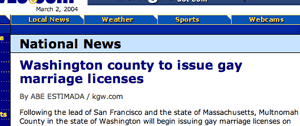
Multnomah County is actually located in the state of Oregon.
But I’m linking to it anyway, since it gacked the photo of Tai Jungcker and Kathy Belge from KGW.com (who want you to fill out a friggin’ form before they’ll let you read the news).
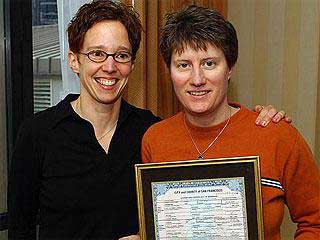
AP photo of Tai Jungcker and Kathy Belge, posing with their marriage certificate after a news conference for Basic Rights Oregon.
Tai Jungcker and Kathy Belge got a marriage certificate today.
They’re going to get married tomorrow, right here in Multnomah County.
God, it feels good to be on the right side of this wall.
update— The invaluable Jeff “Emma” Alworth provides some sobering but vital context.
further update— The illimitable Zoe Trope provides some giddy and equally vital photographs.
Sexing the pronoun.
A friend’s been going on about a recent inamorate: “Zie sent me a mix CD,” he’ll say, or “I can’t wait to see zir.” And on the one hand, I’m looking on with the bemusement of the comfortably entwined: gosh, aren’t they cute at that stage? On the other, my teeth are slightly on edge. Kids these days, with their hopped-up language, haring off after the latest fad without the least concern for tradition. Zie? Zir?
What the hell is wrong with hi and hir, huh?
At least, those are the gender neutral pronouns I recall as having (relatively) broad circulation, back in the day. But: as I teased my way back toward the day in question, trying to pin down the where and the when of how I’d first come across them, I was finding them decidedly slippery. I’d used them, of course, in a fanthing from 1987 or so—the androgyne sidekick of the steely protagonist of some third-generation xerox of Neuromancer: “Hi yanked hir ceramic throwing knife from the plastic telephone case and climbed out the window, lowering hirself into the neon-stained night,” that sort of thing. But I hadn’t invented them: who had? Who’d been using them? (I’d been reading a lot of Orbit , sure, but can we get more specific?) Had they just been in the air? Why had they gone away? Where had this zie and zir come from, and when, and was I out getting a beer or something while it happened?
And so we Google.
Our first stop is the vaguely dismissive Wikipedia entry, which doesn’t list my remembered set (hi, hir, hirs, hirself), but does inform us of two warring pronoun factions: sie, hir, hirs, hirself, and zie, zir, zirs, zirself, which was coined to address the possible confusion some saw in sie/hir’s overly femme tilt. But Wikipedia is criminally light on etymology and morally deficient when it comes to sourcing. “Some science fiction writers,” it says, helpfully hyperlinking science fiction, “have been known to use the sie and hir pronouns for fictional hermaphrodite characters.” Which authors, though? And what other pronouns? (Like hi, instead of sie?) —Trust me, in a herd of cats like “science fiction writers,” there’s no consensus. Especially for something so small as a pronoun.
(Wikipedia does list the first recorded usage of hir on Usenet, back in 1981—but the nominative form of this variant seems to be heesh.)
From there we move on to Dennis Baron’s “The Epicene Pronouns: A Chronology of the Word that Failed.” We have, it seems, abandoned the vagueness about our dismissal. —Baron’s list gives us a glimpse of how far back the quest for a gender-neutral English pronoun has stretched; how many have been tried; how none have caught on. He cites science fiction—we learn that LeGuin’s 1985 screenplay for Left Hand of Darkness used a, un, a’s (the novel, written in 1969, used then-generic he, his, him); we’re told that Klingon has the gender neutral ghach, and that Vulcan has no common gender pronouns—but that’s just ice skating over deep water, there. He does note the sie/hir faction (listed here as se/hir) is common on alt.sex.bondage in 1992.
(Baron also gives me at least a word that would probably have been useful all along: epicene. But: take a look at its dictionary definition, and you’ll start to get some idea of the problems we face when tackling something like gender and neutrality and pronouns. How can a thing which has characteristics of both the male and female also be sexless? How can it as well be effeminate and unmanly? —Baron also lets us know hi was indeed in use: in 1884, but as part of hi, hes, hem.)
From there we move on to the motherlode: the admirably monomaniacal Gender-Neutral Pronoun FAQ. The history page starts with William H. Marshall’s observation of the English epicene pronoun ou in 1789 and hares off into an impressively extensive listing. But again: light on the science fiction authors (then, why look to the words science fiction authors use? We want to know what real people say when they really talk about these things), and hi is still only noted as part of that 1884 set. I’m no closer to figuring out where my “broadly circulated” set came from, and when.
(It occurred as I was typing this up that maybe I’d been thinking of Medea: Harlan’s World; it’s about the right time, and the fuxes have a sexless if not entirely gender-neutral life-stage. But a quick browse through the usual suspects turns up no hits, and there’s no bloomin’ index. —Then again, maybe it was Alan Dean Foster?)
So why are all these attempts to give our language something it rather desperately needs doomed? (Are they doomed?) Well, it’s an attempt to consciously hack the way people speak and think, and the hack has a more-than-vaguely hectoring air about it: the way you normally think and speak is wrong, it says; this is the right way. That the champions of epicene neologisms do have a point exacerbates the effect. And we all know how popular Puritans are at parties. Call it the problem of utopia; like vegetarianism and dress reform and suffrage and free love and anti-vivisectionism and a fascination with esoterica and Asian religions, epicene pronouns bubble up every now and then, here and there, and when they recede yet again, well, maybe the high-water mark is a little higher than it was last time.
Progress.
Anyway: epicene pronouns aren’t enough. In a system of two genders, you need five sets of pronouns to cover all the bases properly demanded by an egalitarian politesse:
- male;
- female;
- androgynous, or epicene;
- sexless;
- assuming no gender at all, or non-specific.
The epicene pronouns, after all, still privilege gender (and sex): the person in question is assumed to partake of both. (This is how, by the way, epicene can at once mean “partaking of both sexes” and “effeminate, unmanly”: masculinity, after all, is a pure state of grace, from which one can only fall.) It would be best to have as well a pronoun set that one uses when it would be if not inappropriate then unnecessary to refer to a person’s sex (or gender) in the capacity in which one is addressing them: presidents and police officers, reporters and handyfolk, letter carriers and committee chairs. But it would be rude to say it: to deny their gender and imply they had no sex. Best to assume nothing.
(That’s the meaning of peh, the Spouse’s contribution to the field. —A modulation of penn, coined by Chas for use by his aggressively egalitarian Siblinghood of Wreckers and Freebooters, in our off-again on-again joint fantasy world. Saying “penn” in the game to refer to a hermaphroditic character got to be second nature rather quickly; unlike a lot of the aforementioned attempts at epicenery, it’s put together with an ear towards speaking: based on one rather than he/she, it runs penn, penn, penn’s, pennself.)
But if an epicene can’t make it, what hope has a true non-specific?
And anyway, we’re no closer to who planted hi and hir in my brain. Not that it’s all that pressing an issue: hi and hir might solve the bias problem that the overly effeminate sie and hir has, and it isn’t nearly so aggressively ungainly as zie and zir (the words, not the person): but say “hi” out loud, in the sort of context where one uses pronouns, and it’s all too quickly confused with “I.”
I think I like Delany’s game with pronouns best. In Stars in my Pocket like Grains of Sand—after an opening set on a grimly “normal” world (that is one of the most heartbreakingly beautiful pæans ever to the sheer power and beauty and necessity of reading) he rolls us into Marq Dyeth’s first-person narration, where she, her, hers, herself is the pronoun set of choice for addressing everyone you meet—except someone you desire. —Then it’s he, him, his, himself.
(And anyway, there’s always they. Are you not legion? Do you not contain multitudes?)
Peletaa kuullaah da-Qraabay Kawkbey.
To enhance your experience of The Passion of the Christ phenomenon, the Guardian has prepared a compilation of useful Aramaic phrases.
Auget largiendo.
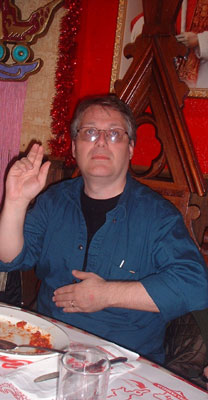
Scott McCloud, cartoonist.
APE, 2004; we all went to Bucca di Beppo’s on Saturday night and sat at the Pope’s Table.
Further photos forthcoming. (Email me with any name errors or corrections, would yez?)
Canadian television.
Yes, DeGrassi Junior High, and all those American shows that shoot Toronto for Manhattan and Vancouver for Jersey, but you’ve got to give it up for a sitcom that scores both David Frum and Noam Chomsky as guest stars.
The mind, reeling.
The president’s trying to enshrine the first discriminatory constitutional amendment as a bloody-shirt tactic to drum up more votes. His supporters are smearing war heroes while puffing up their own and blatantly lying about the record of his most likely opponent. We are finally hearing the truth about what the administration knew going into Iraq, and how little it had to do with what was said or what we did; the pay for soldiers on the front lines has been cut, the promised support for first responders never materialized, and callous privatization is hiding the true cost of this disastrous blunder. The president’s budget is a transparent joke, larded with boobytraps set to expire after his increasingly theoretical second term; every federal source of once-credible objective data and analysis has been poisoned by his political goals. Even science and the public health is subject to the political whims of the Mayberry Machiavellis. And if they are successful in openly stonewalling the investigation of the most devastating terrorist attack ever on American soil, we can at least rest assured that their obscene attempts to capitalize on the tragedy this coming September will not go as smoothly as expected.
Also, Kenny-boy still walks free.
(Aw, shit. I almost managed that with a straight face. I’m sorry. Lemme try it again—)