


Further, not-so-meaningless internet-related activities.
Billmon has uncovered the most glorious hack. It seems georgewbush.com has a really keen tool: enter your ZIP code, and it’ll bring up a list of your local papers. Type in the letter you wish to send to the editor(s), check off the papers in question, press the “send” button, and presto! You’ve siphoned off a tiny chip of his 200-million–dollar war chest and used it for truth, justice, and the American way. (If you’re at a loss, Billmon suggests you take the HRC or Lambda Defense Fund letters as boilerplate.)
What are you waiting for? Go” alt=”” /> Go!



The devil’s ice skates.
Seriously: Andrew Sullivan’s dish today is well worth your browsing time. No one thing: just email after email, pouring over the transom—
I am (or, I never thought I’d say it, was?) a dyed-in-the-wool Republican who (much like you) has spent the last two years proselytizing my liberal friends for GW. I am also a woman who has been in a committed same-sex relationship for 25 years. I feel like I was body-slammed today. What a quandary: I don’t know for sure that the Dems will be worse in the war on terror, but I do now know for sure the Republicans will be worse in protecting my equal rights. This is just a depressing day.
And this—
We’ve witnessed a shift in Republican politics. The Republican establishment used to pay lip service to religious conservative interests while openly courting independent voters with moderate policies because it knew it could get the religious conservative vote regardless (who were they going to vote for, Clinton!?). But now, it seems Bush is paying lip service to independent interests while openly promoting religious conservative policy. Who are we going to vote for, Kerry?
Well, yes.
But also—
President Bush didn’t “declare war” on the civil rights of homosexuals; left-wing activist judges, mayors, city bureaucrats and the gay movement have declared war on the rule of law and the institution of marriage. President Bush has merely responded to what others have started. The battle is now joined and I believe that the overwhelming majority of the country will be in the President’s army, as you’ll soon find out.
(Confidential to that last: you’re probably thinking of Arnold’s promise of blood in the streets if the marriages aren’t terminated right this minute, but you might want to re-think that whole “army” motif—considering the current C-in-C’s track record in that particular regard.)
Meaningless internet-poll–related activities.
Oh, go kick some homophobic wingnut ass, would you?
Andew Sullivan also has some interesting numbers for the currently faint of heart. (This is what it’s come to: I now stand shoulder-to-shoulder with Andew Sullivan. The mind reels.)
And der Gropenfuhrer’s veiled threats of riots and blood in the streets aside, look at it this way: whoever supports such an amendment—whether it would nuke all civil unions and partnership benefits currently negotiated piecemeal in states and municipalities across the country, like Musgrave’s grossly misrepresented proposal, or whether it scales back to merely mandate groin checks before the issuance of first-class marriage licenses—now has to walk up to very specific people and say, “You aren’t married anymore. I’m destroying your family.” This is much, much harder to do; then, the abstract’s always easier than the concrete.
Also, via Atrios: the Fidelity Pledge.
Mars tanked; this will tank. (Remember Mars? We were gonna go to Mars. In a rocketship. Zoom!) —There might be a brief plateau in the plunging polls, but there won’t be a bounce; that’s all this is for, after all: a toehold, a chance to catch a breath on the way down. A bit of red meat for the slavering hordes, but get real: who the hell else are the slavering hordes gonna vote for? (Run, Roy, run!) It might pass the House—the perennial flag-burning amendment always does—but it won’t pass the Senate, not in its current form: and if that famous second sentence is stripped out or rewritten to allow faggots and dykes the rights to marriage in all but name, well, you won’t end up making anyone at all happy with that, now, will you? And if it or something like it does pass, we merely have to hold the line in thirteen states for seven years to keep it out of the constitution. Or less—I’d lay money that if the Senate did pass this, it’d be with a hellishly tight ratification deadline. If the people want it, they want it now, right? (Otherwise, they’ll just keep getting married in Massachusetts and San Francisco while solons natter…)
The rat’s cornered. The scales are finally falling from too many purblind eyes; whole divisions of his reserves are packing up and melting away by dark of night. His hardliners have pushed him into a rash and ill-advised kulturkrieg, but we can contain him. We haven’t won yet, but we will.
Today’s half-assed declaration was an act of rank desperation, and everybody can smell it.
Cookies (and bourbon).
So we’ve got boxes of Samoas and Thin Mints and even a box of Tagalongs in the freezer, and there’s an open box of Lemon Coolers on the table, and much as a friend might haul a carton of milk out of the fridge, sniff it, and make that face and then hold it out to you saying, “God, this is foul, you gotta smell it,” Patrick Nielsen Hayden points out Girl Scout cookie time again.
So pick up a box or three and spread the word. The Girl Scouts will doubtless weather this storm the way they have weathered storms going back to the ’50s and beyond, but they weather them largely because people like you and me support them by, among other things, buying cookies. And hey: you get cookies! Those Lemon Coolers, for instance? They’re pretty good to nibble on as you’re savoring an I-just-flew-back-from-San-Francisco-and-boy-was-that-a-rough-landing drink.
I’m just sayin.’
Political action.
When Jenn and I got married, we had to go to the county to file for a marriage certificate, so I figured sending an email to Portland’s mayor, Vera Katz, might not be the most direct route toward seeing that Portland joined San Francisco and New Mexico and maybe soon Chicago on the right side of history. But Vera must be hearing from a lot of people on this subject these days; not an hour later, I got back a form email—
Thank you for sharing with me your thoughts about same-sex marriage and your recommendation that such benefits be extended to citizens of Portland. Naturally, the recent action by San Francisco Mayor Gavin Newsom has raised questions about whether or not I have the authority to grant marriage licenses.
In both Oregon and California, the county serves as the instrument of the state for recording marriage licenses. However, Portland and Multnomah County are two separate governmental entities. This contrasts with the City of San Francisco and San Francisco County, which are unified. There, the Mayor shares an administrative role with the County Board of Supervisors. Therefore, Mayor Newsom had the authority to ask staff in the Office of the County Clerk, which is located in City Hall, to issue marriage licenses to interested couples. While I share your conviction for full civil rights for all citizens, I have no such authority over county functions.
She goes on to outline her role in working with the county to set up our domestic partnership registry. “The only role the City has ever played has been to refer individuals seeking license information to the County,” she says, or rather her email says, or rather the email composed by her assistant says. “However, at the appropriate time I will make known my sentiments about the right to marry.” And she closes with a plug for Basic Rights Oregon.
Not too shabby, one supposes, for an elected official. It might have been nice, though, if she’d gone on to point out who, exactly, one should contact in the Multnomah County government to pass along one’s thoughts on the matter. So here’s the contact page for Diane Linn, current chair of Multnomah County.
(So we’re here in San Francisco for APE, and in a little room in Patrick Farley’s house in North Berkeley I can plug a yellow ethernet cable into the iBook I brought from home and then read about a quick action taken by an old friend up in Olympia who was inspired by what’s happening just across the Bay here, and without getting up from my seat I can engage in a little back-home political activism with a quick Google and some email. Yes, it’s old hat, and yes, we’ve heard it all before, but still: this brave new world has its terribly cool moments.
(Though it would’ve been cooler if my iBook were wired for wireless, I know. Sigh. Always room for improvement.)
And then, as I’m making my last-minute live final edits, this—
The Sandoval County clerk’s office granted licenses to 26 same-sex couples before New Mexico attorney general Patricia Madrid issued a late afternoon opinion saying the licenses were “invalid under state law.”
The clerk’s office stopped issuing licenses and told newly wed couples their licenses were invalid. A crowd outside the office reacted with boos and shouts as a deputy clerk read the attorney general’s legal advice.
—via Alas
Especially noteworthy is this passage from the AP article:
“The governor has always been a champion for human rights. He supports equal rights and opposes all forms of discrimination. However, he is opposed to same-sex marriage,” said Marsha Catron.
Breathtaking, ennit?
Bringing it on.
This made me weepy. (But in a good way.)
This, though? This made me cheer.
(While I’m at it, Barry makes a good point about post-noting the fourteenth amendment.)
Send flowers. (Did you know you could send flowers? I’m getting weepy again.)
update— More cheering!
Mars
or, Mappa Mundi (the vague direction thereof).
- There are striking differences between “Canal” Martians and “High” Martians. Putting it bluntly (which, you should remember, almost always is misleading), Canal Martians are much more like Earthlings than High Martians, who are rather, well, not. Some might call them two different species; it remains to be seen how true this is. There is some intermarriage, but it’s almost entirely of a ceremonial nature, and almost never results in offspring; when it does, said offspring are always venerated as near gods or hated and despised as demons incarnate. Or so the stories go, anyway. There aren’t all that many around these days for anyone to go and do some objective verification. Perhaps because intermarriage is almost unknown, these days. Population pressures have fallen off to the point that they just aren’t as necessary as they used to be, to secure alliances and formalize territorial claims. Perhaps.
- Then again, that could just be horseshit (or the nearest Martian equivalent), and those ghettoes of pie-bald untouchables by the abandoned canal sump are the result of what happens when High Martians rape and pillage a Canal Martian caravan or suburb or bazaar and then the kids are turned loose to fend for themselves. Who knows?
- Of course, it isn’t “Mars.” Or “Martian.” Or “Ares.” Depending on who you ask, it’s Melender, or Gheltok, or Lipirh, or Laskar. The first two are terribly old, and though they pop up all over the planet, one can trace them to High Martian languages if one is patient enough. “Lipirh” and “Laskar” are more recent coinages (as old as Babylon, say); found more commonly among the Canal Martians, especially where tensions between the new school monotheists and the old school pantheists are high. (Lipirh being the Widowed Mother, name of choice among the pantheists; Laskar, the Blood of God, and we know who likes to go for that kind of crap.) But most Canal Martians—to whom actively asserting a religion is either intellectually gauche or not really something they think about, from day to day—just call the planet Melender, or some derivation of same, more often than not; it’s the closest equivalent of “Earth” here on, well, Earth. (Erde. Myr. Terra. Etc.)
- Which begs the question: what do they call Earth?
- High Martians—those I’ve bothered to think about—speak a language rather remarkably like Cornish, or so a linguist might well note. Thus, I will call them by their “proper” name: the Gaurgathi. There are, of course, as many names for Gaurgathi as there are languages among them, and as many nasty little nicknames as there are nasty little imaginations to dream them up. (Koska and Plati leap to mind, for instance.) Similarly, the Canal Martians—at least that branch whose locus happens to be in and around the religious dispute alluded to earlier—speak a language which, remarkably enough, would seem to partake of Carolinian and a smattering of Indonesian; they are referred to (as a race, in these parts) as Gehelender, or Choltoc, or Opais, or Liannan. None of which came from either of the actual languages which I’ve pillaged. So sue me.
- Most Liannan (to pick one; we’re talking about the Canal Martians, here) are sallow: pale yellows, oranges, ochres and reds abound in skin tones. Eyes are typically gold, hazel, yellow; the occasional dark hazel, green, or exceptionally rare brown are named “mud-eyes” and are generally considered to be terribly lucky. Pupils are slit, like a cat’s. Most have a faint down on their skins, and what hair they have tends to grow close and tightly matted, like thick curly hair or short fur. (There’s a qualitative difference between hair and fur, or so I’m told. Damned if I know what it is.) Gaurgathi have low brows (criminal intelligences) and high-set ears and noses that tend towards the big flat squashed variety. They tend to be much more hirsute and actually grow long manes and facial hair (males and females). They tend to be slim (most inhabitants of Melender are ectomorphic) but with enormous, bellows-like chests to better breathe the thin, thin air.
- There are also some “blue” Melender. Mostly among the Gaurgathi, though they occasionally pop up among the Liannan—mostly far, far away. (From where we stand here and now, by this as yet unnamed canal, near this brewing religious conflict.) Their skin is a deep indigo black, the color of the sky at zenith; they are known as Bhel, Dulas, Sienni, Bwong’iit, and they tend to keep to themselves.
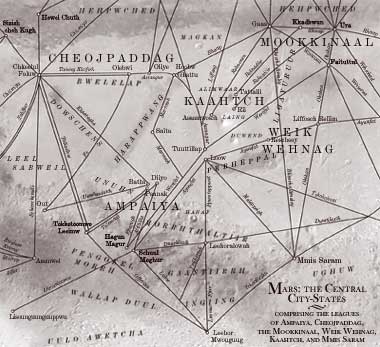
Elysium and the surrounding environs.
The inhabitants of the city-state of Ammwel follow a bizarre cult-like set of strictures: the Ocqotong. They must keep detailed journals of their daily transactions, and diaries of their innermost thoughts; these writings are gathered together, encoded and read through some sort of double-blind system (so that no one currently living can be identified with their writings—well, not easily), annotated, collated, cross-referenced, and shelved among the collective memory of the entire city for the past couple of millennia in the great Perpus Takaan, a magnificent example of Later Hy’attit design. These are used to examine recurring patterns in history and to correlate and attempt to identify reincarnations of previous Ammweli; once someone dies, their writings are released to whatever priestly hierarchy runs the Takaan (the Ppappalepal, perhaps, who are dour, and wear silly codpieces), and an attempt is made to fix their past identity, their place in yon Great Scheme of Things. (Since ancestor worship is a big deal, having a relative who just died turn out to have been the reincarnation of someone important from eleven hundred years ago—based on the similar style with which they composed their grocery lists—well. This can be quite prestigious, if not lucrative.)
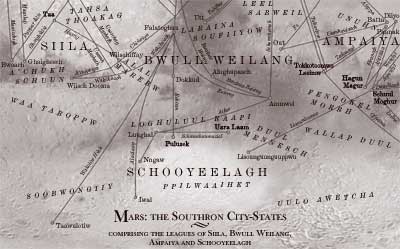
The Hellas Basin.
The Ampaiya League— Comprising the city-states of Tokkotoomwo Leeimw, Out, Batta, Diiyo, Paanak, Hagun Magur, Schuul Moghur, Leehoralowah and Leehor Mwouguug, the Ampaiya League is one of the richest and most cosmopolitan on Mars, vying with the Schoorhugullang in industry and agricultural output. Its network of canals is also arguably the best maintained, counting among its number the Offriina, the Liibw, the Uumhaidasch, the Werefat and Ayuufat, the Ffranogh and Afittikka, and the mighty Talimaat corridor. Ampaiya is a major source of liftwood, and, through trading along the Werefat and Ayuufat canals, is one of the only outlets for the narcotic attigha, grown in the cool, dry foothills of the Kaahtch. Though Lisounguunguuppwu is these days considered more a member of the Schooyeelagh, thanks to the Duul Mennesch caravan trade, close ties are nonetheless maintained with Ampaiya, and the water pumped from the Ppilwaaihet along the Lisounloomw canal is another important factor in Ampaiya’s vitality.
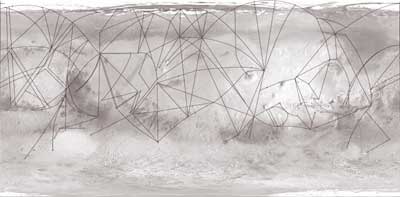
The planet Mars, with major canal systems indicated.
APE.
If you’re looking for me over the weekend, you’ll need to look in San Francisco. The Spouse and I will be attending APE: her to promote Dicebox, me to stand around looking at comics and try not to get in the way too much. There’s no particular table involved; we’ll be found more likely than not in the company of Patrick Farley or Lori Matsumoto or Kris Dresen or Madison Clell or Scott (or Ivy, or Winter, or Sky) McCloud or one or another of a variety of Pants Pressers, not to drop names or nothin.’ Plus, copious amounts of sushi will be eaten, and we’ll probably try to get to 826 Valencia Street again (this time, when it’s open), and there’s apparently a bookstore I need to visit, and we might even try to squeeze in a trip hereabouts, though I think all our evening meals are already spoken for, darn. Anyway.
Mars
or, Misunderstanding.
Helene Smith went there, first.
“There,” being Mars. Not the Robinson Mars, or the Bradbury Mars (she might quite have liked that one, though English was the lingua franca), not the Wells Mars or the Burroughs Mars or the Marses of Bear or Bova or MacDonald, and not the Mars of Burton or DePalma or Moore. In the end, of course, Mars is what you make of it (ask not what it is about Mars, Red Planet, Bringer of War that so many human societies worshiped it as a blood-caked, vengeful deity: ask instead what it is about humanity)—and Helene Smith’s Mars was made of newspaper columns feverishly entertaining the possibility of life on the Red Planet. Its perihelic approach in the last quarter of the 19th century coincided with an error in translation: Giovanni Schiaparelli wrote of the streaks of color he saw while observing Mars, naming them “canali,” or channels; this was misread by the English and Americans as canals (surely, had French, Queen of languages, been involved, this whole misunderstanding might have been avoided), and on so slim a premise was hung the breathless tale of an ancient civilization, their planet wasting slowly but inexorably into desert, striving against all hope to draw the last water from dying seas to crumbling, mausoleum-haunted cities in an engineering feat the likes of which the Earth had never seen. (Why ancient? Why a desert, when Flammarion had written not twenty years before, “May we attribute to the color of the herbage and plants which no doubt clothe the plains of Mars, the characteristic hue of that planet…”? Mumford, of course, tells us the graveyard is the first sign of cities; it is also the last they leave behind. Still: Why such an air of death, and decadence, and genteel despair? —It is worth noting that Schiaparelli named many landmarks [seas, and canali, but also plains and mountains] after the Classical geography of Hell, but this may have no more to do with it all than the then-recent completion, after much heroic effort, of the Suez Canal through the ancient, mausoleum-haunted deserts of Egypt, or perhaps the decision made by Percival Lowell to build his great observatory in the bone-dry deserts of Arizona, where the air was clearest.) When Clara Gouget Guzman, a wealthy French widow, tried in 1891 to foster peace and harmony among the worlds by offering a prize of one hundred thousand francs to the first person to communicate with extraterrestrials, she excluded Mars from consideration; it would prove, she felt, too easy to contact. —Better to try for the shier off-worlders: those tall and blond Venusians, the squat, fungoid Lunarians, perhaps the as-yet unknown creatures that might brave the Great Red Spot just recently discovered on far-off Jupiter. (The Greys of zeta Reticuli and the reptilian Draconids from the constellation Draco were more shy still, hiding as yet in the wings; we were terribly provincial in those days. —Though one might well remark on the remarkable coincidence, that aliens from the constellation Draco are, themselves, draconic, the wise pattern-maker will smile benevolently, or roll his eyes in exasperation, as may be his wont, and explain, patiently, or through gritted teeth, that there is nothing to remark upon; there are no coincidences. Propter hoc, ergo post hoc; the constellation Draco is so named because we have always known that the aliens from that quarter of the sky are reptilian—here there be dragons. We have merely chosen to forget.)
I say Helene Smith went there first, but this is, in the end, sheer conjecture. She herself went nowhere, of course, except the offices of Theodore Flournoy, Professor of Psychology at the University of Geneva, Switzerland. He was interested in her claim to have been a medium or “channel” (canale, in the Italian spoken just over the Alps) for Marie Antoinette (though her handwriting, when under the influence, in no way resembled the former Queen’s, and Smith—which, of course, was not her real name—was more than willing to familiarize her royal chum with the latest contrivances of the Steam Age, so that Marie’s messages from Beyond might refer to telephones and steamships with no evident confusion); he was astonished to discover that, when put under hypnosis, Smith did not renounce her claims, but produced more, many more, as if from a bottomless well: she had lived in ancient India, and on Mars, and proved still literate in the Martial language when entranced, recording a number of messages in the Martial alphabet (for, in the late Victorian era, the sentient inhabitants of Mars were referred to as often as not as “Martials”). —Today, her curious and lovely curlicue script, which corresponds on a one-for-one basis with the twenty-six characters of the Roman alphabet, can only be found in James Randi’s Encyclopedia of Claims, Frauds and Hoaxes of the Occult and Supernatural, which fact reminds me of a pithy moral, though I cannot find the scrap of paper on which I jotted it down. —The French were delighted to discover that the ancient and advanced language of the Martials was structured identically to their own, which they had always held without peer in grammar or syntax. How nice to find such incontrovertible proof! We can, perhaps, ignore the fact that French was Mlle. Smith’s native tongue. The Parisians were more than happy to do so, and marveled at the sketches of Martial fashions she produced: unisex styles, with loose blousy pants and long, embroidered shirts cinched at the waist by broad belts, quite sensible attire for hot, dry days in the desert. (And we see again how advanced the Martians were, how ahead of their time. Unisex styling, almost a hundred years before the advent of the pantsuit, or the burning of bras!)
She was under hypnosis, and incapable of consciously lying, but Flournoy (unlike the French) was never swayed to believe she had actually lived on Mars, or in ancient India, or had preternatural contact with Marie Antoinette. Instead, he made a crucial distinction: While he did not believe what she said, he believed that she believed. For her part, Smith, who had come to realize Flournoy had been her husband in long-ago India, was furious at this perceived betrayal. She demanded a divorce—easily enough granted, as Flournoy had never recognized the marriage, no matter how much she might have believed in it. She never spoke to him again. By the end of her life, Catherine Elise Muller (for that was her real name, if ever there were one) had come to live full-time as the Virgin Mary.
Flournoy’s slippery concept of the truth, of course, plagues us to this day. (What else could lie behind the undergraduate’s favorite exit strategy from an inconvenient relationship? “I love you, but I’m not in love with you.” What you believe to be true is as valid as what I believe—unless, of course, your idea of love inhibits mine, much as her idea of Mars subverted his of a rational, logical universe. —No wonder she asked for a divorce!) So much so that, in an attempt to explain how Muller, or Smith, could so fervently have believed what was so patently untrue—or how Virginia Tighe could have so vividly remembered her life as Bridey Murphy of Cork, Ireland when she had never left the continent of North America—some researchers have coined the term “cryptomnesia,” for that which we know, but do not know we know, and so must remember in other ways. Virginia Tighe’s nurse, when she was an infant, was from Ireland, and told her many stories of the old country; surely it is easier to believe these stories might have permeated the malleable wax of her unformed mind, only to surface later as vivid memories she could not explain, than it is to believe in reincarnation! —Yes, well, sigh the pattern-makers, with a sardonic edge to their grins, it’s not called Draco because it looks like a dragon, now, is it? Look at it. Does that loose rope of stars with a noose at the end look like a dragon to you? No, it’s Draco because we know the Draconids come from those stars. We just don’t want to remember. (Or, says a dissenting voice, they won’t let us remember.) But all nod their heads and agree: cryptomnesia; QED. —Thus do the master’s tools chip away at the foundations of his very house.
But one should not laugh at the concept of cryptomnesia. Otherwise, one might have to believe a little green man really did climb through George Ellery Hale’s window late one night to give him an idea as to how he might build the world’s largest reflecting telescope, by far, on Mount Wilson in Los Angeles. Whether or not one chooses to believe, we must believe that he believed; one cannot argue with the enormous reflecting telescopes he built: three of them, two on Mount Wilson and one on Mount Palomar, much larger by far than any previous. —The little green man continued to climb through his window late at night and advise Hale on the quotidian details of running the Mount Wilson observatory until his—Hale’s—death, in 1938.
I say Catherine Elise Muller went there first, but isn’t the lesson to be learned rather that we all might have been there, at one point or another? (Cryptomnesia, perhaps, but what early childhood experiences could possibly have suggested to her what life on Mars was really like? A critic once described the compositions of Phillip Glass as sounding “like a high mass on Mars.” How did he know?)
Some time ago I picked up a book which purported to outline the curious societies springing up across America, support groups for those who are “walk-ins,” alien entities who, whether accidentally or with a deliberate agenda (always peaceful, of course, or so they tell us, and why should they lie?), have chosen to incarnate themselves as humans on the planet Earth. I was disappointed to learn that the author was not so much a bemused and gregarious skeptic as an enthusiastic fellow-traveler, and soon put it away, though not without gleaning what entertainment I could, much as a churlish man might kick a dog already lying at his feet, simply because he has nothing better to do. I was amused to discover that the symptoms of being a “walk-in” include a profound feeling of alienation, and were, in fact, remarkably similar to the symptoms of Young People who are Having Problems with Drugs. This might begin to explain the rather ambitious estimates of the number of “walk-ins” in the United States alone: some two or three million, in various states of self-awareness and confusion, with perhaps ten times that many still “asleep” to their true selves. Imagine! One in ten of us is from another planet! Does the possibility not fill you with wonder? —Bored, I aimed one last kick at the dog’s belly by flipping to the back of the book, where the author’s afterword promised to detail his own slow and painful journey to the “admittedly incredulous” realization that he was, in fact, an alien. I was not unrewarded. I can only ask you to imagine the peals of laughter which rang out when I discovered that the first inklings of his profound alienation, his questioning of his very identity, began during his freshman year at a small, private, liberal arts college in Oberlin, Ohio.
Bells and whistles.
So. The new design. Still kicking the tires and working out the kinks; if you wander too deeply and fall into a morass of undigested code, just remember: the back button is your friend. Anyway. This is a lot closer to what I’d wanted when I first decided I wanted a blog for myself: those who were around in the mad old bad old days might remember this little ditty, from back when the entries were few enough and far enough between that I could hand-roll the CMS without too much effort. When I made the switch to Movable Type—blessed be its name—I tweaked the style sheet and the templates just enough to look more like me than not, but as a temporary measure, see, with the ever-present intention of crawling under the chassis and tinkering under the hood and whipping it into shape. Any day now. Gonna get right on that. Yup.
Sixteen months later.
The important point to note right now is this: we’re in the middle of switching the accounts that host Long story; short pier. As I understand it, this means little packets of information are as we speak circling the globe, dropping in on DNS servers from here to Timbuktu for a little tea, some gossip, and oh, by the way, when you get around to it, could you change the pointer for longstoryshortpier.com? Thanks. —This, apparently, takes a few days.
So: for now, you can get here directly by using the subdirectory itself: thecityofroses.com/longstory/, much as you could (and still can) get to the old pier through jennworks.com/longstory/. But longstoryshortpier.com is the more robust link: it will always end you up at the pier, wherever the pier might be, while more specific subdirectory URLs might land you at old, outmoded, unupdated piers. So: use thecityofroses.com/longstory/ as an interim link; feel free to keep longstoryshortpier.com in your blogrolls and such; and if you had jennworks.com/longstory/ as your bookmark, you’ll want to update it. (Of course, longstoryshortpier.com is at the moment pointing to the Spouse’s site; the mysteries of what’s being discussed in those DNS kaffeeklatschen are beyond me.)
Bored yet? The rest gets numbingly technical. That was the important bit, so feel free to bail out.
The first thing I had to do was fix MT’s file-naming system. Straight out of the box, Movable Type uses a numerical key based on the entry’s place in the database as the name of the HTML file: the first entry made is 0001.html, the second 0002.html, and so forth and so on. Which is all well and good, until you delete the sixth entry because of a mistake and so 0006.html is scrubbed and now the sixth entry is 0007.html. And then you let your best friend run a blog off your MT install, and her first entry is seventh in the database, which means it’s 0008.html, and your seventh entry, posted right after hers, is 0009.html, and, well. —This works fine so far as it goes, because who pays attention to the actual file names when you’re following hyperlinks? But! Say you want to move your install. Say your best friend wants to host her blog herself. Say you got a better deal on bandwidth. Whatever. So you export all your entries and you install MT elsewhere and then you import your entries and rebuild—and all the links other people have made to you out there in the Islets of Bloggerhans are instantly rotted away. Because your new MT names all its files based on the order the entries were made to its database, not some other database you used on a server in another state that it never met before.
Luckily, there’s lots of ways to massage MT’s archiving system. I followed Mark Pilgrim’s recipe for cruft-free hyperlinks: now, every entry builds its file name out of the entry title itself, or keywords—if, as is frequently the case, my entry title is just a wee bit too long. Plus, I hacked off the .html extension: that way, I could (someday) upgrade to, oh, php or some other bite of alphabet soup. But: no matter where I move or what I use, the permalinks will stay just that: perma. No link rot!
(Unless, of course, one’s main URL points inexplicably to one’s Spouse’s index page, as little packets of vital information waste time tea-and-crumpeting with DNS servers. But we’ve been over that. It’s temporary. All will soon be back to normal.)
Of course, there’s the problem of the legacy archives—all the old permalinks out there that point to the old, entry-number-based file titles. Those links are rotten at the moment; those old entries are orphaned. I have an idea, though: the old MT install is still operative, with the old file names. If I were to change the individual entry template to nothing more than MT tags that would generate the new file name, then rebuild the old site, then copy the files generated and drop them onto my new host—that should work. Then, each old link would bring up a file that says, “Hey, the discussion moved, go here,” and link. —That, at any rate, is the plan. But it would involve a lot of typing of key words from the new install into the old install. So I might not get to it just yet. On the other hand: it really doesn’t pay to have Brad DeLong annoyed with you. So I might just prioritize that.
Next up: accessibility. I dove into Mark again (and I really need to add him to the colophon over yonder) with his clear and terribly helpful Dive Into Accessibility series. Some of this stuff is already bog-standard on MT, some of it isn’t, but if you run a website, you owe it to yourself to take it all to heart. —Most important: the simple and elegant liquid three-column display I gacked from Floatutorial requires the main content of the blog—this stuff you’re reading here—to be coded after the more nattery stuff in each of the two floating sidebars: pretty much ass-backwards from an accessibility standpoint. Mark’s hidden skip link was a lovely little solution that salved my conscience as I went for what passes for gusto hereabouts.
Also, I decided to add underlines to the links, after years of inveighing against them, and I decided it would be a good idea for the links in the main blog portion to be a different color if you’ve already visited them, after years of inveighing against that. It’s supposed to be a tiny discreet brown line that is easy to skip over if you’re reading, but still easy to see if you’re looking for a link, that changes to an even more discreet blue if it’s a link you’ve already visited—from Eschaton, or Making Light, probably. But different boxes and different monitors are rendering the simple CSS in very different ways; my Windows box at work wants to make all the lines thick and black, for some godawful reason. So while I’m warming to the theory, I may scrap the praxis. —Then, my Windows box is fucking up the CSS something awful in IE 6.0: it ignores all my calls for Georgia and (since it doesn’t have Lucida Grande) Verdana in favor of rendering the whole site in Times Roman. And let’s not get into what I had to do to get it to render the boxes right. It’s still fucking up the frame colors on the deltolographs to the right there.
Other niggling background stuff I did: I scrapped the MT code that opens comments and trackbacks in new, little windows; I always hated that, and try never to click on those links on other people’s MT blogs unless I have to. If I want the content opened in a new window, I’ll bloody well use a new window. Otherwise, just use the one I’ve already got open. Oy.
I also added permalinks to comments: not that there’s a lot of traffic hereabouts, but there’s the occasional meaty addendum, and it’s nice to point to it specifically. There’s a little graphic ding at the end of each comment that serves as the handle for the permalink, and bad me: there’s no text backup for it yet. So I’ll be adding the word “link” there shortly, that will also serve as the handle for the comment’s permalink. Oh, and I scrapped the catalog archive pages—since MT doesn’t yet have a handy pagination function, each category page just kept getting longer and longer and more and more difficult to browse. Monthly archives are much more user-friendly. Feel free to graze.
Other stuff: I’m using an MT sideblog to maintain the linchinography, since the lack of ability to meaningfully alphabetize the stuff coming out of blogrolling.com—a great little service otherwise—was really getting to me. Basically, I set up a new blog in Movable Type, then stripped out all the archiving functions, and set up the main index to look like this:
<ul>
<MTEntries sort_by=”title” sort_order=”ascend” lastn=”999”>
<li><$MTEntryBody$></li>
</MTEntries>
</ul>
Each link is entered as an entry in the blog, and given a title that lays out how it should be alphabetized (“Wilson, Trish” for Trish Wilson’s Blog; “Rittenhouse Review” for The Rittenhouse Review). MT then builds an index page (called linkroll.html) that’s really just a bare-bones snippet of HTML: a UL list of each entry in the linchinography. Then, on the main index template for the pier, I stick
<$MTInclude file=”<$MTBlogURL$>linkroll.html”$></>where I want the linchinography to go, and voila!
I’m using a similar technique to maintain the Deltiolography sideblog to the right there.
And otherwise: there’s some rough bits to file off the comments preview page, for instance, and the trackback ping report, and some of the links on the monthly archive page are wonky, and there’s content and links to be added to the right, there; I’m still mulling over the suggestions in this handy sketch of semantic markup—I want to be better about using <cite> properly, say, but then I need to make sure I have a .noitalic class when I want to cite short stories or plays, and I still don’t know for sure how I want to set up blockquotes, and so forth and so on, ad infinitum. But the work progresses. One is never done with anything, after all.
What’s that? Entries? You want me to actually make entries, too?
Oy.
How fast?
Yeah, I know Atrios has his finger on the pulse of the Islets of Bloggerhans. He’s a superstar, man, the Beatles of blogging, he’s the first and last stop on my hourly must-read list.
But: when the RSS feed for his entry pointing to the announcement of the Koufax winners shows up a good ten minutes before the RSS feed for the Koufax announcement itself?
Well, you just gotta wonder, is all.
(Congratulations to all and sundry; no always-the-good-friend-of-a-bridesmaid-who-helps-her-into-her-awful-sea-foam-taffetta-gown-but-never-a-bridesmaid bitterness here. Nossir.)
Diagrammanomicon.
Momus is one of my favorite pop stars, which should surprise no one: a lycanthropic formalist, a jet-setting dilettante, a gadfly in the best possible sense of the word, he writes fiendishly stylish pop songs about pirates and Beowulf and Wendy Carlos and Tokyo neighborhoods. I mean, how can you not love a song like “MC Escher”?
The conventions of rap dictate that every MC who takes the mic
Claims to be the best, fills his set with hype
It’s OTT.
But if we imagine a world where every MC really is badder and fresher
Than every other, it just gets madder and madder
One of those rooftop salmon ladders
Drawn by …
MC Escher
The impossible rapper
Ain’t nobody does it better
Under pressure
MC Escher
He’s so clever
Gives you pleasure
Forever…
His website’s always been a go-to for those coffee breaks when you want to spend fifteen minutes playing with ideas that might end up going nowhere, but so what. And, well, now he’s got a LiveJournal; more coffee, please! —Today’s entry starts out with one of the reasons why (un-neo-)conservatives today might well distrust the CIA beyond all expectation: the CIA, it seems, heavily subsidized abstract expressionism in the 1950s, as a cultural front in the cold war: macho, cerebral, muscular art, the art of capitalism and liberty, going toe-to-toe with socialist realism. (Following up on yesterday’s playful entry, which was in part about how pop art came along and yanked the tablecloth out from under abstract expressionism.)—The CIA pulling NEA duty? Horrors. But! From there, we skate into the fascinating work of Mark Lombardi, whose beautiful diagrams of money and power look like old skool uggabugga.
Anyway. Commended to your attention, and all that.
What the hell is this, a threat?
Still working on it. (For those who want a preview, here. Baboon’s ass has been fixed; individual archive is mostly working [ignore that top nav line for now]; monthly archives and linkroll to be massaged, but hell, it’s pretty much open for beta.) But! Saw this banner ad for the RNC on my soon-to-be-dumped Sitemeter—

—and had to share. (Points here, in case you were wondering.)
A creation myth.
There were, by most accounts, two Priest-Kings at the Theocratic seat of Aqiir. These accounts claim variously that they were brothers or cousins. The Efendi claim that they were father and son; that the one known as Efend (named posthumously—the Priest-Kings had little use for names) made up the one known as Bel, fashioning him solely for the purpose of shattering the Demiurge’s hold over death. There is even a rather fashionable heresy among the Efendi that Bel was a Steward, remade by Efend into a Priest-King as a test of the limits of Demiurgic power. The San of the Sanût archipelago claim that the Priest-King known as Bel did not hold the seat of Aqiir jointly with Efend, but was instead the Priest-King of San. His seat, they claim, was the mountain known as Mfirifir, and that when he was killed his realm died also, and within the space of a few years had become the Erg, driving his people, the San, into the sea. This is a believable story of itself, but the San consort with djiin, and follow Besor, the Mother of Lies; they also claim that San and Aqiir were lovers, and that the example of their love served to bring Love into the world—but slowly, like a drop of dew growing on a blade of grass suspended over the throat of a thirsty man; that the sudden shock of San’s death let in cold Reason like a glaring beam of light through the crack his passing left in the world; and that the giant eli, the island-squid, are intelligent, in their fashion, and that if you listen to the songs the San say they sing, you will learn one of the four truths left to us all.
These are variations, though, on the theme that runs throughout the Aqiirian lands—from the Sanût isalnds along the 700 miles of coast to the deep northern desert, throughout the Erg and the mountain ranges of the Efendiit and the Lekiimût. This story is the bedrock of Aqiir, and it sets the stage for all that follows.
In the beginning was the Demiurge, and the Demiurge was the world, and it was not good. The Demiurge created the world according to a great pattern, and is the world, and the pattern, all at the same time: that there should be a finite number ever to the people in the world, and that when they died they would be brought back into the world to live their life over again. Over this endless chain were set the Priest-Kings and their Stewards, given land and power to do as they saw fit, to no further purpose, or pattern. Bel and Efend (or San and Aqiir) were two of these Priest-Kings. Bel was, by all accounts, tall and strong and beautiful to look upon, and also quite fond of hunting. Efend was quite ugly in appearance, and stunted in his growth, and his back was hunched, and he did not have all his teeth, but he was fiendishly clever, and his creations were second only to those of the Demiurge, and even the God-Emperor was, they say, envious of Efend’s intellect.
Bel came to Efend one day, bored of his sport, desiring a new beast to hunt. And Efend, who could deny nothing to Bel, went away into his rooms in the great citadel at Aqiir to think on this problem. As he did so, Bel amused himself in another quarter of the citadel, which, from what little evidence survives, must have been one of the largest examples of Theocratic construction—eight miles to a side, with, in its center, a dome a mile in diameter and a quarter-mile high, floating above sixty-four great pillars like planed and polished mountain-roots. Efend’s rooms were at the top of the sixty-fifth pillar, which rose through the center of the dome and climbed another quarter-mile yet into the sky.
After some time Efend came to Bel with an egg—an egg made of clear glass, filled with swirls of color and light. Bel took the egg and smashed it, and out flowed so swift a creature that Bel could not catch its shape. Crying joyfully, he called to his hounds and set off after it.
And a year and a day later, he returned with its broken body. It was beautiful, all sinew and wings, and its feathers were all the colors of a sunrise, and its scales were the colors of all the moods of the ocean. Its blood, the color of rich wine, still dripped from Bel’s hands and lips, and from the muzzles of his hounds. “It was magnificent,” he said, with a touch of sorrow in his voice, “and I have never seen an animal that could run so fast, or swim so, or fly so high and far. But an animal that flees so becomes tired, and an animal that tires will make a mistake, and when it did… Please, Efend. Make me a new beast.”
And Efend smiled a small and curious smile, and swept the remains of the egg into one hand, and took up the glittering body of the beast in the other, and went away to climb the eight thousand steps to his rooms. And while he was gone, Bel called some people together and formed them into armies, and gave them weapons, and he built a citadel by the sea for himself and his hounds and five of his favorite Stewards, and he ordered the armies to lay siege to him, but he made short work of them with his marvelous sword. He raised up a second army, and gave them the citadel, and he had his hounds and his Stewards lay siege to it, and for a time he was distracted, but not for long. And when he came back to the seat at Aqiir he found Efend, who gave him an egg made of lapped leaves of copper riveted together, and Bel cried with joy and took the egg and lifted it up and smashed it down on the ground. And out sprang an enormous creature armored all in metalled scales so strong that Bel’s marvelous sword could not pierce them, and it leaped straight for Bel’s throat like a river, and Bel was bowled over. Their wrestling was clamorous, and raised great clouds of dust that blotted out the sun, and in their tumbling they brought down eight of the great pillars like planed and polished mountain-roots, sending the ceiling of a quarter of the dome crashing to the earth. But after a year and a day Bel came up out of the rubble bearing the sullen weight of the beast over his shoulder, and his eyes were downcast. “It was magnificent,” he said, “and I have never felt so weary, or had my strength tested so—no matter which way I turned and thrust, I could not find a weakness! But then, I noticed that before shifting its weight, it would squint one eye at me, taking my measure, and the very next time it did so I braced myself and twisted its neck until it cracked. Even an animal with so much tireless strength will make a mistake, and when it does… Please, Efend. Make me a new beast.”
And Efend smiled a small and curious smile, and swept the shards of the second egg into one hand, and took up the tremendous body of the beast in the other, and went away to climb the eight thousand steps to his rooms. And while he was gone, Bel called some people together and assembled them into work-gangs, and set them to rebuilding the great pillars that had been destroyed by his wrestling, and to raise the roof that he had brought down to the earth. But this was dull business, and he left it in the charge of one of his Stewards, and took some of the people down to the sea and made ships for them, and taught them to sail, and then swam out to fight them by himself. And for a time he was distracted, but not for long. And so he came back to the seat at Aqiir, where he found Efend, who did not give him an egg, but instead held something behind his back.
“What do you have for me, Efend?” asked Bel. Efend said nothing. Behind his back he did hold a third egg, it is true—a cool and blemishless egg of obsidian. But as he had come down the eight thousand steps from his rooms, he had felt it jump, once, in his hands, and this filled him with dread. He said to Bel that it was nothing, really.
“Oh, but it is,” said Bel. “It is something which you are holding back from me, and you are playing with me, and you are trying my patience. Give it to me. Please.” And Efend gave the egg to Bel, whom he could deny nothing, and Bel took the egg and smashed it. Out of it crept a cautious creature, sinuous and black, neither cat nor lizard, though it perhaps took equal parts of both. Bel stared at it, fascinated. He drew his marvelous sword and struck, and the beast reared up and struck back, and they sparred there until a careless blow by Bel—who, truth be told, was becoming bored with this sport as well—that left his arm open to the beast’s claws. They marked him with three perfectly scored lines of blood.
Bel left off the attack he had been half-heartedly planning and resolved to do away with this, the most disappointing of Efend’s gifts. And then the beast did a most curious thing: it raised its spade-like snout and sniffed the blood that oozed down Bel’s arm and, so quickly that he almost did not have time to interpose his marvelous sword, it leaped, so that even as his sword pierced its belly to the hilt, and even as its blood like cold black water spilled over him, it took his wounded arm in its mouth and worried at it with its teeth. Bel felt his own blood flowing into the beast. They stood there, Bel stooped backwards from the weight of the dying beast, the beast motionless save for the pulsing of its throat, and Bel stared, fascinated, into the beast’s dumb eye. He saw light growing within it, an eye that was for a moment so glossy and black that he could see himself, clearly, before it clouded over. And then it shuddered, swiping his side with its claws, and that was when he threw it from him with a shrug of his marvelous sword.
“It was,” he said, and he paused, and turned to look at Efend directly. “Magnificent…” He wiped the blade of his sword, thinking. It had not been a swift beast. Nor terribly strong. And he had been wounded before, many times. But something, something about this time, this beast, had started his heart so that it still battered itself against his ribs.
Efend smiled then, a broad smile, and not at all curious. He had knocked out two of his teeth. He explained that he had given them to the beast, and that with those teeth, the beast had had the power to kill.
Bel shook his head at that, and interrupted. “I cannot die,” he said to Efend. “I am a Priest-King.”
Efend shook his head, and his smile was now so small as not to be noticed. “With those teeth,” he said, firmly, “the beast could have killed you.”
Bel frowned, and looked away, at the dome of the great citadel and the dust still hanging in the air where his people labored to raise one of the great columns. He looked out at the mountains beyond, and up at the sun in the hazy white sky. He took a deep breath of hot dry wind blown over hundreds of miles of empty desert and he looked down at the beast like a puddle of tar at his feet. And he smiled suddenly, and leaped into the air, laughing. “Make me another!” he cried. And Efend swept the shards of the egg into one hand, and the limp body of the beast in the other, and went away to climb the eight thousand steps to his rooms. “And another!” cried Bel after him as he went. “And another! And another!”
And that is how the lekiim were born.
Woo-hoo!
No, I’m still not back yet. But Ana-Marie Cox is.
(Is the joke wearing thin? Do you have any idea how hard it is to find suitable visual representations of piers? Especially since my new favorite image-distortion technique compresses about as well as, well, something that doesn’t compress at all. —A 100 k logo? I think not.
(Oh: and Orcinus should really read this brief article recommended by D-squared.)
On magic—
An upside to dead hard drives and digging through old backups, hoping against hope you stashed file X away on that dusty 250 meg Zip: you run across old correspondence. This, then: part of a four-year-old exchange with a prosepctive player in a role playing game that never quite got off the ground. I was trying to explain what it was I wanted from magic, in this ambiguous other world, and explain my dissatisfaction with the name-the-spell-and-roll-the-dice mechanics of the magic systems available in most commercial games, and in the course of laying it out, well—read for yourself, if you like. —I’m not “back” yet, by the way; you’ll know when I am: there’ll be a whole re-design and everything. A sleek new front end and some tinkering under the hood. And yes, it’s been two years since I started this blogging thing (hereabouts): thanks to wood s lot and language hat, who noticed, and where were the cards and flowers from the rest of you? And I was going to say something about the monumental effort that is the Koufax Awards, but cutting and pasting old correspondence is easier. Enjoy; I’m off to wrestle with CSS and figure out what I’m going to do with six whole header tags.
I’d like to know more about the magic. Not just about the “system” (if there is one) that your character learned, but how she came to learn it, and the story behind it. I don’t want to know it, or all of it, before we begin play; I’m perfectly comfortable letting it be something that develops as we go along—but it is something that I want to be privileged in the character’s narrative. Is seeing auras something that she can just do? Or is it a formal school of Liannan magic? Does everyone take on, or at least invoke, aspects of their deities? Although we do need to think of it in a list as a starting point, and to prevent the dreaded Assumption Clash (at the start), I’d like very much to as quickly as possible move past it, to the point where the magic is more holistic, organic—magical.
Of course, she is your character. Not mine. (And you know all this.)
My other point: my own preference for the invocation of magic would be to keep it as naturalistic as possible. (I think that’s the word I’m looking for.) Since we want to keep things ambiguous—and we do, trust me. Thus, instead of saying, “I want to use Waters of Vision to try and figure out what Huxtable’s up to today,” saying “I stand up suddenly, walk over to the dresser, and peer into my reflection. Then I pick up the pitcher and pour some water into the bowl. [Imagining as I am the pitcher and bowl that grace the guest rooms of every decent house in Western movies, say.] I splash some on my face, rub my eyes, flick some water over both shoulders to slake My Lady’s thirst, mutter ‘Wongoti rhanun maah affata maah,’ under my breath, and think dark thoughts of Huxtable. Where is he? What is he doing?”
Re-reading all that, it comes across as a bad White Wolf “how to pose” essay. Sigh.
I know you know all this. And yet I feel compelled to say something about it: to avoid Assumption Clash, and also to forewarn (and thus forearm) us both against taking the magic for granted, relying on the system, instead of trying to elicit that which the system is designed to facilitate. Relying on the system has the paradoxical effect of making the magic both more and less real: on the one hand, it removes everything from the realm of concrete action and physical description, distancing everyone from what’s really going on; on the other hand, by invoking rules, one lends an air of authority if not verisimilitude to the proceedings. “I’m using Waters of Vision to try and see what’s going on” implies that the magic is real; “I’m peering into the water in the bowl on my dresser to see what I can see in the ripples” leaves crucial room for doubt and ambiguity.
(The paradoxical epistemology of rpgs: precisely because they are so subjective—based almost wholly on the subjective cause-and-effect dialogue between players and referee—they end up being much more objective than the real world.)
Am I making any sense? Is this in any way helpful? Or am I worrying enormously over nothing at all?
I do intend to start compiling a list of Liannan linguistic terms any day now. (I did find chapters of Lowell’s book on the Martian canals, with pencilled maps and catalogs of canal names—so we can name features on Mars what the original Victorian areologists would have named them, and not base it on today’s names. But that’s a different matter entirely.) And again, your character doesn’t have to be from the Liannan culture; make up your own. (Somewhere in there, the Liannan morphed from being all Canal Martians to being a specific culture of same. Sorry for the confusion; it’s all still a tad bit in flux.) Feel free. Once we know some specifics, we can start to build the bigger picture of Mars/Melender. But I’m liking the Carolinian/Indonesian feel so far, so I think I’ll run with that, myself. “Wongoti rhanun maah affata maah,” roughly translated, would mean “Wring the tears from my eyes that my sight be clear.” Though I’ve probably mangled the grammar horribly.
But like I said: there aren’t any linguists playing. (Unless you’re holding out on me.)
Yes, I intend to pick at everyone’s characters to some extent. You just had the bad luck to a) pick a role which is crucial to one of the main themes I want to toy with (and dissatisfactions I’ve had with games in the past); and b) you got the most in the fastest. I’m going to have a knock-down, drag out fight with K next on the not-so-fractious South.
Magic.
I have, as you’ve probably gathered, a profound ambivalence towards the subject.
Magic is something that I’ve always wanted to believe in, rather like God or an afterlife, but for the longest time I was never quite able to bring myself to make the leap of faith required. I have, sort of, on the point of magic at least (and it is, somewhat, related to, if not God, then some of the questions God was created to answer). —Though it has been pointed out that I am making that leap on the word of a known pathological liar.
Then, I always thought Sherlock Holmes got it wrong—when you’ve discarded the improbable, whatever’s left, no matter how impossible, is usually the truth.
But magic isn’t something to believe in, to my mind. It’s a way of thinking, a way of perceiving, a way of being; not something that is or is not, not something one does. Magic, to my mind, is essentially passive; it is almost entirely about perception. (Which makes it incredibly powerful; knowledge, after all, is power.) (And perception, as any student of management skills will tell you, determines reality.) Still. Before enlightenment, chop wood, carry water; after enlightenment, chop wood, carry water.
Healing? I tend to ascribe most of it to the placebo effect, I’m afraid—which is not to denigrate it at all. The placebo effect is incredibly powerful (1 in 3 is better odds than a lot of medicines being sold for two and three digits a gram), and knowing how to elicit that and use it is a necessary skill to being a healer—one given terribly short shrift, these days. And it can be argued that to successfully harness the full power of the placebo effect, the healer must know that what he or she is doing isn’t a placebo him or herself; the idea that the sole purpose of the trappings of ceremonial robes and eldritch tomes and magical words and angels and devils is to convince the magician that she is capable of doing this thing that all experience says is impossible. Ego boost. Not that I’m going to quibble if I ever find myself with a mysterious ailment unresponsive to the usual treatments. There is no objectivity in a foxhole.
Wealth spells? Synchronicity; coincidence (which is not a dirty word); the old trick of remembering the hits and forgetting the misses. Divinatory preparation of one sort or another which leaves one better able to grasp opportunity when it knocks; psychological reprogramming, almost, to deal with whatever mental blocks might be present. —And did you notice what I’ve tried to do? Already, I’m sliding out the back way, trying to explain one mindset in terms of another: magic in a scientific sense. As if there is a deeper reality, an objective cause-and-effect relationship underlying the outward skin; a backstage to sneak into, waving my press pass, where the band is hanging out with gorgeous groupies and good booze and the Truth. Doomed from the start.
(A wealth spell is performed; a recalcitrant creditor sends a long-overdue check the next week. Are they related? Did the one cause the other? More to the point: would it have happened if you hadn’t? What-if games; endlessly fascinating, ultimately futile. I, myself, am ultimately agnostic on the subject—who can say?—but Descartes’ wager is awfully enticing. Might as well believe there’s a connection; what have you got to lose?)
Maybe I’ve just been reading too much Lao Tzu.
Did Crowley really practice what he preached, with regard to wealth spells? Somehow, I doubt it, but that’s probably just my terribly prejudiced (if terribly fond) view of the cantankerous old prankster. “Do as I say, don’t do as I do,” he says, eyes twinkling; “Say boots without shoes.” Indeed.
What don’t I believe in?
The numinous. I don’t believe the spirit realm or astral plane or whatever you want to call it is somehow separate from the physical; there is only one place, and that’s inside my head where I remember and process the impressions I receive from my senses. Period. (You might be real; then again, you might be a figment of my imagination. It’s an overactive one, honest.) The physical/spiritual split is one of many unfortunate remnants of the 18th century, when we first approached these ideas and concepts with a rigorous scientific mindset (or at least what passed for same at the time). (I do tend to find it odd that so many people who profess to hold holism in such high regard never question this ultimate dichotomy. Then again, I have a profound mind/body split to deal with myself—I can never get used to the fact that me, this point of consciousness in space and time, depends so utterly on this sack of meat and water and cascading chemical reactions. Gives me the willies, it does. Peoples is a paradoxical lot…)
Which actually takes care of a hell of a lot of it, I think.
I also tend not to lend much credence to fields, auras, brainwaves, action at a distance. Yes, I know such things have been measured and detected (by objective means; I’m sorry I keep falling back on that, but I do)—Kirlian auras and such (and I remember the lovely photos of Bowie’s hand before and after snorting cocaine)—but much, much too small, both in terms of power and in terms of information-carrying capacity, to account for the phenomena they are generally supposed to cause and/or influence and/or account for. Though and at the same time I don’t rule out the possibility that in some fashion picking up cues from someone’s electromagnetic field—dueling kinesthesiæ, perhaps—is a part (and perhaps even an important part) of the general ability we have to synthesize sometimes astonishingly accurate (and sometimes ludicrously wrong) overviews of someone’s current state from tiny cues in body language, facial expression, vocal tone.
Feh. Could I qualify it any more, you think?
Where do I stand, then.
Yes, I do believe in magic. Though putting it that way is deceptive. One doesn’t believe or not believe; one is either capable of perceiving the world in those terms—or at least appreciating that perception—or one isn’t.
(Say I’m in an apartment that is empty, and I hear my flatmates bounding up the stairs from outside, animatedly discussing something. Some time passes, and I realize that the front door never opened, and the apartment itself is silent. I poke about. It’s still empty; no one stands on the steps, waiting for the door to open. Later that evening, it turns out neither was anywhere near the apartment at that time. Perhaps we ought to whip out Ockham’s razor at this point—but which way should it cut? In the end, “intense auditory hallucination” is no more simple nor explanatory than “premonition.” Whichever way you slice will ultimately be determined by your prejudices and perception—things you bring to the table. The skeptic will find the idea of “premonition” distasteful, and feel that some hallucination or intensely relived flash of memory a far more simple explanation [though he couldn’t point to the specific mechanisms and parts of the brain involved, or the specific stimulus that resulted in the response in question]; the magician would find the idea of premonition far simpler—or, given that others had similar experiences in that apartment throughout the summer, that there’s something about the location itself, the apartment, perhaps, which causes temporal or psychic echoes [though she would be hard-pressed indeed to cite the specific mechanisms whereby these things occur, nor would she be able to ascertain directly whether the echoes heard ever “actually” happen in the “real” world, at some other time].
(Me? I generally shrug and leave well enough alone.
(And if you believe that, I’ve got a lovely bridge to sell you. All right. I generally try to appreciate both sides of the equation, and take up one or the other as it suits me, and keep my back to the wall and my eye on the door and plenty of wiggle room all around.)
Okay. So I heard people who weren’t there, pretty clearly.
I’ve thought thoughts I’m pretty sure were being thought by the person next to me, and not the thoughts that would ordinarily be flowing through my stream of consciousness at the time. (I tend to lose patience with most descriptions of telepathy—that’s not what thinking’s like, at all.)
I’ve seen someone’s vague premonitions come rather startlingly to pass, in a way which pretty much rules out subjective interpretation. (But not lying, to be sure.)
I once wore an eyepatch for a live-action game (I was playing Peter Norton, a part Cherokee riverboat gambler—ah. It’s a long story) and experienced some rather intensely odd visions through the covered eye throughout the day.
People who were close to me—and people who weren’t, especially—have told me they come from Other Places or Other Times. My response has varied from guarded acceptance to having a difficult time keeping a straight face. I have been embroiled in their personal mythologies, and wrapped up in crises I couldn’t begin to explain today, but certainly seemed terribly important at the time. (A summer’s afternoon, a crown in a tree—okay, I wasn’t there for that bit. I’m sorry; I’m being maddeningly vague. To say nothing of coy. Perhaps I should just move on.)
What else?
Well, there’s the guy in Amherst, Massachusetts who took an ex of mine under his wing. They both fight psychic evil in their sleep, and he’s both summoned the Christ spirit down to officiate at a handfasting and banished Set from this plane of existence. (Ever notice how the most powerful wizards are almost always working at the mall?) (Of course, they could just be taking Crowley at his word. I really think that sort of thing worked much better at his class level in an Edwardian English economy. But I’m teasing, now. Slap my wrist.) I later learned that the mythology of the whole fighting-psychic-evil-in-one’s-sleep thing was based on a then-popular series of trashy fantasy novels…
And yes, I once sat on a couch and felt someone elicit some impressively tangible sensations in my hands without touching them. Suggestion? Hallucination? Supercharged Kirlian auras? Ancient Chinese secret? Magic?
Obviously, I’m rather skeptical. I would even call myself a skeptic, to a certain extent, except that it clashes with my boyish charm and gee-whiz enthusiasm, and most people who call themselves skeptics give skepticism a bad name. (Rather like those die-hard atheists unable to wrap their brains around the idea that they could be clinging to the lack of God through faith and faith alone…) My classic example being Tarot cards: while I won’t ascribe to them any supernatural or paranormal powers (seems rather silly to do so to something mass-produced by US Games Systems and distributed willy-nill across the country—how many people and machines have fondled that pack before you picked it up, smelling of incense?), I do find them terribly useful in a, well, magical sense. By focusing on a problem, question, or situation, and then interpreting and reinterpreting it through the symbolism and structure of a Tarot layout, I can be forced into thinking about it in new ways, gain new perspectives, make connections I hadn’t made previously. Magical—and yet not at all supernatural or paranormal. Useful—but not every time, and not always to the same degree. But most skeptics will dismiss Tarot cards and Ouija boards and the like out of hand as piffle, as nonsense, as things only fools and weak-willed simps would believe in—strictly out of prejudice. Terribly irrational on their part, don’t you think?
I adore The Amazing Randi; I think he’s doing a terribly important thing, and I wish more people paid attention to him. But he’s a complete asshole, and as fanatical and dogmatic as the people he’s arrayed himself against. Makes a person sigh, it does.
Science and magic aren’t incompatible in the sense that it is possible for individuals to appreciate both. Magic is lovely, dark and deep, and it does work; science is one of our most impressive collective accomplishments. I see both of these statements as true, without snapping my rhetorical neck. (And scientists are just as capable of bad science as neo-pagans—or pagans of any stripe, to be sure—are of bad magic.) Rather like general relativity, and quantum theory: both work in their respective milieux, though both are contradictory, and fail when they cross to the other side.
Christ. Stop me before I start quoting Zen koans. Please.
I suppose, then, that my view of magic is ultimately passive. Will in accordance with change, not change in accordance with will. Might explain why I’ve gotten so little done with it.
(I do quite like the dictum that one must, of course, buy a lottery ticket to be able to win the lottery. Chop the wood. Carry the water.)
The $64,000 question, of course, is what does this have to do with your character, and her magic?
I believe rather firmly that there is no power inherent in systems of magic, pantheons, words, wands, rings, etc. These are merely the tools used by our brains to work with some terribly numinous stuff, metaphors which enable us to grasp otherwise slippery, preverbal and postlogical concepts. (Which is why these things are all so damned hard to talk about.) Thus, there’s nothing more real or true about, say, Martian magic than Hermetic. Both are means to a similar end, rather like Islam and Christianity. (Actually, that’s a terrible analogy.)
Your character will be speaking with something when she speaks with her god, but her god is, ultimately, a mask. It remains to be seen how much of that mask is created by the thing in question, and how much by your character.
This does not in any way lessen the importance or even reality of the systems, pantheons, words, wands, rings, or masks. In fact, learning the “truth,” coming to see the reality, may very well destroy your ability to work with it in the first place.
Okay. Given that it’s been almost a week now since you sent me the letter in the first place, I should probably wrap this up and whip it back.
One hopes this hasn’t been too deadly dull.
B’s been in touch and has expressed a guarded interest. He’d prefer a Monday or Tuesday night slot. Sigh.
And Jenn’s reading a biography of Alice Roosevelt (Teddy’s eldest daughter).
And I’ve just got my hands on Luc Sante’s Lures and Snares of Old New York.
This thing could take off yet.
More later.
All I have to say is, once this is over, the Iraqi people better be the freest fucking people on the face of the earth. They better be freer than me. They better be so fucking free they can fly.
And so we went to war with the Islamofascists: a clash of civilizations, the final showdown between tolerant Enlightenment rationalism and grim, dark, authoritarian terror. And what did we do when we won?
Fuck you, Bush. Fuck Rice and Powell, fuck Cheney, fuck Donald “Vases?” Rumsfeld. Fuck the House, fuck the Senate; fuck the Democrats who trusted you weaselly little fucks and voted for this fucking farce. Fuck Thomas Friedman, fuck Christopher Hitchens—hell, fuck the entire fucking press corps sideways; not a one of you fucks did your fucking job, and you’re still ignoring this. Go write about another fucking sweater, you useless, lying fucks. Fuck you Instapundit and Andrew Sullivan; fuck the Freepers and the Little Green Footballs; fuck Lileks, fuck Tacitus, fuck Misha, fuck the captain of the fucking USS Clueless, fuck John fucking Cole. Hell, the mood I’m in, Josh Marshall and Kevin Drum and Big Media Matt can go fuck themselves for being suckered in however briefly by fucking Kenneth Pollack, who was in turn suckered, so by all means, fuck him too. Fuck Ambassador L. Paul “Jerry” Bremer III. Fuck the CPA and the IGC. Fuck Grand Ayatollah Ali Al-Sistani and Abd Al-Aziz Al-Hakim. Look at what you’ve done. Look at what you’re doing. Look at what you’ve said and what you hoped would happen and look at what is actually happening right now. Tell me this was worth tens of thousands of dead and wounded. Tell me this does one whit to make the world a safer place. Tell me how many lives it will save and improve. Tell me!
Ah, to hell with the lot of you. Fucking bastards.