

Anent the preceding:
I feel a bit sheepish over how I left the problem of steampunk, for all that this isn’t about steampunk, and won’t be, dammit; a bit glib, to toss off Íkaroi and asymptotes without acknowledging how any one of us worth our salt should take a fence planted and a gauntlet thrown like that: back up for a goddamn running start. —And I never should have linked to Catherynne Valente’s magisterial rant without acknowledging her morning after.
Still, do or do not; there is no try. Tripping over the gauntlet and faceplanting into the fence does nothing but bloody your nose and besides, the fence likes it. —And anyway I’ve got angels of my own to wrestle with. (The themes of seduction and colonization running just under the surface of urban fantasy, say.)
But:
(And I don’t yet know for sure quite what to do with this which is why it’s being stuck over here to one side as a parenthetical—)
There’s this thing Nisi Shawl didn’t say so much as allude to and play with, on a panel at the 2009 World Fantasy Convention:
What I said was that some critics had called cyberpunk a reactionary response to feminist science fiction. This is true. Specifically, I’m pretty sure this is something Jeanne Gomoll, among others, theorized about.
I brought up this point because though I don’t personally believe that cyberpunk was a reactionary response to feminist science fiction a) It’s an interesting premise to examine; b) Examination leads me to think that while cyberpunk and the cyberpunks were not antagonistic to feminist science fiction, part of the media hype surrounding it was an attempt to find something, anything to look at other than feminist science fiction; and c) Parallels can be drawn between the popularity/commodification of cyberpunk and the popularity/commodification of steampunk in relationship to, respectively, feminist science fiction and speculative fiction by POC. Also, I was being somewhat provocative, which I think is kind of my job on a panel: to entertain as well as educate.
This isn’t about steampunk, dammit; I’m not trying to kick it once again. (Here, have some lovely steamy boosterism from Nisi Shawl, a glorious backing-up for a good hard run at the damn thing.) —It is an interesting premise to examine—note the elision to genre-as-marketing-category in the above, which is where marketing dollars pool, instead of fears; but remember that marketing dollars have fears of their own.
But this is about urban fantasy, and while I know for a goddamn fact the way only someone who’s lived through the past forty years can know that history doesn’t progress, not any more than evolution does, that any narrative here is necessarily constructed by a guiding, editing, distorting hand without which you have just a bunch of stuff that happened, and while I’d never presume to call urban fantasy qua urban fantasy in any way a feminist genre—it is more concerned, much more fundamentally concerned with gender and interpersonal relationships than cyberpunk ever was, and while I’d never make the assertion that the leather pants and the elves in sunglasses and the vampire CEOs and etc. and etc. are in any direct or meaningful way an offshoot of or outgrowth from or improvement on cyberpunk—don’t get distracted by the dam’ furniture—
Still. The idea won’t leave me alone, is all I’m saying.
But anyway the urban fantasy crew for whatever bucks it might bring in is still I gather second class in the Beowulf game; fangfuckers, they’re called, and paranormal romance is said too often with a sneer; I know, I’ve felt it on my own lip more than once. —It’s late. I’m digressing. There’s other moves to make. I need some sleep.



Trapped—in a world he never made!
Abhay—I’ve told you about Abhay, right?—starts off talking about X’ed Out and Joe the Barbarian but ends up making one of those salient points about the differences between Grant Morrison’s Invisibles and his Batman, and what happens when the bald chaos magician tries to become /become/ «become» the hairy-chested love-god.
Obversity.
There’s every now and then the occasional moment you can look back at, point to, a specific slice of spacetime where you can say there, that’s where the science dropped. —A while ago Felicia Day went and said this about a book by M.K. Hobson, friend of the pier:
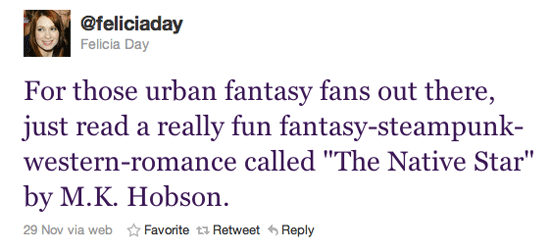
And when I saw that I said to myself now waitaminute what on earth is she doing calling out a steampunk novel to urban fantasy fans? Because I mean on the one hand, goths who just discovered brown. On the other, leather trousers half-undone. But there came a tapping on my shoulder and a light was glaring in the corners of my eyes and when I turned to look I was struck dumb at that very instant by the insight:
Steampunk is the fantasy to urban fantasy’s SF.
You remember what I told you about how we were gonna abstract it up and out? How you shouldn’t get distracted by the furniture of swords and rings and rocketships, or zeppelins and tramp stamps? —Yeah. Like that.
In this book I argue that there are essentially four categories within the fantastic: the portal-quest, the immersive, the intrusive, and the liminal. These categories are determined by the means by which the fantastic enters the narrated world. In the portal-quest we are invited through into the fantastic; in the intrusion fantasy, the fantastic enters the fictional world; in the liminal fantasy, the magic hovers in the corner of our eye; while in the immersive fantasy we are allowed no escape. Each category has as profound an influence on the rhetorical structures of the fantastic as does its taproot text or genre. Each category is a mode susceptible to the quadripartite template or grammar—wrongness, thinning, recognition, and healing/return—that John Clute suggests in the Encyclopedia of Fantasy (338-339).4
—Farah Mendlesohn, Rhetorics of Fantasy
4. Clute and I have had a number of discussions over which formulation of the grammar of Full Fantasy to use here. Clute being Clute, the formulation has gone through several revisions, rethinkings, and renamings. In the end, and knowing this is not his preference, I have chosen to go for the most physically accessible formula; that is, the version in the Encyclopedia.
So I was working my way through Mendlesohn—remember Medlesohn? This all started as a sequence of posts about Mendlesohn—and hit that passage right there in the introduction and had to stop. A grammar? Of fantasy? Qua fantasy? What on earth was this thing, with its talk of stages, categories, wrongness and thinning, recognition and return? I didn’t (and don’t) have a copy of the Encyclopedia myself; Clute I knew only vaguely as a critic (and spoiler) of some renown; Mendlesohn doesn’t spell it out much beyond the above, and some tantalizing hints throughout the chapters on her own quartered circle—but she did pick the most physically accessible of the possible formulæ, right?
Well, at $150 a pop, not so much. —And yes the library has a reference copy, but easy trumps free every time: a Google or three, and there we were: a talk given in 2007, making this if not the vision or thinking or naming close to that which Clute might rather Mendlesohn have used, at least a candidate rather close in time to the composition of the above.
Go on then, read it. —Even though I’ll be summarizing (in my own idiom and for my own purposes), you’ll want it under your belt so you can see for yourself where my model of her model of his model gangs agley.
Just—remember, okay? All models are wrong—but some are useful.
Clute’s model—at least as presented in this talk—isn’t just a quadripartite template for fantasy, but a triskelion encompassing, well, everything: the fantastika, which is another way of saying /fantasy/ or «fantasy» (or «smoke», or /mirrors/): “that wide range of fictional works whose contents are understood to be fantastic.” —This fantastika is posited as a Dionysian return of that which had been repressed by the cool, composed Appollonian excesses of the Enlightenment; by 1700, Clute notes, (at least within English literature),
a fault line was drawn between mimetic work, which accorded with the rational Enlightenment values then beginning to dominate, and the great cauldron of irrational myth and story, which we now claimed to have outgrown, and which was now primarily suitable for children (the concept of childhood having been invented around this time as a disposal unit to dump abandoned versions of human nature into).
This stuff, this fantastika, “the irrational, the impossible, the nightmare, the inevitable, the haunted, the storyable, the magic walking stick, the curse,” (the rocket, the ring, the sword, the goggles, the guitar) are then pressed into service as a means of dealing with those world-changes wrought by the aforementioned Enlightenment, the geist haunting the Zeit, the “World Storm” in the title of his talk: the unchanging state of constant change brought on by the onrushing Industrial Revolution, the Singularity that has always already been happening for some time now. —Clute identifies three main modes of this fantastika as of the twenty-first century, and bemoans their names: Fantasy, Science Fiction, and Horror—modes, mind, not genera, not idioms, not category fictions, not rigorously defined academic exercises, but modes, each passing through or touching on four basic stages of story, each differentiable by the skew it brings to those stages, the way they roll through the fingers and trip from the tongue:
- Fantasy, as noted, begins in wrongness, proceeds through thinning, has a moment of recognition, and then returns by turning away from the world storm;
- Science Fiction begins with the novum, the new thing, proceeds through cognitive estrangement on its way to a conceptual breakthrough, and ends up in some topia somewhere, in the eye of the storm perhaps, or somewhere through it, past it, beyond;
- and Horror, which begins with a sighting, then thickens about our protagonists until it can revel in the moment when we cannot look away, and leaves us shivering in its aftermath.
Or, if I might boil it all down to a grotesquely simplified reduction: a rejection, a celebration, a surrender.
Are there problems with this model? Oh yes. How could there not be? Setting aside for a moment how easily and even treacherously the one mode can slip to another within the same story, passage, sentence, you start squinting too closely at the details; who among us has not celebrated their surrender to something rejected? (We are Legion; we contain multitudes.) —No, I’m looking at the kernel of it all, the bedrock assumed beneath our collective feet:
—given the obvious fact that only bad worlds are storyable—
And oh, but this is Crisis-continuity, this is someone always insisting the stakes must be higher, this is someone just stopping in the face of the problem of Utopia, this is why movies suck and television doesn’t and the difference between Marvel and DC and this is much too much to go into right now but most of all it’s wrong, I mean let them be mindful of death and disinclined to long journeys, yes, but for fuck’s sake they will still be storyable, will still have stories, stories I at least want to hear and see and read—
Oh but that’s a tangent. Excuse me a moment. Ahem and all that. —What I meant to say was problems aside the simple clarity that triskelion brings to any discussion of the phantastick (to use my own preferred bumbershoot) is a powerful explanatory tool: one can easily see now why Star Wars is fantasy, and Star Trek is science fiction, and how delightful it is to consider Last Night as a gentle, whimsical, Canadian horror film.
And steampunk, well: but here’s another place the model starts to break. —Oh it’s fantasy, all right, whether there’s zombies or not; it is a nigh-desperate attempt to return, to reject, to recognize, but look at what’s being recognized, look where we’re returning: we don’t want the world-storm not to have happened. We want to go back to when it all began and try to do it over again. To ride it out better this time. To restart that Singularity, to make sure we get the zeppelins, dammit, and the goggles, and all the adventurous history this thinned mean world of ours won’t let us have. —Steampunk wants a mulligan on the Industrial Revolution, because what if? What if we had?
(—But that also requires a mulligan on imperialism. Oh what if. What if we hadn’t.)
So it isn’t as simple as all that, this celebration of something rejected, this adamant attempt once again to duck some awful, ugly truths. Still I think the triskelion helps us catch a glimpse of why it is the Great Steampunk Novel’s an asymptote no Icarus has yet managed to brush.
As for why urban fantasy’s really SF, well—
On a clear day you can see forever.
Julian Assange : Tim Berners-Lee :: Martin Luther : Johannes Gutenberg
QFMFT
“It’s a bit of a wonder to me that there are so many people who remain a-quiver with anger over the fading heyday of crit-theory jargon in the humanities when there are fields of professional training as chock-a-block with buzzwords as ‘strategic management’ appears to be.” —Timothy Burke
So yeah, about that Patton Oswalt essay—
One rather wishes he’d been better versed in the critical nuances of SF; he might then have been familiar enough with the concept of “cosy catastrophe” to realize what was staring at him from the mirror at the end of his screed. —Thing about pieces like this and the terribly similar “Alex Chilton” essay from Joshua Ellis is they suffer from what it was Pauline Kael never said about Nixon: the only proper response to noticing that everyone in contact with you works the same dam’ cultural referents these days isn’t OMG looming geek monoculture but damn I need to get out more.
Ambit valent.
Looking over the last entry in this occasional series I am, well, flummoxed; it’s a long and shaggy mess, isn’t it, and what I’d thought was the crux of it all—the omphalatic hinge?—got rather lost in all the noise.
—Probably doesn’t help that I hadn’t the faintest idea what that hinge even was until I’d written over half of it.
The which being: this whatever-it-is-we’re-pointing-to, this urbane phantasm, this lupily dhampiric gamine in an Eddi and the Fey T-shirt knotted up to show off a tramp stamp, this genre is essentially a superposition of two (to me) wildly disparate concerns, approaches, skillsets, Anschauungen: on the one hand, the broadly generalized concerns of what you might call primary world fantasy, where rather than haring off through wardrobes after magic rings beyond the fields we know, one seeks instead to take what wonder-generating mechanisms might readily be to hand and attach them however slap-dashily to real and concrete pieces of the world about us; tipping over stones and peering around corners and turning on lights after everyone else has left to show us the stuff we suspected but never believed could be true, not like that—the very general sort of thing any fantabulist worth their salt’s been getting up to for the past several centuries, made special in this particular only because so many of us here and now live in these relatively new things called cities; look! What changes might they ring on all the old tricks in our packs!
And then on the other hand, Anschauung no. 2: the fears where genre’s pooled: the prickly relationships now between power (and violence) and gender; the ways in which those relationships have changed suddenly, or how we’ve suddenly noticed they’ve been changing all along—or haven’t, at all, despite what you might think, might want, might hope—and how all those changes, or those things that stubbornly refuse to change, upset all manner of privileged applecarts and unsettle—make storyable—so much that we yet unthinkingly take for granted when it comes to power and gender (and violence); look! What changes this might ring on all the old tricks in our packs!
—Changes which have been happening (or not yet been happening dammit) in no small part due to these relatively new things called cities so many of us have been living in lately. I mean, you put it that way and all.
I’m left thinking—when I look at it this way, from this angle, with this set of vectors in mind (who was it who used to talk about how there were too many notes that had to be played but couldn’t be blown through a horn all at the same time so instead you play them one after another really fast instead, an allusion of chords? Sheets of sound? Was it John Coltrane? Yeah okay never mind), what I’m left thinking of (again) is the Engineer and the Bricoleur—the differences between coolly designing a system from the top down, and shaggily building a system from the bottom up; clean clear processes and principles thought through and carefully set down against solving the immediate problem that presents itself with whatever’s to hand and then up and on to the next—there’s a dizzying gulf between these two approaches, these disparate Anschauungen; it’s hard to keep the needs and goals of both in mind at once, and maybe this is why I keep flipping the coin over and over in my hand, startled every time the other, different side’s revealed—but look! It’s all one thing! And yet—
Probably doesn’t hurt that William Gibson has been twittering up the distinction between genre and narrative strategy that was I think made about him and his work by was it Dennis Danvers? I think? —And yes, it’s specifically SF-as-genre versus SF-as-narrative-strategy, but let’s pretend for a moment we can generalize it, unpack any intent from its strictures and look at each one by the other for a moment because this distinction’s gonna become important and you don’t want to be tripping over the furniture of swords and rings and rocketships when we abstract this shit up and out, and for fuck’s sake let’s all be as charitable as possible when regarding the connotative sneers that inevitably attach themselves to genre whenever it’s teased out like this; there’s some value to the exercise I think if we all keep our hackles down—ain’t nobody here Docxtrinaire, okay?
Where was I? —Genre, narrative strategy; urban fantasy; wonder-generating mechanisms, power and gender, sex and violence; cables and snakes and pythia. Right. —If one approaches urban fantasy as a genre, as a category fiction, as a transaction between a writer and an emergent and self-organizing audience with certain expectations that actively seeks out the sort of thing it likes because it likes that sort of thing; if one wishes to maximize the return (of enjoyment, of feedback, of reader response) on one’s investment (because who wouldn’t), one’s going to take a look around at what went on before to suss out the processes, the systems, the rules or at least the common threads before one sets out to build one’s own, and looking about one would see Buffy and Anita Blake and Mercy Thompson and Jayné Heller and Kitty Norville because there’s the bottle and there’s the lightning and one would be ill advised to push too far beyond (there are rules; there is a process; the audience likes what it likes and will tell you if you listen): and so one ends up with a Strong Female Character who deals with a supernatural intrusion either openly or clandestinely with some nominally masculine, appropriated power—a Phallic Woman, to put rather a fine point on it—and as one merrily sets about storying the hell out of a wonder-generating mechanism built along these lines, one can’t help but subvert and uphold, interrogate and reify all manner of gender roles and the power rules that they imply.
And if one instead approaches urban fantasy as a narrative strategy, as a way of generating story by taking up old wonder-generating mechanisms and plugging them into whatever relatively new bits of the urban environment present themselves to see what might happen, well: a great deal has changed over the years and so a great deal must be changed without changing too much at all, and that’s one of the challenges to be relished, but nowhere more than in the simple fact that we all see men and women and whatever différence might yet be vived very differently now than we did when the songs were first sung and the spells were first cast and the monsters first ripped from the dreams that spawned them, and one can’t be honest to the characters who find themselves in such a framework without helplessly being drawn back again and again to subvert all those gender roles and the power rules that they imply, and also to uphold them; to reify and interrogate them.
Whichever way you turn, they make the world go round.
(And oh but there are whole universes of discourse I’m glossing over here. Every nut-brown phouka in the room just cocked an eyebrow as if to say oh yeah, hoss? What about race? And I shake my head, later, later, Christ isn’t this all big enough as it is for the moment?)
So let’s not pretend this blurry, loosely drawn bivalent ambit is in any way either necessary or sufficient, but it’s nonetheless helpful (or why would I bother?). —One of the minor problems that has bedevilled me in skating around the problem of URBAN FANTASY (to turn the neon sign back on for a moment) is what’s to be done with Charles Stross’s Laundry books? Because he’s merrily attaching wonder-generating mechanisms to all manner of urban settings, and yet what he’s doing clearly isn’t URBAN FANTASY, as any fule kno. —And for a while there I was handwaving it away with muttered strictures about unity of place or somesuch; now we can all clearly see it’s because he isn’t taking up that other prong, of power and gender, because he doesn’t have to: his wonder-generating mechanisms are drawn from the chilly, post-Enlightenment well of Lovecraft. —And so.
From winter to winter again.
“…in that narrow world between the hills, she loved the river most. It is here and going elsewhere, like a story.” —Greer Gilman sings her mother on.
Signs and portents.
Driving down Hawthorne this morning I saw that at some point over the holiday weekend someone had spraypainted “Wiki-Leakes” in red across the windows of the Bank of America branch by the Fred Meyer. This poor schlub in corporate mufti was out trying to scrape it clean. —It's gonna be a year, 2011.
Sacramento Morty’s.
You’ve been following along with Dylan Meconis’s daily Danse Macabre sketches? If not, go on: catch up. —Now. Turns out, this one?

It was specifically commissioned by the Spouse. For me.
I know a provocation when I see one.
Victorious.
There is, of course, a limit to how much Assange can win. In the US, officials are finding that while there were certainly structural reasons like expanded technology and overclassification behind the theft of the leaked documents, practical reasons were equally important. Thanks to an imperative from then commander of the U.S. Central Command David Petraeus and others to share information with allies on improvised explosive devices and other threats, the Central Command allowed the downloading of data from its secret in-house network, SIPRNet, to removable storage devices, officials tell TIME. The information was then carried to computers linked to secret networks used by allies and uploaded. The process was derisively called “sneaker net,” because it was so inefficient, although it replaced the prior need to manually retype all information into the allied computers.
New restrictions on downloading media have been imposed over the past six months, restoring the restrictions that existed before the leaks. That may be one victory for the US.
—Massimo Calabresi, “Why WikiLeaks is Winning its Info War”
The more secretive or unjust an organization is, the more leaks induce fear and paranoia in its leadership and planning coterie. This must result in minimization of efficient internal communications mechanisms (an increase in cognitive “secrecy tax”) and consequent system-wide cognitive decline resulting in decreased ability to hold onto power as the environment demands adaption.
Hence in a world where leaking is easy, secretive or unjust systems are nonlinearly hit relative to open, just systems. Since unjust systems, by their nature induce opponents, and in many places barely have the upper hand, mass leaking leaves them exquisitely vulnerable to those who seek to replace them with more open forms of governance.
—Julian Assange, “The non linear effects of leaks on unjust systems of governance“
Reason, season.
MetaFilter is, well, it’s an online community, and all that that implies. —In addition to engaging linkspam and stimulating discussion, its members occasionally make real actual physical stuff; every year, links to venues where such stuff might be examined and purchased are gathered in the MeFi Mall (aka ShopMe)—which I hereby commend to your attention, for your varied holiday gifty crafty shopping needs.
Molester, pervert, disgusting, an embarrassment, creep.
The hard hard work of increasing US and decreasing THEM is never ever done.
I’m trying, honest, I am.
“…if you’re not careful you will talk about it,” says Ray Bradbury. “Get your work done. If that doesn’t work, shut up and drink your gin. And when all else fails, run like hell!”
What we talk about when we talk about what we’re pointing to.
Urban fantasy as a subgenre usually has a little bit of hard-boiled noir action going on, blending fantasy with the elements of a modern crime story. Here’s a body, in other words, or some other horrible atrocity, and now here’s a hero/heroine with a special magical doodad/heritage who’s going to avenge/solve the crime. That’s the super-duper simple version, and the umbrella term can cover much more, of course…but that should get you started.
So, I am finishing up writing and polishing a YA novel that I thought was UF. But now I’m starting to think it’s not. By strict definition, it is. The MC and fairies having adventures around London. But as a marketing category, it seems like UF might not really work.
Under normal circumstances, it would be considered a straightforward Urban Fantasy/paranormal romance: independent, capable woman pits herself against the supernatural, meets up with mysterious wizard with dark powers and great cheekbones, and sparks fly, at least when Death isn’t waiting around every corner. You know, the usual.
After doing some research on the genre, I wondered if most urban fantasy fiction is in 1st person or you can get away with close 3rd with alternating POVs, corresponding with chapter breaks and/or scene changes.
Urban Fantasy is really bookcover-based, and as a genre is really a mashup of fantasy and romance novels, and we’re still sorting out the schizophrenia of clichés that this has produced.
And, sorry, I appreciate why you might want Urban Fantasy to mean what it meant 30 years ago, and you guys have perfectly good arguments as to why it should, but in common conversation it just doesn’t.
—Artw
Urban Fantasy seems to me to revolve around the uncomfortable relationship between gender and power.
If ten people are talking about urban fantasy, they’ll actually be talking about six different things.
Carrie Vaughn for the win, and not just because she’s written a neat overview of how the thing we pointed to when we said “urban fantasy” shifted and changed when I wasn’t looking into a bunch of other things pointed to by a bunch of other people. —“Urban fantasy,” of course, is a genre, and genera—whether we’re talking about the flavor-of-the-season catch-as-catch-can shelving categories of agents and sales reps, or the (somewhat) more considered taxonomies of critical apprehension—well, they’re social objects:
…those [objects] that, instead of existing as a relatively limited number of material objects, exist rather as an unspecified number of recognition codes (functional descriptions, if you will) shared by an unlimited population, in which new and different examples are regularly produced.
—And so while it’s possible to quibble and snipe over this trope or that and whether it’s really part of how you think the thing you think you’re talking about works at this precise moment in time and place in history, you should never think you’ve actually defined the thing in question, not necessarily, not sufficiently, not at all—it moves when you aren’t looking, shifts, changes; while you’re otherwise engaged, someone else points to something else entirely, and here we are left talking past each other, the ten of us, about six different things. —At least.
So what am I pointing to when I say—
Well, Christ, what is it I’m saying, anyway? Urban fantasy? Low fantasy? Modern fantasy? Syncretic fantasy? Contemporary fantasy? Indigenous fantasy? —Well much as my own finger might rather prefer contemporary fantasy (actually, my finger might best prefer indigenous fantasy, as suggested by Brian Atteberry: fantasy “that is, like an indigenous species, adapted to and reflective of its native environment,” but Lord does that fast become a problematic term)—I think it’s clear; the game’s given away: vox populi and critical weight and a couple of filips and grace notes we’ll come to all compel me to walk over here and sit me down under the blinking neon sign that says URBAN FANTASY.
Despite those wags who insist the “urban” must mean that Little, Big isn’t what I’m pointing to and Perdido Street Station is. It is; it isn’t; all of these terms have their problems, even the milquetoasty “contemporary.” —But it’s urban we’ve settled on; urban it is.
So that’s what I’m saying. What is it I’m pointing to?
At the end of the nineties I spent a lot of time walking from an office on Park between Washington and Alder to an apartment on the same block as what would later become Robin Goodfellow’s house at midnight, at one in the morning, at two. My route to avoid busy Burnside took me through what we were only just derisively starting to call the Pearl, through the heart of what would one day become the Brewery Blocks, when it was still, y’know, a brewery, and at midnight or one or even two the glass bottles would be clink-clinking together on the conveyor belt that ran overhead across the street from one stage of the brewing process, in that building there, to the next, in the building yonder. And somewhere on one of the corrugated metal sides of one of those buildings there’s this thing, and I don’t know what it’s called, but it’s where the main power line comes in and it comes down the outside of the wall in a sort of pipe that ends in in several up-curled snouts like horns from which sprouts a thicket of much thinner cables that branch out to carry the power off hither and yon throughout the building. And sometimes there’s one that isn’t in use anymore, so there’s no cables sprouting, just those horns, upturned, empty, waiting. And walking past at midnight or one or two I saw them and I said to myself, I said snakes, I said pythia, I said oracle—
—and there she stood all of a sudden, sprung fully if not finally formed into the pinkish-orange streetlight: this Lori Petty-looking kid with spiky yellow hair and goggles pushed up on her forehead and black jeans and a white T-shirt with the sleeves ripped off and mismatched Chuck Taylors with duct tape on the toe, and one work-gloved hand was on her hip and the other was holding a glimmering baseball bat, and she very obviously expected those snouts to turn and talk to her—
Kip, meet Jo; Jo, meet the author.
But that isn’t the point, that little where-I-got-my-idea moment, and anyway I’m lying about it. Just a little. You can’t help but lie about something like that when you set it down (and of course I warned you I would). —No, the point is the moment just before, the moment when the thing there on the side of the building shivered, or could have shivered, maybe, if the light had been right; when a wonder-generating mechanism of fantasy reattached itself however briefly to something any one of us could see out in the world: cables; snakes; pythia: not a portal opening onto some secondary world beyond the fields we know, but something indisputably here and now: contemporary; indigenous; syncretic.
The only reason it’s urban is because so very many of us who make it and read it these days live in cities. (Or suburbs, yes. Or exurbs. Urban. Look at the words.)
So that’s what I’m saying, and that’s what I’m pointing to, but what is it I’m talking about? Any fantasy which draws its sensawunda from the here and now? Because that’s awful broad, isn’t it? And there’s nothing at all in there about noir or crime or hard-boiling anything or vampires or dhampires or werewolves or witches or undone leather pants or tramp stamps or cheekbones or a close 3rd with oscillating POVs or well anything specific, you know? —Yes, yes. And no, I’m not talking about something that impossibly broad. I mean, it’s definitely a thing, it’s a valuable distinction, but it’s an awful big circle on any Venn diagram you’d care to make. We should maybe focus. Look more closely where we’re pointing. Keeping in mind of course that nothing we say can ever be necessary or sufficient enough to define what it is we’re talking about, so we’re just fucking around, right?
So if we take a closer look say at Enchanted—
Yes, Enchanted, the 2007 Disney flick about the animated princess who falls through a manhole into 21st-century New York City—
Yes, it’s an urban fantasy.
Look, just watch this, okay?
See? Urban fantasy. —No, not because it takes place in a city. Not just. But because it takes something particular to a particular city—no, not busking, or not just busking, but—well, watch this—
I mean, this shit really happens in New York. The spectacular busking, the audience participation, the spontaneous musical numbers, the sort of moment that just doesn’t happen, not in the same way, in Harvard Square or on Maxwell Street or Pioneer Square or wherever it is in London that busking goes down. —And granted, Central Park isn’t usually full of pre-rehearsed Broadway players between roles, but that’s just part of what makes the movie moment transcendent (and scoff if you like, but silly, and overblown, and swooningly earnest, these things all transcend)—thus magical, thus fantastic, but a fantastic moment grounded and rooted in a very real place we all know or at least can get to, not just drawn from but indisputably of a very particular here and now. —Wonder, however clumsily, reattached.
(It works the other way round, too. —I read Folk of the Air years before I ever flew down to the Bay Area and rode BART out to North Berkeley and when I got out of the train and stood on the platform and looked around and the way the light soaked the air without ever quite falling and the dark hills over there and all the water that you couldn’t see left me stranded in Avicenna for a long and dizzying moment instead, with Julie Tanikawa about to ride by on her big black BSA. —The indisputable here and now, without warning, reattached to wonder.)
But remember that none of this is necessary to define what it is we’re talking about—Bordertown is urban fantasy beyond the shadow of a doubt, and yet rather firmly takes place in a city that doesn’t exist, or rather (and this is the key, though it’s still off thataway, on the edge of the fields we know) it’s variously every city the authors see it as and need it to be, patchworked, multivalent—nor any of it sufficient to so define. (So why are we talking about it? I don’t know. Passes the time?) —When I started thinking about these posts and this one in particular I figured I’d stop here, you know, rough out the idea that what I was pointing to when I said “urban fantasy” was anything of the fantastic in an otherwise recognizable place, and then I would’ve backed off and tried to knock that over from another angle, see what happened when it broke.
But that isn’t it, and it isn’t sufficient. It isn’t even a genre, not yet. It’s—an idiom, a loose collection of tropes, windowdressing; it’s too clumsy and loosely fitted a tool to use for any close-in work. (Hell, you could fit great steaming chunks of magic realism in that definition, and I think we all know that’s not right.) —So: more focus, more specificity, more—noir? More boiling? More cheekbones? More leather? More Glocks?
I mean I started kicking this around because it seemed to me there’d been a divergence between old skool urban fantasy and the paranormal romance that lines the supermarket shelves these days; because saying to myself that what I wrote was urban fantasy meant trying to imagine what Jo Maguire would look like in leather pants on the cover of a book her tattooed back to us all (and then bursting into laughter; “I thought it was UF, but now I’m starting to think it’s not”); because I thought I saw ways that television and comics and role playing games had helped shape and widen that gap, which fascinated me, and anyway I’m a sucker for roads less travelled and not taken. So I set up my oppositions and sketched out the common ground and started doing the spade-work necessary to figure out exactly which term I preferred and whether I agreed that indigenous fantasy is essentially a rhetoric of intrusion or immersion and while I was dithering about Daniel Abraham went and said, “Genre is where fears pool—”
—and see that’s what’s missing from what I would’ve been talking about, that’s why what I’d had in mind as common ground wasn’t a genre any more than SF is a genre, or fantasy, or superheroes. Genre is where fears pool. It’s the immediacy, the kick, the redlining engine that doesn’t leave you the luxury of looking back and seeing what you just ran over, and urban fantasy, says Daniel Abraham, seems to him to revolve around the uncomfortable relationship beween gender and power—
And that certainly isn’t sufficient, no, and it isn’t necessary either but nonetheless watch it all slide and slip and snap quite suddenly into place, Anita Blake and Buffy and Eddi and Farrell and Doc and Oliver and one could even start reaching down for some of the dimly glimpsed taproots like Conjure Wife and hey, like I said, there’s Enchanted at the other end with some self-consciously conversed Disney platitudes about princesses saving the day.
But that’s heady and it’s late and I’m dizzy and this has gone on long enough for now. I want to back up, come at this ungainly construct from another angle, try to knock it over. See what happens when it breaks. And anyway I think I need to take up Clute next. —So.
Why SF doesn’t work any more.
On the one hand, there’s earnest little think-pieces like this, that limn lively ideas whose time’s long since come, whose time’s been settled for a good long while now in the chair over there by the door, tapping its toe, looking at its watch; basic, simple ideas, easy to communicate, desperately necessary, more than able to carry us through the state in which we seem to have stuck ourselves:
As productivity increases, we seem faced with a choice between environmental disaster or massive unemployment. Unless, of course, we slow down by reducing working hours and sharing the work. Half a century of economic growth has not increased our happiness. More free time might well do so. It will certainly improve our health.
And on the other, there’s a couple of septaugenarian billionaires who’ve decided in their wisdom to poison the none-too-healthy political discourse of the United States, skirting genocidal levels of ethnic hatred; to pillage and loot the remnants of the vibrant middle class that was this country’s finest achievement, the whole point of all that hullabaloo of freedom and liberty; to repeat until we all can’t help but say ourselves: we can no longer afford to take care of the things we’ve built, the schools we need, the art we love, the friends and relations too old, too ill, unlucky at just the wrong time; they’ve coldly plotted, these two, the murder of millions if not billions of people yet to come, just as any supervillain might; they decree that my daughter and your son must live lives so much smaller than they possibly could have been, so much meaner than they potentially could be—and all because these two men in some abstract sense feel they are not making enough money, here and now; in some abstract sense (which no doubt they could explain to you at some length, with charts and diagrams), they feel they pay too much in taxes.
(Meanwhile? The nominally leftist party in this country, on the verge of historic midterm defeats, is standing up for unpopular tax cuts for the rich and quietly working to gut the last vestiges of its former triumphs.)
And, for an instant, she stared directly into those soft blue eyes and knew, with an instinctive mammalian certainty, that the exceedingly rich were no longer even remotely human.
(Yes, Papa. We know. They have more money. —Watch how big that more becomes, you let it grow unchecked a bit.)
Was I saying something?
Sorry, y’all. Occupied elsewise, finishing nos. 10 and 11. —More soonish?